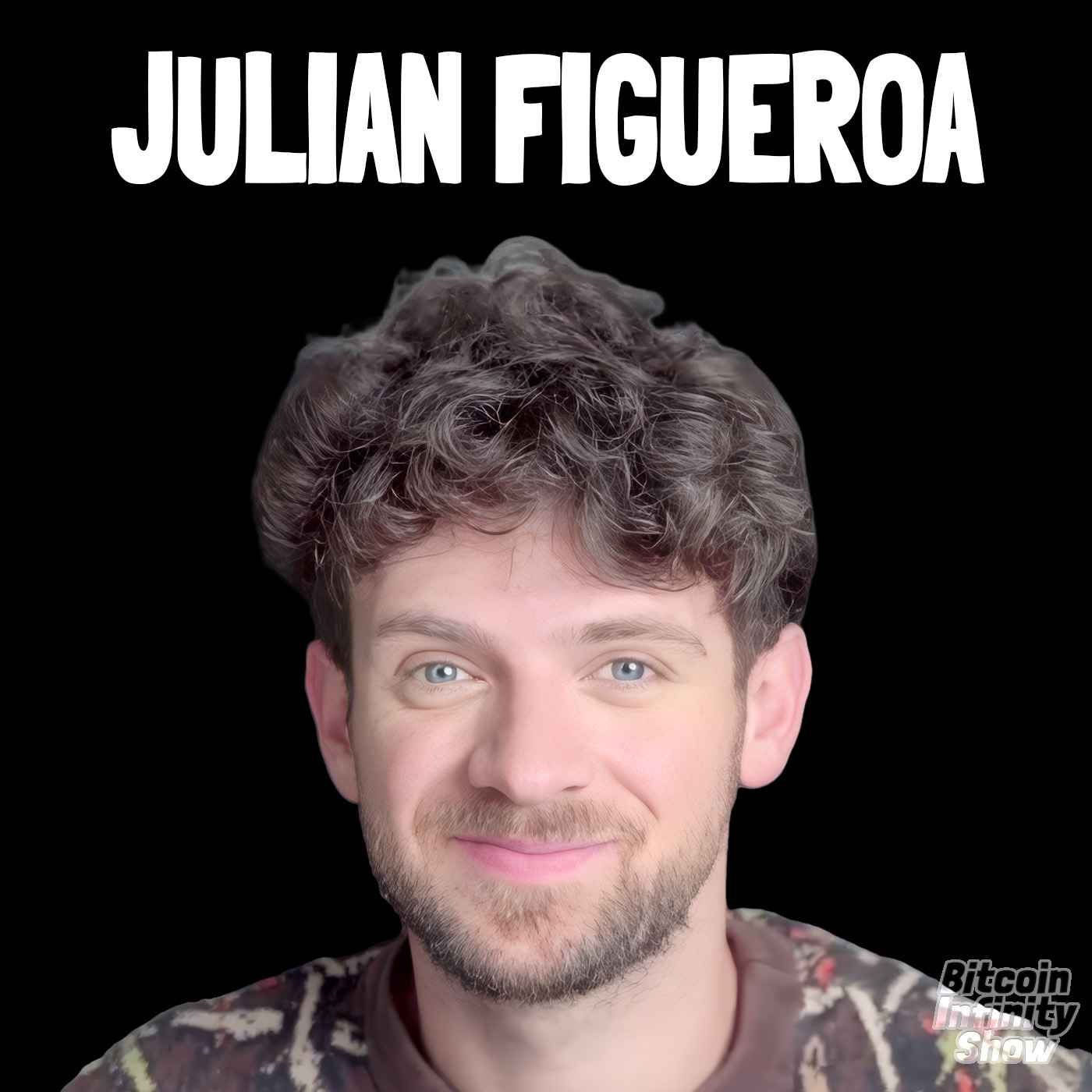
Bitcoin Content Creation with Julian Figueroa | Bitcoin Infinity Show #186


 Fountain

 YouTube

 Spotify

 Apple Podcasts

 RSS Feed
Julian Figueroa joins the Bitcoin Infinity Show to talk about his journey from early Bitcoin investing to founding GetBased media and producing high-production Bitcoin content like Exit Manual, focusing on making Bitcoin concepts accessible through humor, metaphors, and real-world visuals. They discuss YouTube strategies for growth in the niche, the importance of consistent weekly shows, and how creators can balance originality with proven formats to build sustainable audiences. The conversation explores Bitcoin's role in enabling creative freedom, the challenges of standing out in a slop-filled online world, and why optimism and adaptability drive long-term success in both Bitcoin and content creation.
Connect with Julian:
Connect with Us:
https://www.bitcoininfinityshow.com/
https://bitcoininfinitystore.com
https://twitter.com/BtcInfinityShow
https://twitter.com/knutsvanholm
https://twitter.com/lukedewolf
Join the Bitcoin Infinity Academy at our Geyser page: https://geyser.fund/project/infinity
Thanks to our sponsors - check out their websites for info:
BitVault: https://oshi.link/37L1WI (Our referral link!)
BitBox: https://bitbox.swiss/infinity - Use Code INFINITY for 5% off!
Club Orange: https://www.cluborange.org/
Bitcoin Adviser: https://content.thebitcoinadviser.com/freedom
ShopInBit: https://shopinbit.com/bitcoininfinity - Use code INFINITY for a €5 discount!
The Freedom Footprint Show is a Bitcoin podcast hosted by Knut Svanholm and Luke de Wolf.
In each episode, we explore everything from deep philosophy to practical tools to emit freedom dioxide to expand your freedom footprint!
00:00 - Introducing Julian from Exit Manual
00:31 - Julian's early Bitcoin story
02:35 - Treating talent and channels like TV shows on YouTube
06:44 - The high production value of Exit Manual
09:04 - Using AI in writing and creative processes
11:43 - Camping in Madeira
17:23 - Pivoting the business to weekly shows
19:55 - YouTube growth strategies: VidIQ and outliers
35:17 - Balancing creativity with business reality
41:00 - Creating scenarios for creativity to come to you
49:00 - Creating a Bitcoin action movie
50:58 - What are Bitcoiners trying to reaffirm with content?
01:01:03 - The potential of the off-grid Bitcoin lifestyle
01:06:12 - Bitcoin thrives in adversarial environments
0:00 Julian, welcome to the Bitcoin Infinity Show. Nice to have you here. Thanks for having me, Knut. Awesome to be here. You haven't been on the show before, so let's start with what we always start with, with new guests, which is a TLDR on who you are and your rise to fame in the YouTube sphere and so on and so forth, and in the Bitcoin sphere for that matter. All right. TLDR. Ooh, I always like these because I do take too long to explain the whole story. but I'll do it as fast as I can. Essentially, found Bitcoin as a means to buy drugs online in 2013, ignored it for three years, popped up on my radar in 2016, became an investor, changed my entire financial life right out of university, basically quit my job to start a video production business with some of the proceeds from the Bitcoin.
0:52 I decided that I wanted to teach more people about Bitcoin, so I started making my own videos starting in 2019 and kind of grinded at that for about five years, not really understanding YouTube and how all that works. Eventually met Isabella Santos, who's my co-founder, on a documentary project that I was pursuing. We decided to start a company early 2024, along with my friend Adam O'Brien. And the rest is history. We've been cranking out documentaries, shorts, all sorts of different shows. And most recently, the biggest one has been called Exit Manual, which I launched early September. And yeah, it's been a smash hit. People seem to love it. It's just me with a camera bouncing around explaining Bitcoin in all sorts of cool locations with props and metaphors and a lot of humor.
1:32 And yeah, it's just everything that I've always wanted out of a Bitcoin show is to take all these concepts and make them a bit more digestible for, you know, the person who can't or just hasn't found the conviction or time to go through a three hour book or podcast yet and just want something more palatable, but still has that, you know, that maxi Bitcoin maxi energy. yeah adam adam o'brien is that adam of from become well yeah yeah i don't know how he does it i thought so yeah yeah we have we've had him on before uh yeah great guy and isabella i run into isabella every now and then uh uh yeah she's great and she's doing fantastic isn't she did you part ways with isabella or what happened there like because you did a lot of things together right no no not it all uh what we've this is funny this has come up a lot because we have multiple channels now it used to be we we have one channel called get based and the company is called get based and we used to put everything on that channel but what we realized is that youtube very much likes um to treat talent and channels like tv shows and so imagine you have a show called game of thrones but every like second week a reality TV show pops up under Game of Thrones. You're like, no, I came to watch a whole bunch of people with swords and dragons. Like that's what Game of Thrones is connected to.
2:55 And so we found that, you know, in the past people used to think of channels sort of as brands like CNN or Fox News, and they could just use this as like a dumping ground for all sorts of content. And as long as you had an alliance with the brand, you'd watch it. But people's viewing habits have changed. And so we decided, okay, every creator is sort of going to have their own show. And going beyond that, every show is going to have their own channel. So even if I wanted to get into like live streams or something, I wouldn't even put it on that channel. I'd start a new one up. And it's a cool place to start because I think one of the things about Bitcoin and definitely about the creative process is having to dismantle your ego. And we had this thing for a very long time where we had this channel with like 20,000 subscribers and we wanted to do everything on that channel.
3:38 And we just found that it wasn't getting the reach that we thought it should have gotten. And so we started two channels, BTC Isla, and then later Exit Manual from zero. And now those channels are bigger than our original GetBase channel. So it just goes to show you, especially with YouTube, you don't have to fear starting from zero. You'll get just as much reach potentially within your first three, four videos if you know what you're doing. Yeah, I think we've experienced that with the, I mean, I put the Academy, which is our other show, which is basically just Luke and me talking about a chapter from one of the books every week. And we put that on the same channel as the main show. And I think that maybe have, I mean, you're the YouTube guru.
4:21 I'm just, I just show up to do these things and then Luke takes care of the rest. He's, he's my YouTube guru, but I think there might be something to, you know, diluting the thing by putting another thing on it. It doesn't necessarily boost the channel. When people came there for one type of content, then there's another type of content. So maybe we should actually start a separate channel for that sometime. We're in between books now. We recorded the last one for the last book. So yeah, maybe that will happen in the future. It's good to consider. And I think YouTube kind of just knows audience participation in your content better than we can ever know it. And I think there's this preference of like, okay, what is your cadence? Is it every Thursday or every Friday? Is the thing that you're posting an hour long? Is it always this format? Okay, if that's the case, then that should be its own little, you know, its own little channel. And if you have other things at different cadences or frequencies or styles, like, you know, move it, but it's going to be very hard to convince.
5:21 someone made a really good analogy to me and it was basically that social media is like a giant highway and it doesn't seem like a big deal to send someone from twitter to youtube or from like one youtube channel to another but it's sort of like switching lanes and it's like if you're in a really nice lane on a highway you don't want to switch unless you need to get in front of a car or you need to take an exit or something like that people you just stay in your lane and you drive 100 kilometers as you need to and kind of autopilot and um yeah you can look at youtube kind of the same way where people just want to kind of be on autopilot with their content and you shouldn't make them change lanes unless you really have to yeah i'm gonna have to dissect digest that for a while what that actually means maybe maybe that's like an american thing but you know when i'm when i'm cruising down like highway five like no i mean i'd like to just click a button and do nothing Yeah, you feel comfortable in your lane.
6:14 Yeah. But yeah, I mean, my most comfortable lane is, of course, the X account or the Twitter handle, which I still call it, because that's where my biggest following is. Then again, there's different methods for different platforms, of course. And you have your Noster as your lifeline if everything else goes to shit somehow. Yeah. So, but the exit manual, it's been doing remarkably well from the get-go. And I mean, the videos are super ambitious. You do a lot of editing and stuff on them and there's visual effects and there's the cuts and you go to different places.
6:54 And there's like the production is super high, super high value. I mean, how do you manage that? Do you do it all by yourself or how does that work? Like how much help do you have with that? Oh, thank you. I do not do it all by myself. There's no way I can do it. if if i had to every single week so we have we have an amazing i'll call him like creative strategist ben who he has done a lot of the editing before benjamin cote but now he just helps me with ideating and sort of packaging the videos we spend so much time on the titles and the thumbnails to know exactly what's going to hit and then the script writing um we have a whole team that does all the editing it's the the work that i do is really the writing the grabbing the camera and being a goofball in a bunch of public locations and then sending it off to our editors.
7:40 But it's a process. Like there are a lot of people who do all four or five steps on their own, but in order for us to get the show out every week at the quality we wanted it to, it has to be split up with some experts in their domain. Yeah, yeah. I always find that impressive. Even if it's a small team, it's still super impressive. Yeah. and to be consistent in quality. Yeah. What Ben's done and like, you know, advice for creators is you kind of have to go through the trenches and do everything yourself, but make sure you get out of your head that only you can do it at some point or no one else can do it.
8:20 Every time you learn how to do something and you find a style, like write it down, log everything that you do in your creative process because you will find people who can do it. That was the big hang up when I first started creating is I thought I had to do all the editing because I heard from other big YouTubers, you know, there's YouTubers with two, four million subscribers and they still do all their own editing. And I just thought, well, that's just the way it's done. And it's not. Now the economics change quite a bit when you get an editor, you have to definitely figure out how you're going to finance all that stuff, you know? But if you can figure it out, you can have so much more fun with it and it's way less stress and you can spend more time where it really matters, which is in the idea phase. yeah the best the best way i know to do stuff like that is of course the profit split model which is so easy when you're on a bitcoin standard too and you can just split sets but yeah it's it's for everyone to figure out and i but i think that's the beauty of it like even ai use like there's a lot of shit on on ai because of all the slop that comes out of it but i've found that i use ai very differently from luke for instance or from anyone else like we all find our own little niche ways of using it. And if you can find a specific enough way and still put the same care into the end result, then results will differ a lot, like from prompt to prompt and what you're using it for. And I'm using it mostly in writing, but in a very different way than I think other writers do. I don't use it for making outlines and stuff. I use it for all sorts of strange
9:57 things so i think there's something there that people will find their own way of using the tools it's sort of like when in the early days of pop music when when people started using the instruments in ways that might not the distortion was never an intended use case like for the electric electric guitar for instance and i i think this is like similar to that yeah like autotune it's it's just a tool and and man i would implore people though like do check out the tools there's been this massive weird Luddite like backlash to AI. And I'm very glad like the Bitcoiners haven't done a lot of that. Like we're using it or maybe embracing it too hard. I kind of joked the other day that I'm kind of getting tired of Michael Saylor's like AI photos himself.
10:41 Like they're super lame. They don't look like him at all. Yeah. The guy is 60. Yeah. It's like, okay, boomer. But there's so many cool ways to use AI. Like we've done a lot of cool visual effects with it. like, you know, me getting hit by trains and stuff and you can use it however you want. I think the thing is, is it's, it's got to elevate your art in some way, right? Like I use AI to replace what a human could do. And then every now and then I find a use for AI that, you know, we could never use a human for, you know, to do physically or manually on, on a project, but to each their own, you know? And I think at the end of the day, the free market will let you know if your, your stuff as AI slop because it'll just get, there's just too much to compete with.
11:25 If you're making slop, then you got to compete with all the other slop, right? But if you're not making slop, then you're in a good position, right? No, we want good old fashioned pleb slop, like AI assisted pleb slop. That's the way to go. I mean, yeah. And I've seen you do a bunch of things with my friend Joe lately. Yeah. The latest video, like you were on Madeira. When were you on Madeira? Oh man, two weeks ago. It feels like a month ago now, But yeah, not even 12 days ago, I was there. And how did you like it? I loved it. I went to Madeira for Bitcoin Atlantis and I've been to, I don't know. I mean, it's very easy to go to 20, 30 countries if you live in Europe.
12:06 But for someone in Canada who spent most of those 20, 30 in South America and Asia, it's one of the most amazing places I've ever visited. And it's just stuck with me after 2024. And so I thought this year I really wanted to get out of all the rain in Vancouver for a bit. And I went camping in Madeira. I've never done that before, like traveled intentionally all the way across the world just to go camping. But it was super fun. I loved it. Madeira is such a cool place because you basically have every biome within a 20, 30 minute ride, maybe except for snowy mountains. but you have rainforests there, you have deciduous forests, you have beaches, you have these like huge rocky cliffs. And it's just so fun, especially for someone like me, because I just, I get so stimulated by nature, just to be able to bounce around to all these amazing vistas, you know, in one day. So yeah, I definitely recommend going to Madera. It's also, there's something kind of magical about it, otherworldly. Like it's sort of, they have this area at the very top of the mountain or the top of the island is very, very high.
13:12 And so most of it is covered in fog for most of the day. So you can go there and they have these forests, like I did one of my videos in, and it feels like you're in the heavens. And then you can go down to these cliffs, which look like the edge of the earth. Like you go and there's these massive, I'd say 80-story cliffs behind you, and then just pure ocean, Atlantic Ocean, infinitely right in front of you with massive 20, 30 foot crashing waves. So yeah, it's such a special place. I had to, I had to film my episodes while I was there. No, I love it too. And I think I had already been on Madeira like five times before the whole Free Madeira thing happened And we had these meetings with the president and everything and then all the institutions and then Atlantis and everything that went into that Unfortunately, I haven't been able to go back since Bitcoin Atlantis.
14:06 And I miss it a lot. Like I've been traveling so much to other locations. So Madeira has just been too low on the priority list right now. But I do miss it. I love it there. I was bummed when they announced that the next Bitcoin Atlantis wasn't going to be until 2028. And as soon as I heard that, I said, nah, we're going to figure out a way to get back there. I'll make an excuse for myself. And did you get to see Andre when you were there? No, I didn't. I didn't get to. I did a Bitcoin walk. That was kind of cool. Have you been on a Bitcoin walk before? Yeah, yeah. I've been on plenty of Bitcoin walks. I don't believe I've been on one in Madeira, but I've been walking with Bitcoiners in Madeira. So I guess I have, but not a walk labeled as a Bitcoin walk in Madeira, but I've been on other Bitcoin walks.
14:52 Yeah, for sure. This guy I met in Madeira's name is Endo. He has basically set this thing up as sort of like a satellite thing in a whole bunch of cities where it's just, it's a Bitcoin meetup, but they just do a hike. And I love that because I find the quality of conversations when you're walking are just somehow better. I don't know what it is. It's like we have this like secondary stimulation with nature and our feet, but it's so much more enjoyable to me when the weather is nice than just, you know, sitting in a room or a cafe or something like I still love those. But there's something so much cooler about just doing it all in nature. No, there's something about walking that unlocks something in the brain, I think. Yeah. I mean, I usually get my best ideas of walking.
15:34 Absolutely. Like for the books and stuff, like most of the work is just walking. and as you say like the best conversations is on foot when you're walking with someone and just yeah and you get into those bitcoiner conversations where you can skip all the all the small talk about the weather and go straight into like quantum mechanics or whatever you're discussing i absolutely love it it's it's different and madeira yeah all the types of forests as you say like there's this really old jungly type of forest on the middle earth like things on the far west side of the island did you see that yeah the finale forest i camped in there oh cool it was a little wet i don't recommend camping there you can camp somewhere dry and just visit it yeah the northern parts are way rougher than the southern i like that too no i definitely hope i get back to madeira sometime before the next atlantis but i thought it was a genius move to to have it every four years yeah it's gonna make them very special yeah especially for us who do the traveling circus kind of thing it's a lot yeah so what else what other adventures have you been on lately uh other than madeira oh man i feel like last year was was like earlier last year was more of the adventure time so we made a pretty big pivot in our business we were doing a lot of documentary content and kind of visiting circular economies and seeing all that kind of like what Joe is doing right now. But, you know, personally, the issue with it is doing these big
17:09 scale documentaries. It takes months and there's just a lack of cadence that doesn't help you when you're trying to grow and do this for a living. So, you know, we would produce these documentaries. It would take two, three months to edit. We'd be lucky if we could crank out one per quarter. We were aiming for one per month and they would still take three months. Joe is cranking out multiple a month. I don't know how he does it. He just must have like a really efficient process to it. But we just found the documentary took so long and it was so important for us. One of the things early on with our business is that we were not able to make enough money through sponsorships, through peer-to-peer donations, through any of this to actually build anything, you know, real. Like we have editors to pay, we have ourselves, we have rents and all this stuff. And we couldn't do it just putting out one video every month or one every two months. So we were doing other types of work as a boutique video production agency. We were making ads, we were running other accounts for people and, you know, posting shorts and things like that. And it just wasn't working because it was dividing our attention up. And so basically back in May, we decided, okay, we have to turn this whole ship around because we were burning through Bitcoin and we were almost bankrupt, you know, for the media business. And we said, we're going to figure out something creative and fun that we can do once per week. And we're going to just do that until it blows up.
18:26 And we're going to do what we did early on in our Bitcoin journeys, which is put your head down in some books and learn how this whole thing works. And by whole thing, I mean how YouTube works. So I took the studiousness that I needed to approach Bitcoin with to get it. And I applied it to just learning YouTube and social media and just went through hours and hours of podcasts from experts and packaging and people running these accounts for Mr. Beast and just took down notes. And we've just kind of figured out, OK, there's certain trends to follow. I don't know if you want to get into all that, but I can I can drop some tips on what we've done to really figure out how to break, you know, to bigger audiences. But we just studied a whole bunch of this stuff. We applied it to Isabella's show first, and that really started to take off early in May.
19:09 And then we said, hey, we got to do a second one of these. So we started my show end of August. and it's been working. It's been, I mean, there's definitely like a luck component to it, but there are a lot of strategies that you can use to kind of ensure some really big growth early on. And we're super grateful, but those are the big ones. This year and I think for next year, that's basically what we're just going to lock into is we have these weekly shows. We're hoping to launch more. Adam is hoping to do a show and we're always looking for talent in the Bitcoin space who wants to grab a camera and do something kind of outside the box. but more and more of those shows just so we can get bitcoin out of the echo chamber uh enlighten me please what are what are some strategies that work all right so if you're really serious about youtube and i would say of all the social medias that is the quickest to monetize and it's probably the best place to go for a couple reasons number one if you look at the growth of all streaming platforms netflix disney plus etc and you put youtube in there every streaming platform for the last three years has a lower average watch time from the end user except for YouTube. YouTube is the only viewing or media platform right now that has increasing share of watch time from viewers. I don't think that trend's going anywhere. I really think that all media is going to be decentralized. You're seeing Mr. Beast make things that are now more expensive than most TV shows are. You know, one of his shows that he puts out once every two weeks has got like a $10 million budget.
20:40 He's an outlier. The second biggest YouTuber is maybe doing them for a million dollars a week or $2 million a week. But there's going to be so many of us in the next like five, 10 years. So I would say focus on YouTube. Learn how YouTube works if you want to do a show about anything. And then if you want to grow well on YouTube, what you really have to do is you have to get these tools that you analyze things within your niche and look at other really top performing videos. And you kind of use those as inspiration and you build off of them. So I use this tool called VidIQ. There's also TubeGenie and one of 10. And what these tools let you do is they let you add a whole bunch of YouTube channels that you know of in your niche. And you can find these things called outliers.
21:23 An outlier is basically a video that has a lot more views than the average view count of a video on that channel. And you can basically go through a whole niche of like 100 creators and find everyone's outliers over the last month or three months or a year. And if you find commonalities, like two people talked about a subject in the finance niche that popped off, then that's probably a good indicator that you should do a video on it too. I'll give an example. If you're watching this video on YouTube, you probably know that there's this silly 0.1 Bitcoin thing. I don't know if you've seen those, like get to 0.1 Bitcoin. Yeah, it's funny because it used to be 6.15 but yeah that's what deflation does right deflation crushes you but if you took every single bitcoin youtuber and you put them in a list and then you organize by outlier you try to find their most viewed videos those ones are the most viewed videos for a reason and i know that like the inner creative like hates copying you know but you can take just the title and the concept and that keyword and you just do your own thing with it right you don't have to you know recreate the the exact same video, but you know that people click videos with those titles and a certain thumbnail combination. Another one was crypto reset. There was something in the summer with, I think them using stable coins to like reset the debt and a bunch of finance creators made videos about it. And those videos way outperformed. So we were like, okay, the thing that all these
22:54 videos have in common is that they use the term crypto reset. It was something with the word reset. So we did the same thing. You know, that's 10% of the videos, just making sure you, fulfill that title promise. And then we just went hog wild with the actual video and it did really well. And we had very good confidence that when we were writing it and all that, that it was going to do well because of all the other outliers. So that's my first tip is get one of those tools that helps you find the outliers and start, you know, amalgamating as much data as you can from people in your niche, whether it's Bitcoin, finance, whatever. And it's just supply and demand. Like if there's outliers for a certain topic, that means that there's a lot of demand and probably not enough supply for that topic yet.
23:38 So it's like everything else in the free market. You find supply and demand, like you find what the market needs and you focus on that. Yeah, and it's weird because it's, yeah, you're totally right. It is like a free market of ideas. It's very psychological though. Like, you know, people use this term clickbait, like, oh, somebody tricked me into watching a video. But there's a reason that certain things click with us. And I can't begin to understand why. I can only explain it in hindsight. But there's just words, 0.1 Bitcoin, reset. There's just certain things. And you can try and be original and think, on first principles, I think this will go viral. But you're going to have a much higher degree of confidence if you can find some evidence that an idea has worked before yours, before pursuing it.
24:25 And I'm not against being original, but if you want to grow in this space, you want to make it a sustainable career, like get up to the point where you are big enough to just pursue your random original ideas. Don't do it in reverse. Like, like I spent so much of my career trying to like figure out what people were going to think was viral without actually seeing it done before. I was like, oh, this is a new idea, but I think it's going to go viral and I'll be the first one to do it. It doesn't work like that. You have to kind of ride the coattails first and then you can kind of define, I guess, your own genre. No, but this is this is nothing new. Like this is how media or anything basically has ever been. It's just that it moves faster on the Internet, of course.
25:08 But all free markets are like this. Like, well, but the thing is, is like artists, artists have a hard time with that. I just find, you know, artists have a real thing about being original. And I think it blinds them from free markets sometimes. If you look at the greats, they were always inspired by others. And all your favorite bands from when bands mattered are like an amalgam or amalgation. What's the word? They were inspired by a lot of other bands, not just one. And of course, if you find good thumbnails and clickbaity titles, then you can be original within that. It doesn't have to be. You can still know what game you're playing. and I know like Tarantino for instance all of his movies are in a very specific genre it's just that it's a Tarantino movie in that genre like I think that if you're going to be an artist there is no other way than to be it all the time and you have to know the rules to know when to break them so you have to some people say for instance that if you're too technical as a guitarist that will harm your emotional reach or whatever but that's only true if you you can still be very technical and choose not to be a show-off right i mean and this is true for for everything sometimes less is more sometimes more is more but yeah you have to find your own way i i guess but yeah i'm gonna have to do some more homework i guess it's a it's a whole different game in like the longer form space i will say like when you're
26:39 doing podcasts, I still don't understand, like, how does YouTube figure out, you know, how do they, how do they crown a kingmaker in that? The one commonality I've found with podcasts, the biggest ones is they seem to all be hosted by comedians. There's something about lightening the conversation that I would say the top 20, 30 podcasters consistently have some sort of like comedy edge to them. But other than that, I can't figure out like, you know, what, what makes a Joe Rogan versus as a Tucker Carlson in the top, like five or 10. Yeah, Joe Rogan calls himself a comedian, but like he's not a humor guy. Like if not first and foremost, that's not how I view him anyway.
27:21 But I do like comedian podcasts like the trigonometry guys and stuff like that. By the way, I was going to mention there's ADD brain off on another track here, but there's a great Veritasium video about clickbaits and why they work and why you shouldn't be ashamed of them. And he's another great content creator. Yeah there a lot to learn there And with the comedy angle yeah I think there there something to that i think comedians like uh when you getting good at it you your brain rewires itself or something so like i think comedians think in a different way because you you not only have to listen to what the the person you're talking to is saying because that's super important but you also have to find these trigger words and put them somewhere back in your brain so you can quickly bring them up to make a joke at some point later.
28:14 And I think most brains don't work that way. They don't file a word to bring up a joke at a later point. Yeah. I mean, I grew up with a father who did that all the time. It was all about puns and dad jokes. So I'm wired, and I see that in my son as well. He's being wired that way, and there's unfortunately nothing to do about it, because it just happens. But it is what it is. I think what comedians have, which makes them very easy or like good to listen to is a couple things. I think most comedians, they're not just, I wrote a bit, I'm going to just say it, I'm going to walk off the stage. They have to adapt and be observational.
28:54 You have to constantly be in tune with your audience. They're very good observers of human behavior. And a lot of comedy comes from that too. Just, hey, you ever watched that one thing? Why do people, you know, do this? Like the Jerry Seinfeld sketches, like comedians have to always be studying life and looking out for ironies and all sorts of little things to get their routines from. But the other thing that comedians are very good at is improv. And that is a whole skill onto itself because it's very hard to be a very good conversationalist if you can't do the yes and thing that is required of improv. That's like the number one rule of improv when you're just acting a bit is you can never shut down a conversation. You always have to find the next segue to keep it going.
29:36 And I always find really good podcast hosts, they always have a really interesting way of going from one thread to another. There's never a dull moment. So you have those two big skills, and I think that's probably why they excel at podcasting. Yeah, it is definitely a skill. Like, just keeping the conversation going. I mean, it's easier for me now that I've done it, like, almost 200 episodes. but like in the beginning I could really, and still happens sometimes, I really just hit a wall and I go, oh, oh, and you have to fix it in post. Yeah, or you go down like the wrong rabbit holes. Like you'll go down like a really weird one and then it'll be 40 minutes somewhere where you're like, I don't know if people are going to find this that interesting.
30:23 You know? Yeah, I don't worry about that too much. I think podcasters, they get a bad rap in this space. Like, oh, it's a bunch of people at their desk and they do this. And I'm like, oh, the free market has a way of figuring out if you can do this. I think 80% of podcasts don't make it past episode two for a very good reason, right? No, because there is a thing to consist of. And I'm very fortunate because like I never intended to be a podcaster. I just like accidentally became one. It's never my intention. But once I started doing it, it's like, hey, I kind of enjoy this. I'm going to do more of it. And that's the way it is now. And I'm happy to like have a couple of good sponsors, even though the channel isn't super big or isn't moving in the mountains anytime soon, but I don't care. I can sit here and, you know, keep in touch with the people I like that I meet across the globe. And like, what could be better? Like, yeah, I know. I've talked to you this exact thing. I was like, what could be better than, than getting paid to talk about your favorite subject with people?
31:24 No, it's, it's, it's insane. Like if you see it for what it is. And so, so like, And sometimes if it's, you know, in a, I'm, uh, I want to do something else. Like if I'm watching a movie with my kids or something and, oh, I have a podcast now. Oh, damn. But that's like, dude, what the fuck? You don't have to go and get up. You don't have to do it nine to five. You go to do a podcast every now and then it's, it's not that hard. And no, so it's, uh, it's definitely a thing worth doing just for, for the conversations themselves. I think I would still be doing it even if we didn't press record. I mean, almost. Then it's always fun to learn a new game. And to me, like YouTube and all this stuff, like it is a game and I might as well.
32:08 I mean, I don't want to pretend that I'm trying to be a world champion of some kind in it. But I do find it interesting that you can be better or worse at it. I mean, the internet is a computer game in a way. It's a very weird one because you can view likes and subscribers and impressions and stuff as the score, or you can view money as the score, or you can just view what did it do to your life as the score. In that sense, it's sort of like Minecraft. There's no real goal to the game. You just do things and build things and you see where you end up and it becomes more or less impressive.
32:51 And I mean, if it wasn't for X and I mean other things with platforms I've published my stuff on, I wouldn't have gone on all these adventures and met all these people that I do all the time now, it seems. So yeah, it's weird, but it's fun. Yeah, it's a weird life. I still have a very hard time explaining what I do to my parents. Like they don't get it because they watch the videos and they don't get, well, how do you make money at it? And it's like, is that all you do is you just put a camera and you just kind of act by yourself? Like, wouldn't you rather be in a movie or a play or something and just explaining? No, it's fun because I have all these people on the Internet and they comment and you build a community.
33:33 And then the best part, the best part is when you step out and you go to a conference and someone says, hey, I listen to your podcast. I watch your show. And then all that, you know, putting files into the void thing becomes real for once. That is the big payoff. So, you know, I really like conferences for that now. Not it's like I'm not trying to explain like me ingratiating myself, but it's so cool to realize, oh, I've been just doing my thing for so long that I just feel it's this process of me at home putting files on the Internet and then getting views. and it's like no I've had real people come to me and say hey I got this wallet because of you or I quit my job because of you like those are the things that matter but you don't get that feedback loop until you know you go out to an actual event at some point oh I mean so Bitcoin Twitter changed my life Bitcoin conferences changed my life even more yeah absolutely like and and all the people I've met during the the journey and everything it has led to and keeps leading to. It's just Luke and I, we have a saying it's the surreal doesn't end. And that's truly what it feels like. It just keeps getting more surreal every year. And we have another saying too, and that is head in the clouds, feet on the ground. Because I think you need both. I think you need to know that bizarre things can happen and people actually do get lucky.
34:59 You're not getting lucky if you're not playing any games, but if you keep at it and if you're having fun, then something crazy may happen. But at the same time, you shouldn't get yourself into a ton of debt because you think you're the funniest guy in the world or whatever or the best artist in the world. So how do you manage keeping your feet on the ground while still remembering to have your head in the clouds that any day now anything can go viral? That's a really good question. Honestly, I think the thing that had my head in the clouds for a while and why I didn't focus and learn the YouTube game early enough was because I had Bitcoin to burn to make all these videos. So I was thinking, like, at the worst case, I'm just doing what I want to do because Bitcoin allows me to do that.
35:44 And I wasn't really being too accountable to, I guess, myself and my own skills and, you know, my future family and stuff because I was just doing stuff kind of selfishly. And it was like, well, if it goes viral, it goes viral. If it doesn't, it doesn't matter to me because, you know, I can afford it and I can still afford to live and I can still do all the things I want to do. When I when I was forced to start taking it seriously was really when I got a co-founder, Isabella. And when we started getting employees, because now it's like, OK, well, you can't just pay for four, five people's salaries on your own Bitcoin. You actually have to have a business model here that makes sense. And so, you know, the first year was us constantly feet on the ground trying to figure out how do we actually pay for all the things that we want to do.
36:25 and it makes you kind of reevaluate and cut out the fat of these, these kind of lofty projects that just take forever and don't really generate revenue. So it took us a year and a half to finally, you know, cut the cord on this thing I was so emotionally attached to, which was doing these documentaries and really focused on something that was actually marketable that could help a potential sponsor out, but also could grow an audience. So what we did is we said, feet on the ground, it's a show a week, there's availability for sponsors, the revenue will come from that, and it will pay all of our salaries. And then the head in the clouds idea was like, okay, so once we have this show, we lock down a title and thumbnail weeks ahead of time. And then the head in the clouds is whatever you want to put pen to paper for the actual script.
37:08 You can use as many metaphors as you want. We can use AI for visual effects. If I want to get hit by a car, I can buy props off of Amazon, you know, for random things. I can pay a Bitcoiner. Bitcoiner made me a Paul Krugman puppet. You can let your head in the clouds go there once you have a structure. But the real impetus was having people on salary who are expecting themselves to show up and actually have work to do every single week. That's what keeps you kind of locked in, at least for me. I think independently, it's just very hard to be disciplined if you have just yourself as a creative. As soon as you add other people to the mix, and I think it's inevitable for most people's success, you start looking at it very differently and it starts becoming more real and less of like sort of this fantasy, starving artist thing that people kind of romanticize too much.
37:56 So I would say, honestly, sometimes like the best thing that you can do is give yourself a ton of bills. Necessity is the mother of invention when it comes to creating stuff sometimes. Yeah, makes me think of Stanley Kubrick. Do you know what kind of deal he had? I don't think it will ever... He's one of my favorite directors of all time, but I don't know like what specific deal. so he had a deal with I don't remember if it's Universal or Warner Brothers or whoever employed him, MGM or one of these big Hollywood studios at a very early stage like somewhere between Lolita and Doctor Strangelove or something like that, he got a lifetime contract you can make whatever movie you want, how many movies you want, we'll pay for all of it, you decide the budget and you just make whatever you want for the rest of your life.
38:48 So he had that like in his 30s, which is like, it makes me wonder. And he delivered like, boy, did he deliver. It's not like he just took the money and run, right? But he could theoretically just have sent them a five-minute video of him jerking off every 10 years and, you know, wanted $100 million for it every time. But he didn't. He made all these masterpieces. And I wonder how you can be that disciplined and how that works. And if a contract like that will ever happen to anyone ever again, because it's so strange. I mean, of course, contract probably signed before 1971, right?
39:31 Yeah. But yeah, it's very strange. I didn't know about him. He had free reign. And well, one of the things about all his movies, I believe, is they're all book adaptations. I don't think he's ever done an original screenplay. No, no, that might be true. Yeah, yeah. But yeah, some of the books he changed a lot. Like, for instance, Stephen King hated The Shining. He hated The Shining, yeah. Yeah, which is like, says more about Stephen King, I think, than anything else. Stephen King's lost it. I mean, was he ever that good in the first place? Yeah. I don't know. But no, I'm very interested in, what's the word, fascinated by the creative process and what creativity is and how it's such a weird beast to try to tame.
40:21 Right now I'm reading Rick Rubin's book about creativity called The Creative Act. That's good. Rock producer. It's really good. It's a very different approach. Highly recommended. Uh, just a lot of it is about like creating scenarios in which you let creativity come to you and how impossible it is to chase it or to industrious your, your industriousness your way through to creativity. It doesn't work like that. Like you have to sort of be inspired and how do you become inspired? You never know when it's going to happen. It's a, yeah, it was very good book. I recommend. I'll let you in on something.
41:02 A lot of people ask me, why do I film my show outside? And it's kind of a cool mechanism for me to find that creativity because now every time I go somewhere, my eye is constantly working to find, this would be a cool place to shoot this monologue or this statue has like a thematic relevance to a topic I want to touch upon in the future. And it's like, if you can figure out in your art some mechanism that forces you to get into settings where you can be creative, it's really powerful. to because it hard to get that if the station where you doing your show is an office right Then all the creativity is in the writing process and very little of it is in the filming process or the editing process But if you can force yourself into situations where you can inject creativity in every single step in the video process, it helps.
41:52 And for me, it's like just being able to get into nature and finding an excuse to get into nature brings all sorts of like cool ideas in. But so so so how do you get the ideas for the scripts? Like, how does that creative process look like? What does it look like? We sort of, so we do this exercise every week where we look at all the outliers and we find kind of terms. And that's kind of our framework is like, okay, the term of the week everyone's been talking about is crypto reset, right? And this is vaguely around this notion of, let's just say, you know, stable coins and dollarizing the debt. okay so we just have to fulfill an explanation of that an explainer on that maybe part of it's an opinion okay so from there the palette's wide open do we want to use a metaphor to explain this do we use props to use it we always start with these sort of ideas from the outliers and i'd say that's like 10 of it right we just know what the title of the thumbnail is going to look like and we know by the end of the video this is what we want to explain to the audience the journey on how we get there can go anywhere right and so i'll i'll sit down and i'll watch some other creators do fun things with props i've seen claymations before you know i'll try and do shots where i'm like you know walking and talking and jumping and so any possible mechanism you know inside of a monologue where i can be doing something with my hands or just talking to camera in a cool location i just write down and i just have this like giant notes app of like possibilities of ways i can
43:26 deliver any type of monologue. And then when it comes to shooting, we just basically, I try and find one sort of location that has a bunch of different cool possibilities for filming. And I film there. Sometimes we do an entire episode around a location. So we had one that was about interviewing finance students. And so we were like, okay, we'll just film on campus the whole time. And the whole video will have a university vibe to it. The one that we did that was like, I would say based on your book about element zero, I was like, let's get to let's get into nature to do it. Let's, you know, let's get out into the ground and sort of like feel out this fog. Like there's a bit of a mystery to understanding Bitcoin.
44:07 Let's start there and let's bring it to somewhere that's like a bit clearer and maybe more primitive. So I really like using locations to tell a story, but it all stems from sort of like just this base outlier idea and then shaping everything around that with all the different tools I have at my disposal. Yeah, funny you should mention Element Zero there, because that's an idea I copied from a guy called Jörg Hermsdorf. Oh, I didn't know that. Very, very, very cool German engineering type of guy who he had a presentation at the Value for Bitcoin conference, which was an online conference like a couple of years back. I think it was during COVID. So they did the whole thing online.
44:48 and that this is his talk was called the last money and it's very similar to element zero he sort of explains bitcoin as this weightless element and that's where i got the idea from i saw the presentation and he's very calm and and focused and engineering as he presents the thing i find it super interesting but i also see like if i could repackage this and make it more like wow-y and exciting-y instead of this engineering lecture. Maybe I could reach a bigger audience with it. And then you only made this beautiful animation to it. So it was really successful and Jörg really likes it. So we're very happy that I put that in there.
45:29 And yeah, there's another thing with Jeff Booth helped me out a bit with the Everything Divided book. And with this chapter, I didn't know how to properly thank Jörg for the idea because I didn't want to leave him out of the book. Like I have to put him in the thank you notes or something, but should there be like an asterisk where I specifically mentioned that this is the thing or what do I do? And Jeff suggested just put it at the very top of the chapter. This is inspired by the talk, and that's what I did, and it was the right choice. So because, I mean, I think most entrepreneurs, they think that or people who want to be entrepreneurs they think that the getting the right idea is the thing that will set them off on the right path if I could just have this great idea then everything would be alright and it's the other way around ideas are abundant you just need to actually chase the idea or actually do something with it it's the doing part that is rare but ideas are everywhere and the The original ideas, I think they come up because people do things and they take other ideas and they blend together in this giant mixer of brains that is collective human mind or the internet or whatever.
46:52 Something new pops out to everyone once in a while. I mean, that's the story of Bitcoin. It's just a collection of disparate ideas all combined together. Exactly. Exactly. So where is the show heading next? And what are your plans for the future here with this thing? The days of today. Okay. It's a couple days from Christmas. I don't know when this episode's coming out. I assume after Christmas, unless you're really quick with turnaround. This episode, we have a bit of a mempool of episodes. Okay, perfect. Around a month. There is, we have a whole action movie that you'll be able to see then when this episode is out. Cool.
47:32 Yeah. So we did this click baity video called at 80K I'm finally selling all my Bitcoin. And I won't spoil the whole thing, but basically it looks like one of these car confessional videos and then we hired stunt people and a visual effects team and we got Ben to fly out from Quebec as a director. And it's like a whole Bitcoin like fight sequence with Santa Claus and myself and we're beating up central bankers. fantastic yeah that was fun that's always been like a like that was the first time I've kind of like I'm always a little bit of an actor in these things but that was the first time where it was like oh I have a script I gotta remember my lines and it's dialogue and it's a back and forth and we want to do more of that stuff so we'll see what the appetite for it is you know we like my thing is I love film like a huge lover of movies and so you'll see in a lot of my works I have references to all sorts of different films that I love and documentaries and uh we're realizing more and more as we do this business that at the end, like, yes, I can write, yes, I can direct and script, but probably like the best place I can be, the unique talent that I have is probably my like acting ability and just sort of bringing things to life either physically or just through my monologues. And so we're just basically, I'm trying to give every single role I've ever had to everyone else and just focus in on this acting stuff. And this video is sort of like basically the first trial of that where i literally i i've never written something and only been the actor in it and not the director and and the cinematographer and all that so we got a whole
49:07 crew i was like okay julian like hands off like don't give stage direction to the other actors like let the director make the decisions here and let the editor edit it and just be the guy on set as well as an actor and uh it went great and we're hoping to do more of those we're also thinking Yeah, we're also thinking, so Isabella did this living on Bitcoin for 21 days challenge back in the summer of this year. And that went really well. We're thinking of doing something where we try and cross America only using Bitcoin. We have to figure out all the rules and stuff. But I think now that Square lets you spend it at different places, it's probably pretty feasible. And I think everyone loves like a good old fashioned US road trip.
49:49 So we're coming up with like a concept right now, but basically some sort of challenge where I have like 10 days to cross the states and I can only use Bitcoin. And maybe I start with, you know, a thousand sats or something and I cannot touch fiat whatsoever. So I have to earn sats to buy my methods of transportation to the next city. And we're thinking it all up, but it'll be like a real thing that we do and hopefully have some sort of like mechanism for like the audiences to contribute. And this is all loosely based off of Ryan Trahan's idea. He did a series this summer where he went to every state in America. But he had this really, it was all like a fundraiser for St. Jude's Children's Hospital. And basically, he had this wheel with him.
50:29 And every time someone donated like 10 grand or something, this wheel would go off and he would have to do a challenge. And some of the challenges were like he had to be in pajamas the whole day. He had to go back to the state capitol. and it was so like people loved it because they felt like they were a part of it in real time and so we're trying to figure out how can we incorporate some of that in the you know 10-day journey across the states yeah joe has been doing similar things like where people order him shit from a menu somewhere or did you see that was it was sitting in an airport and like here's a qr code for the our menu and then people started ordering stuff and uh yeah and of course the uh just funding what is doing by by showing people a qr code in the in the live video and yeah yeah yeah absolutely and i think that's what's so fun about youtube as a medium versus every other media is you can still do these very cinematic i call it like soap opera tune in every day or every week thing but because the turnarounds are so fast so much faster than like a real tv show you can get audience participation in in there kind of like how streamers do it right the only thing is like Like the live streaming thing is like a whole different niche where they just turn a camera on for six hours and there's no like very clear story to follow.
51:46 This would have like a clear story. But, you know, if you scan a QR code and you message me a comment, then it would be in the episode two days from now or something. Right. So you would be able to feel like you're a part of it. Yeah. Live streaming is a completely different thing. And if it feels different, I think. Yeah, I mean, whenever I record something, I'm more relaxed because I know I can remove stuff. I never do, but just the feeling that you can, I think is... I'm also not nearly as well spoken, even in podcasts or lives as I am when I just write myself a script and remember it.
52:26 I've had this whole trying to get filler words out of my vocabulary. You probably don't have this issue, but so many younger people do because it's just this weird cadence we have where we say like and you know, and it's every second sentence. And I think part of it is this pressure to talk fast because you seem smarter when you talk fast or there's just people we watch that talk really fast and not really think about the words coming out of your mouth. So you fill all your sentences with like, you know, and so, but, and just taking a minute, you know, low time preference to say, hey, the ideas can come out of your mouth slower. You don't have to fill it with filler words.
53:06 It's liberating, but it's very hard to adapt to. It's like thinking about breathing, you know, manually breathing. Are you breathing enough today? Did you drink enough water today? Did you say like too much? Yeah, I know what you mean. But that's also like, well, whenever I do, that became clear after X amount of X number of conferences in a year. I realized that I had to start improvising like everything. And I had to remove text from all the slides because I got distracted by text on them. So I could just have pictures. and if I had pictures I could improvise around the pictures and then it had some form of it was somewhat coherent but it's still improvising and like improvising is yeah and improvisation is like the skill to if you can improvise you can do anything anywhere so like that's the skill too there's been like being a jazz musician you know you can have a gig anywhere and just do stuff and yeah if I can And if I can do that, I can do anything.
54:07 So like, yeah, I'd like to practice more. It's the number one trait of successful people is adaptability, right? And to put yourself, it's uncomfortable, but to put yourself in situations where you have to improvise is a really good way of training that muscle. One of the things I get hung up on is if something doesn't go my way, I'm like racking my brain trying to figure out what went wrong instead of figuring out what do I do next, right? You have to be able to do that. it rewires you like the heat of the moment but it's all good fun I mean yeah there are all these other tricks like imagining that the audience is naked for instance and stuff like that but yeah another thing about YouTube do you think Bitcoiners and Bitcoin content has actually been suppressed on YouTube and is it still if it ever was hard to say of course um there's a bunch of things going on with that i'll start with this that one of the issues that we have is there's so many bots in the comments and i wouldn't be surprised if it sets off youtube's algorithm or like youtube's moderation features because i know like btc sessions was taken off and simply bitcoin was taken off and i don't know you know i can't tell you why but the one thing that those channels have in common and we have this too is that we're constantly removing these check out this random coin and it's like 20 comments will come in one minute and I don't understand. It's willful negligence. I know that YouTube can build
55:38 something very easy to detect that stuff and just kill it. It's like 20 comments from profiles that have no other activity. So you're telling me that doesn't raise alarms for auto-deletion? That's crazy. So they let that stuff slide. And then I think their own algorithm kills the content because it looks like a bunch of fake interactions. And YouTube can tell when And if I bought comments for a video or I bought views, YouTube would know, right? It's like, well, they definitely know when other people are being spammed and they're not doing anything about it, but maybe they're cannibalizing the content. The other thing I would say is in terms of censorship of the content, no, I don't think so. Um, when I look at the size of the niche, I think there's under, I would say there's under 70,000 people worldwide who consume Bitcoin YouTube content on a semi-weekly basis.
56:30 It sounds very small, but I would imagine, you know, I don't know how many Bitcoiners there are, but I would say like under half a million people have read a Bitcoin book or two, you know, and seriously think about it and care about it so much. so when i see videos and they you know get anywhere between 10 000 to like 100 000 in our niche i think yeah that's probably right um i don't think that's youtube throttling us i also think that as a niche there's a lot of topics that are so much bigger than us like one of the stats i throw out is i'm i you know i've gotten into anime recently and there's this one i watch called jujitsu kaisen and it's like i would say it's like a top 30 anime it's not a massive one, but it's still ongoing. I see people writing video essays about this anime that, again, not as many people watch this anime as own Bitcoin, I would say. But the video essays about an anime, just a voiceover from some guy talking about how he loved the latest episode, 600,000, 700,000 views. I have not seen a Bitcoin video get 600,000 or 700,000 views on YouTube.
57:35 Maybe the best Michael Saylor Bitcoin magazine conference video will crack that. Nothing else will. Not a podcast, not Natalie Brunel, not Simply Bitcoin, not me, not Sessions. We're lucky if we crack 100K on something. That's like a really big thing to crack 100K. So I think the reason behind that is that there's no interest in Bitcoin as a subject if you're not an active investor. It's very like we can try and talk to people about how, oh, it liberates, you know, countries that have bad financial systems or, you know, what is it called? Remittances. We can talk about the philosophical aspects of Bitcoin, but none of these things have any appeal to anyone who is not actively buying Bitcoin.
58:18 In fact, the things that have more appeal are the thing that has universal appeal that has much more appeal than talking about how great Bitcoin is, is how bad it is, because there's way more people that can relate to not buying it than there are people who actually own it. Right. So that content will do better. Maybe that's the clickbait then. Maybe that's the clickbait is talk about how it's a scam and then Trojan horse people into being how it's not. But I see CoffeeZilla and GoodWork and Reason TV and a lot of channels make videos about Bitcoin scammers or Bitcoin heists or whatever. And those videos get lots of views. Yeah, yeah. Because they're not trying to sell me on Bitcoin. They're trying to actually tell me about, don't worry, you didn't really miss it because it's all a bunch of thieves and crooks anyways, right?
59:03 Yeah, yeah. It just reaffirms my biases. and that's really like even within the bitcoin niche like that's why people watch bitcoin content is like they're just trying to reaffirm beliefs all the time like when you're watching content like you're you're so much more likely to click something that has the word you in it because you feel like you're being talked to directly and you're so much more likely to view something that's why like all these channels they talk about price predictions because they're just trying to reaffirm this belief that we have that we made the best decision ever and they're trying of get some expert to reaffirm that for us. And then the people who hate Bitcoin are just looking for affirmation that, oh, I didn't really miss it. This whole thing's a scam. So it's very easy to actually, as a creator, just fall into those traps of just playing to people's fears and desires.
59:49 But I would implore people have fun with it every now and then don make it your whole career because essentially at the same time as you might be getting views from that content people will not develop a personal relationship with you because you just selling people like dream or hate you know it has nothing to do with you it has to do with this like drug that you're selling people so people people don't really like care about their drug dealer they just want more drugs oh that's a good way of putting it i mean And yeah, it sells, but it's not necessarily a good thing. Now I saw this video about BitBoy Crypto and someone who had a fight with him and it's just disaster porn in a way.
1:00:30 And I guess blackpilling sells a lot too. And I kind of hate blackpilling conspiracy videos and people who say that everything's going to shit all the time. Like hopeful messages aren't as well received. that's a pity because hope is a rational choice at the end of the day and we should be hopeful yeah well yeah i you know i'm mixed on that i i do think that if you want to look through the world through that lens that like there's a lot of successful people and their whole career is like blackpilling you can you can see that but also you know some of the most successful people are like motivational coaches like david goggins and and all these people who write really inspirational and hopeful stuff it's just very hard to apply that to i guess maybe finance because yeah like what is there to look forward to everything seems to be getting more expensive and i don't get paid enough right like i'm really gonna listen to a coach tell me like if you just buy bitcoin it's all gonna be okay there is a market for that i mean that's what all the price prediction and the 0.1 bitcoin meme is about but i also think that you get to a point where there's so much black pilling that you stand out very well if you make something hopeful it's like if everyone is talking about how, you know, these secret people in government are destroying us and everything is a conspiracy and the Jews are behind all these things.
1:01:50 There's nothing we can do about it. Then if you make a video about, hey, here's this couple that like left society and they built like a home off grid. Why do those videos do 20 million views? Because people are looking for hope. There's just not that much out there. And then you go back into supply and demand again, where, you know, if everything is doom in gloom and you're offering something that's hopeful, like there's going to be a lot of demand for that and not much supply in that situation. So I'd rather be on the side of history that makes hopeful content, even if sometimes it feels like propaganda. I'd rather be on that side of irrational hope than irrational fear. Yeah. Yeah.
1:02:30 Cheers to that. I mean, absolutely 100%. And I don't think it is irrational. I think it's absolutely rational because you're going to die anyway. So you might just die. Well, die hopeful. Yeah, this is like, you know, I always try and look at, I'm a glass half full guy. Something that has been really interesting to observe is that these people who are leaving the grid, like there's such demand for that content. If I went out and I found some people around me who, you know, built their own homestead, millions of views. People love that stuff because everyone in their head's like, oh, I want to do that someday. Very few people have like the courage to take the leap, especially with like a whole family or something like that. But people watch that stuff and it's like, it's good to know that now, more than any other time in history, it's been more feasible to completely disconnect.
1:03:17 And people don't realize that. Like, yes, we have technologies and hyper loops and all these cool things when you live in a city that make life convenient. But also, energy production has never been cheaper. It's gotten wildly more efficient to just buy a plot of land and generate your own power. You can collect rainwater so easily. You can order parts for anything to live off great off of freaking Amazon now. Like that is so cool. You had to chop down your own trees and like, you know, if you wanted to get parts for a well, you had to ship them from Europe like only like 20 or 30 years ago. And now it's like it's on your door in a day. Right. So it's so easy to completely build your own independence now.
1:03:58 And people really take that, you know, for granted or they don't even realize they have the tools now. No, I mean, that's what Bitcoin is. Even if you don't go out and, you know, solar panel fuel your barn and raise your own cattle, you can still get out of the hamster wheel get out of the rat race and start living on a Bitcoin standard That it what all about It like reclaiming your independence So no it yeah maybe these are some new ways of framing this whole this type of content in the future. Gridless actually means sets the standard more than anything. Yeah, and building these communities too.
1:04:38 I want to be careful about calling them communes because that sounds like a hippie thing, but I'm seeing it everywhere. madera rob and sylvia are building this this great thing in madera and and i'm hearing all the time bitcoin oh yeah i just bought like 20 acres i want to do something on it i have a little plot of land on an island and i'm like man a little bitcoin retreat coming up so i think we're all going to have our own little ways you know to interact with each other more in person in the next few years we're all waiting for the bitcoin price to go up but look at isabella you know she's got this uh with her with her fiancee this whole resort now in mexico and they're throwing bitcoin retreats like every couple weeks now you know so we're all opting out and now there's physical places to it it's not just the money lives in our head that's that's fine but the community can't live in your head all the time you have to have in-person community and they're all popping up in all these different cities now which is super cool yeah and it's so easy i mean there i know of at least three different travel consegur services that take bitcoin though i'm using the shopping bit one by the way and yeah they arrange everything hotels and flight wise so i can totally live off a bitcoin standard and yeah uh and whenever i go to a conference where i get everything paid for i just send them send them the contact and they sort it out and it's and it's available to everyone And you can totally go and live off of your Bitcoin on Madeira.
1:06:07 You can order the entire trip and you can live off of it there, like easily. And it's within the EU, which is becoming this totalitarian state. But still, you can live on a Bitcoin standard in a paradise island in Europe. And it's just insane that people don't know this, but we already live as Bitcoiners in the world. We're already living out this sovereign individual thesis. And it's beautiful. I love, and I always come back to this, how Bitcoin thrives in adversarial environments. To me, the worst thing that has happened to Bitcoin in America has been the whole like, oh, Trump supports it now.
1:06:49 It's all good. Like support from the administration. What does America gain from that in the last year? Okay, we were promised a Bitcoin reserve that we never got. It looks like now the Genius Act is not going to exempt Bitcoin from small transactions. So, you know, there's absolutely no progress in that regard. Meanwhile, you go to Europe and there's like some totalitarian stuff going on there. But look at all the Bitcoin stuff that's coming out of that. You got Vexil. You have all these places that are living on the Bitcoin standard. You got Prague. Like, these Bitcoin are just building so much in Europe. And it's like the more that it gets clamped down on, the better the innovation is. And I love that. Like, there's no other niche like that. Because I think if you apply that thing to AI, the innovation just kind of like moves, but it does tend to centralize.
1:07:36 So it's like, okay, if the U.S. decides they're going to clamp down on AI, well, then China will just benefit from all that. And it's sort of this like zero-sum game. But Bitcoin's not like that at all, where it's like, okay, if you clamp down on it, well, you're just, you're banning yourself from Bitcoin. And then also, you're still going to have people that are going to just skirt around it, which is cool, right? You can't do that with AI. if the government clamps down on data centers like the ai developments cooked there you're not going to see a bunch of innovation come out of the us but if the us decides to clamp down heavy on bitcoin you bet your butt that americans are going to build some really cool stuff from it yeah i mean vexel is there because of the ban on local bitcoins which was the same service but centralized and not peer-to-peer enough like yeah and btc pay server is there because of bitpay that that was a centralized thing that tried to, they were part of the SegWit2X agreement, the New York agreement thing, the cartel who tried to ruin Bitcoin back in the block size wars.
1:08:33 So like, well, it's funny that you should say this because I ask a lot of my guests, especially the political ones like what do you prefer a pro Bitcoin politician or an anti Bitcoin politician And the answer is absolutely not as straightforward as you might think And strategic reserves Why the fuck do you want governments to own Bitcoin in the first place? Like, they're the last people in the world that I want to own Bitcoins. I mean, Bitcoin is for enemies, but that doesn't mean I want my enemies to have Bitcoin. I don't want them to have anything. Like, they're still my enemies. So never understood that. If anything, it would be like if there was ever a politician that promised to like put in a constitution somewhere that the capital gains tax on Bitcoin is completely absurd, which it is.
1:09:23 Then, yeah, that politician might even get my vote if I ever go to vote again, which I find very unlikely. I don't think popularity contests make theft more ethical. That's been something I'm intending with, with the whole like democracy thing, you know. Yeah, the last taboo subject. Yeah, yeah. No, I've been a little bit monarch-pilled recently. I think all the Bitcoiners have sort of come to that. It's like, okay, this works a little bit. Yeah, absolutely. Julian, it's been great talking to you and wish you all the best. Looking forward to seeing the action movie and everything else that's coming here. And when will I see you in real life next time?
1:10:04 Are you coming to El Salvador in January? Probably not. You should. I'd like to. It's just a hassle from probably a hassle from Europe to get there. What am I talking about? It's it's yeah, I've gone there a lot. And so for me, it's it's sort of like I need a really good reason to go back. But maybe I might do it in February, actually, because we are we're actually working with the Bitcoin office there. They're sponsoring next year exit manual and BTC Isla. And I know that one of the things they want us to kind of highlight, which is kind of interesting, is all the NVIDIA chips that they're getting. They got this like first. Yeah, yeah, yeah. E300 or something. So that's cool. But I don't think I'll be making it for the plan B, unfortunately.
1:10:45 But beyond that, I will be at, will you be in Vegas for 26? No, I don't do shit conferences. Fair enough, fair enough. Yeah, I don't owe Bitcoin Magazine anything at this point. I didn't like it last year too much. But what we're getting into now is we're doing retreats afterwards. so we rent like a big house with like a bunch of Bitcoiners and just hang out for like four or five days. We did the Grand Canyon last year and we're going to do Zion. Yeah, I saw that I think. Yeah. Yeah. Yeah, we're going to do Zion this year. But to me, that's what I look forward to more than the conference itself. If I don't see you there, I'll probably see you at Prague. Yeah, yeah. Yeah, I'll be at Prague this year for sure.
1:11:26 Yeah, I'll be there too. That's one that's on the schedule every year. That'll be my first Prague. It looks so good and I've just missed it every year. Yeah. Yeah, I'm going to show you around then. Yeah, you'll have to try and irk well. The beer in Prague is better than anywhere else on Earth. Ooh, I'll have to try it. Yeah. Yo, thanks for having me on. Really appreciate it. My pleasure. I always wish there was more ways to connect with Bitcoiners in person, but it's hard. We all live all over the world. One day we'll have our own country. I don't know if it's El Salvador quite yet, but we'll have it. We'll hang lots.
1:12:06 We will. Anywhere you want to send our listeners. Yeah, that's the last question, I guess. Yeah. We've got a lot of stuff on GetBased. We all have our own channels. BTC Isla for Isabella. Exit Manual for myself. Adam will be launching a new show. Actually, not about Bitcoin, about Christianity and spirituality. So that's going to be a fun one because we haven't done something outside of the Bitcoin niche yet. But keep a lookout for that. We'll advertise it on our own shows, Exit Manual and BTC Isla, but those are the ones to follow. So yeah, YouTube, you'll find me on Twitter under kinetic underscore finance. Fantastic. Make sure to check it out.
1:12:47 Thank you very much, Julian, for this conversation. This has been the Bitcoin Infinity Show. Brush your teeth. Goodbye. Brush your teeth. I like it. Thank you.