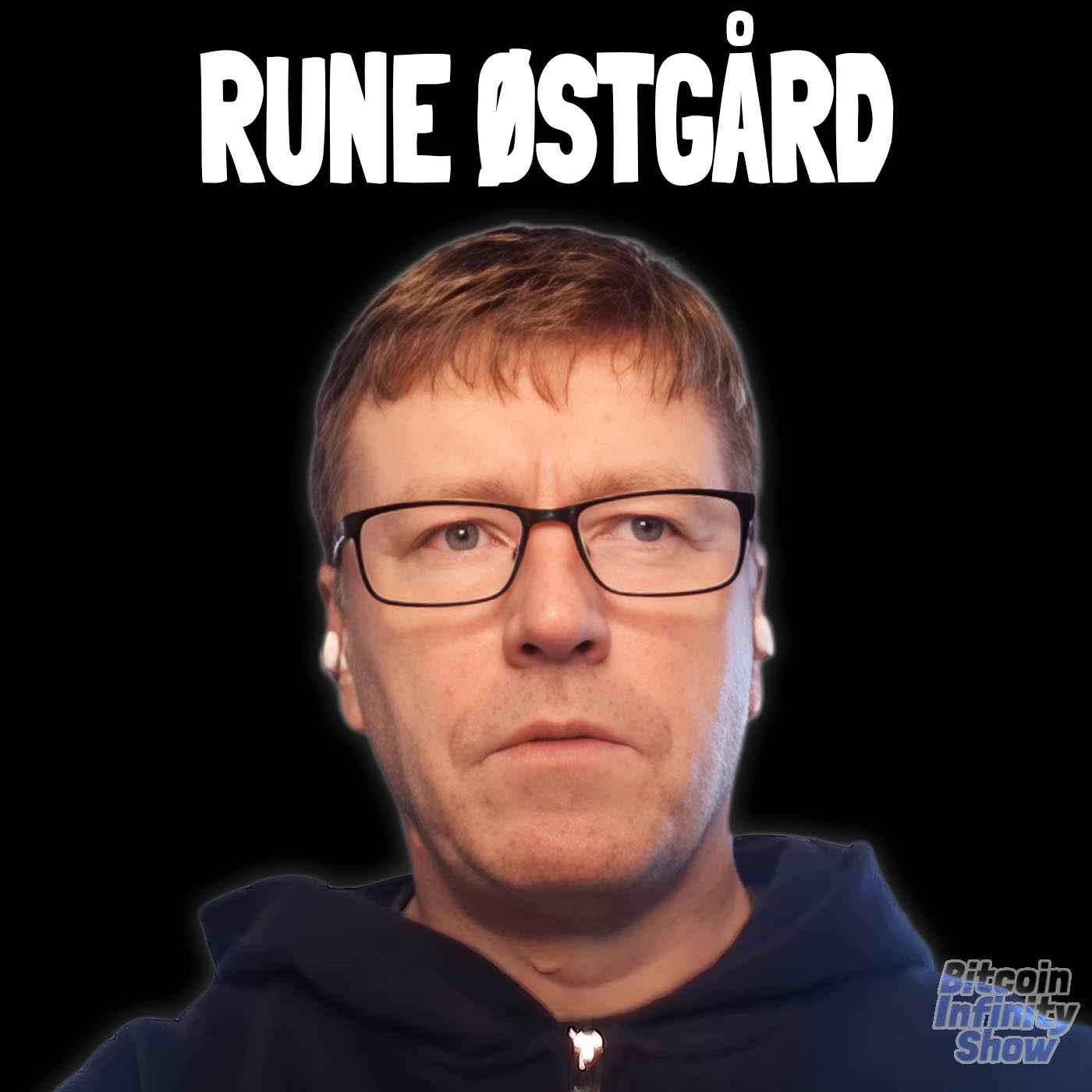
Number Go Up Is a Trap | Rune Østgård | BIS #229

 Fountain

 YouTube

 Spotify

 Apple Podcasts

 RSS Feed
Rune Østgård joins the Bitcoin Infinity Show to talk about his new book The Reality Game and why monetary freedom and competing currencies matter more than most Bitcoiners realize. Drawing on his three years inside the European Commission, Rune explains the free rider problem, the archetypes of Team Freedom and Team Power, and why generous tit for tat beats civil war in debates like the BIP-110 fork. He and Knut also argue over whether Bitcoin’s number go up is the ultimate freedom tool or a trap that quietly changes the people who get rich from it.
Connect with Rune:
Connect with Us:
https://www.bitcoininfinityshow.com/
https://bitcoininfinitystore.com
https://twitter.com/BtcInfinityShow
https://twitter.com/knutsvanholm
https://twitter.com/lukedewolf
Thanks to our sponsors - check out their websites for info:
Invity: https://www.invity.io/ - Use Code INFINITY!
Bull Bitcoin: https://app.bullbitcoin.com/registration/infinity
BitBox: https://bitbox.swiss/infinity - Use Code INFINITY for 5% off!
Bitcoin Adviser: https://content.thebitcoinadviser.com/freedom
The Bitcoin Infinity Show is a Bitcoin podcast hosted by Knut Svanholm.
The Freedom Footprint Show is a Bitcoin podcast hosted by Knut Svanholm and Luke de Wolf.
In each episode, we explore everything from deep philosophy to practical tools to emit freedom dioxide to expand your freedom footprint!
00:00 - Introduction and guest background
04:35 - Satoshi and monetary freedom
08:23 - Bitcoin maximalism and competition
17:06 - Bitcoin base layer and transaction speed
24:14 - BIP-110 and the right to fork
47:17 - The reality game and freedom manual
01:02:07 - Defining freedom vs power
01:07:50 - Archetypes of the game
0:00 Rune, welcome back to the Bitcoin Infinity Show. Nice to have you here. Thanks, Knut. Very nice that you invited me. I'm happy to be here again with you. It's been since last time now, three years or something. Yeah, something like that. I've seen you sporadically on the internet. I mean, I knew you shared a bottle of this beautiful wine. This is still available, by the way. up in a cabin in Norway a couple of years ago. And you've written a new book called The Reality Game, right? Yes, that's correct.
0:40 And it has the subtitle How to Win Freedom. Yeah, so it's sort of a freedom manual for normies, I guess. Or for anyone. Yes, you can say so. I'm sorry, someone's calling me here. I need to switch off my phone. So, there we go. Yeah, but this morning you sent me an interesting tweet, which was topical. We'll dive into the book a little later, I think. Maybe we should do a, since it's been quite a while since you were here, can you give our listeners a small TLDR on who you are and what you do? So we have that out of the way.
1:21 Yes. I'm from Norway. I have been a lawyer for 18 years. I've also written five books in five years, and one of the books was titled Fraud Coin, 1000 Years with Inflation as a Policy. It became quite a popular book among Bitcoiners, and I was invited to a couple of conferences, held some presentations. Later I wrote a book which is named Arrow of Truth, which is solely about Bitcoin.
2:01 It's very nicely illustrated by a good friend of mine, Mattis Storhaug. It's only available in Norwegian this far. So at the moment I've decided to take a break with my writing. and basically I'm looking for a job, trying to create a new career. I don't want to meddle with law all the time. So what kind of job would that be? You want to be a lion tamer or what do you want to be? Yeah, when you grow up. When I grow up, yes. So when I wrote my last book, I had to do a whole lot of introspection and try to find out who am I, how do I fit in this game of freedom versus power.
2:54 And then I decided, I landed upon the fact that I'm a typical problem solver. So you just throw a problem in front of me and I try to analyze it and understand it as well as possible and then try to come up with solutions. So it doesn't matter what kind of problem it is, actually. I become interested in all kinds of problems and immediately want to solve them. So I haven't decided yet which direction I would like to go. So any proposals from people would be welcome. I know the problem.
3:34 I'm that open. I mean, I turn 50 here five days from now, and one thing I didn't expect from turning 50 was that I still wouldn't have figured out what I want to be when I grow up. I think life is more of a series of figuring out what you don't want to be when you grow up than actually figuring out what you want to be. yeah you stumble up upon a lot you know and then it's uh um it's it's kind of um uh it's the destiny that leads us to some extent i think so oh that was funny perhaps i should try to do that and then you're stuck in that game for 18 years or something like that so yeah coincidences Yeah, that's saying yes to things, though, is a good tactic for the most part.
4:29 And you end up in all sorts of weird situations. That's my experience anyway. Yeah. So the tweet you sent me this morning is about James A. Donald, who was one of the first people to ever react to Satoshi's white paper, if not the first. And Satoshi. So they both had insights. So, Satoshi argued that Bitcoin could be temporarily good for freedom, but clearly saw that Bitcoin couldn't fix the world by itself. And here's a quote from Satoshi, everything other than Bitcoin.
5:10 No, I'm reading this wrong. Maybe you can explain this tweet instead because I'm so bad at doing two things at the same time here. So it comes with the age. I know exactly what it's like. So James A. Donald, I think he was cypherpunk, but we don't really know who he is. He was one of the first to comment on Satoshi's white paper. Can you hear me? Yeah, absolutely. Yes. And it sort of kicked off a discussion between the two.
5:54 And one of the key insights from Donald was the following quote. If a small number of entities are issuing new coins, this is more resistant to state attack than with a single issuer. And that's basically in line with what many cypherpunks were discussing. for many years, that we need competition in the issuance of money. So they argued for monetary freedom, basically, which is the term that I use instead, or as opposed to monetary monopolies. That was a key insight that also Donald had.
6:39 And then later in the discussion, And Satoshi wrote, with Bitcoin, we, quote, can gain a new territory for freedom for several years, unquote. So he, in my view, saw Bitcoin as a freedom tool or a newly discovered piece of the board in the game for freedom when we face power. And I think both of them were right in their assessment. And these were key insights that seems to me to have been lost on most Bitcoiners.
7:23 People also in the Bitcoin community don't understand the importance of monetary freedom versus monetary monopoly. They are mainly focused on what is the best money and why. So they support Bitcoin and this has been popularized using many slogans. And also we got the term the Bitcoin standard, which was the title of Saif's book. and I think people have sort of skipped the most fundamentals and so it has become a discussion where it's a Bitcoin or nothing or Bitcoin against everything else.
8:15 That's the main thing. That's the main focus. Yeah, the quote in the tweet is like an imaginary quote quote from your average maxi saying everything other than bitcoin is a shit coin and should be attacked we only need one type of money and that is bitcoin um i i think uh there i i think most maxis don don think that way or at least i don And I speak for many others I know Of course there your sort of not as withered maxis that just do exactly what you say They say Bitcoin is everything and everything else is a shitcoin.
8:59 And I do too, to a large extent, but for a very different reason. I do believe in competing monies. I just think that money converges on tends to converge on one single type of money and that money being gold for the last 5,000 years the preferred type of money everything built on top of gold is not really gold but fiduciary media or fiat and cannot really be counted as money but as currency So I think the way I look at it is like I'm a maxi because I know that money converges, tends to converge to one dominant thing.
9:43 But I would never want to stop people from using competing monies. Like the whole underlying thing, like the deepest thing about Bitcoin is that you get to choose the rules of your money. And you do that by setting your node to certain parameters and say that I'm only going to accept money that follows these rules or this rule set. And then you get to transact with other people who use the same rule set. The thing is that it can be very costly to choose something other than the dominant rule set.
10:27 Since financially, that can be a very bad choice. If you have one type of money with a limited supply, adding more copies of that type of money with a limited supply is a form of dilution in that way. and if you want to expose yourself to the finiteness of one type of money. It's sort of like the game. The analogy I often use is the game of chess. If you play chess by the rules that everyone else, every other chess player uses, you can play with tons, millions of players around the world.
11:07 But if you choose to play without queens, for instance, you have a much smaller set of individuals to play with. And it's sort of the same thing with the forks and the shitcoins, that once you choose another rule set, you have fewer players to play with, and therefore your satoshis aren't going to be worth as much. What do you say to that? Yes, of course, I agree to a large extent with what you said there. But I have to take a little bit issue with what you said about the tendency that it converges towards one type of money and that gold became the dominant type of money.
11:49 That's to some extent correct. But alongside with gold, people used silver and copper coins, that's for sure. So gold was for the large transactions and also for saving, saving for a rainy day or having some capital for the future. And silver was more like everyday purchase. And copper was change and the small purchases you made when you bought things and services are very small value. So I think that has been sort of the dominant situation throughout history, that you have had many types of money for different purposes, used for different purposes.
12:44 And of course, one of them will be more dominant than others. That's basically how it is in nature and in society. One thing becomes more dominant than others, at least in certain domains. And then you have competition. That's the natural state of things. That's my view. So I think that it has been this aspect of monetary competition and monetary freedom has been lost on many Bitcoiners. and of course on even more of other types of people.
13:27 But those who have gone much deeper into things and definitely it's a larger share of the Bitcoin Maxis that understand the importance of what they call the cypherpunks. They talked about competing currencies. That's what was the term they used. So a few people, perhaps quite a few Bitcoin Maxis know about this, but it's too little. It doesn't deserve the emphasis that we should give it.
14:07 It doesn't get the emphasis that we should give it. It's very, very important. It's the very basic in my view. Yeah. Go on. And of course, Bitcoin was very important. And as I wrote in Arrow of Truth, I saw Bitcoin as a tool that, first of all, it was a freedom technology, but also very much a tool that could help us to promote monetary freedom, competing currencies, whatever you call it. Yeah, the difference here, I think, is in what the money is made up of. I mean, gold, silver and copper are all commodities and commodity money first. And I happen to think that there's no such thing as credit money. I think it's all commodity money if you backtrack far enough. And then credit is credit and money is money. And the distinction is kind of important.
15:10 But if you look at the price of silver and copper over the centuries in terms of gold, they have both lost because they're easier to dig out of the ground. So they have a higher or a lower stock to flow ratio, I guess. I don't know. Yeah. Which way around is it? It's a lower one, right? But with Bitcoin and competing so-called digital currencies, they're all just a bunch of people deciding on a set of rules to order ones and zeros in to collaborate with one another. So the stock to flow ratio is programmable and everything else too, which makes this a completely different game in my view and cannot really be compared to gold, silver.
16:07 And I mean, Litecoin in my view was not the silver to Bitcoin's gold. It was just a scam to piggyback off of the success of the predecessor. And this 21 million limit is very much in the backbone of what Bitcoin is and is supposed to be. Yeah, it's one of the qualities that makes Bitcoin so extremely competitive compared to the other types of money that we have. There are many other aspects of Bitcoin that are important too, at least not that the fact that it combines a payment network with the money itself.
16:52 It's very important. In terms of the speed of transactions, etc., it's extremely important compared to, for instance, gold and silver and other commodity money. Yeah here I also have a slightly different view I know you were a proponent of BIP110 I don know where you stand on the fork now and and and where uh what your opinions about the two uh the two different forked coins are but we gonna go into that i have a slightly different view here i i think bitcoin would have been a success without the lightning network too because i think the the base layer is so uh the the finite supply is is uh so much more crucial than the velocity of transactions like velocity of transactions is a very keynesian metric to evaluate the type of money through velocity of money as an important aspect of money i think comes from keynes and the the theory is that every time you exchange a hundred dollar bill you another hundred dollars worth of something of value is created and i don't think that is true because it's the reason And the reason they believe that is because they use it as an excuse for excessive money printing just in order for people to exchange stuff faster, which leads to over-consumerism and quantity over quality and stuff like that.
18:33 And that is never taken into account. So in my view, it's much more crucial that Bitcoin's 21 million cap remains what it is and that it functions at its base layer than anything else, really. Yeah, I couldn't agree more with you. And basically, if you compare transactions on the base layer, on the core network, it's quite speedy, especially when you discuss large transactions. You can try to transfer $1 billion from your bank in Norway to another person's bank in Ethiopia, for instance, and try to see how much time and the money you need to spend in order to succeed with completing that kind of transaction.
19:24 So definitely Bitcoin wins that competition, of course. So it depends on what we are talking about here. For small transactions, of course, it's faster with credit money, debt-based money. But for large transactions, it's nothing like it. Yeah, and therein lies the debate. Should Bitcoin be primarily a substitute for gold or a substitute for fiat money? I'm definitely on the gold side there if you just compare the two. Me too, but on the other hand, I don't find that so interesting part of the debate.
20:13 Actually, it's more the question how should we deal with this thing that we call monetary freedom versus monetary monopoly. I think that's the core of the debate in my opinion. I think a lot of confusion comes from the perceived dichotomy between store of value and medium exchange, which I think is confused because it's really just a medium exchange over space and time. You need both aspects of it for it to function. It's a medium exchange over time when you use it as a store of value because you're actually trading with your future self.
20:58 And the medium exchange over space when you trade with other people. and a good money needs both. Otherwise, it doesn't work. So gold didn't work because it's a crappy medium exchange over space and fiat doesn't work because it's a crappy medium exchange over time. Well, isn't it a bit exaggerated to say that gold didn't work? It didn't give us the freedom that Bitcoin can provide us with, but it was used to a large extent and also on a voluntary basis. Yeah, but I'm saying that the didn't work is referring to that it was replaced by fiat money as a medium of change over space. So its functionality as that was replaced by something faster, even though it came at the expense of the medium of change over time aspect.
21:51 Yes, in that respect, I've also been an interested part of the audience in the discussion. You know, Lin Alden has written quite a lot about this in her book, Broken Money. And I think my view is that one has looked too much at the technical aspect of the things and too little on the politics there. because the reason why debt money won wasn't only because it was much faster, that the transactions were much speedier, but also to a great extent because politics dictated the outcome there to a greater and greater extent.
22:52 So that was very important. I think people gave up on the idea of monetary freedom and let this happen with the introduction of central banking, among other things. And then it was sort of power that dictated the outcome more than the technical side of it. That's my view. Yeah, I agree. But of course you can say that it's easier to win with power play when you deal with gold and silver and copper as the main competitor than if you deal with other types of of monetary technologies, for instance, digital technologies.
23:44 So of course, the technical aspect of things was important, but what was more important in my view was the politics of it. Yeah, and they go hand in hand, right? When you have a money printer, the political class gains power, so they can make even more laws that dictate that you should use central bank-issued currencies. So it's sort of a chicken and egg problem who came first. I think they fuel one another just as... Definitely. So about BIP-110, what's your stance now?
24:24 What's your view on the outcome? Yes, first of all, I think also you touched upon it. It's up to everyone what they want their Bitcoin to be like. And that's one of the more important features of Bitcoin that you can fork off, for instance, and you can censor transactions with your node, etc. And that's a very good thing, also because it promotes monetary freedom. So if someone wants to come up with something which is better or improved, better than Bitcoin, a whole new type of money, or they want to fork off or copy Bitcoin or do something else with it, tweak with it as they want, and they find a community where they want to do it, that's okay with me.
25:18 And not only okay with me, that's something that I support wholeheartedly due to my philosophical understanding of the matter. But of course, I take issue with all those scams that have overwhelmed the digital currency environment. It's mainly scams or everything else than Bitcoin. And of course scamming and people trying to manipulate others into investing in things that are doomed to fail That something that I definitely critical of So that has to be made perfectly clear So when it came to the Bit110 debate, I saw that it was problematic what had happened over the years with Bitcoin, that you had this...
26:21 And that was also perhaps a little bit related to the question, what should Bitcoin be? Should it be a database? Should it be something which sort of accommodates other uses, which can be popular? It led to some changes there that allowed what I see as basically pollution to the Bitcoin network that you can use Bitcoin for sending other types of data.
27:01 And then basically you get the possibility that you can bog down the network over time. That was problematic, I thought. And here they wanted to step back, the people that promoted BIP-110, and go back to what Bitcoin used to be a few years ago. And I thought, okay, that's an interesting experiment. I won't be against it. And I don't live in the future. I don't have a glass bowl. I can't say that this is doomed to fail. So I applauded it.
27:44 Yeah, I'm paraphrasing, who is it, Voltaire? I don't believe in your fork, but I will fight to the death for your right to fork it. That's where I stand. Yeah, two days after the fork, I woke up with a semi-epiphany. And that is that old legacy Bitcoin is now better off the more of us that stay for the next fight. I don't think it's been entirely captured. I don't buy that narrative. However, I thought the outcome was very, it is very worrisome that such a small fork couldn't get enough consensus to just come through.
28:29 and that it was rejected without a rejection soft fork. That's the way things are supposed to be. However, it took me a while to clearly wrap my head around why I don't believe in the fork. And the penny sort of dropped when I saw that they started to spam the new chain. A bunch of trolls started to spam the new chain. And then some Blake2B proponent pointed out that it costs you twice as much to spam the new chain. But that's only true in Satoshi terms.
29:13 So spamming the old chain would cost one Satoshi. The same spam on the new one would cost two Satoshi, according to this guy. the thing that misses is that the purchasing power of the satoshi is completely different so the purchasing power of an original satoshi prevents spam much more than uh than anything else like ironically the fees were the most important filter all along from this point of view and also every other attack is now cheaper to uh to execute on the new chain simply because it has less purchasing power. So I think the thing people, believing in a fork requires you to not view the ever increasing purchasing power of the Satoshi as part of the immaculate conception.
30:06 Because I think the conception isn't done yet. Bitcoin, immaculate conception needs, if it's ever done, like this needs to evolve. and yeah what are your thoughts on that to start there yes first of all I think that this is sort of an infinite game it will continue until either the the blade to be chain is sort of permanently established as a sort of competing type of money or it dies. Then it's over. Then it's neat. But I can't say at the moment how this is going to play out. So I support that someone tries to do something and I think most Bitcoiners or Bitcoiners should welcome competition just like Bitcoin became a competing type of money to the fiat currencies.
31:14 So that's my philosophical take on it. I think it will take time, quite a lot of time, before we see what kind of direction this goes in. At the moment, I can't say for sure that it will win, that it will be a success, or that it will die. It's the competition itself that I support. so don't you see a risk though with if um if one way to compete is just to fork off and do your own thing uh and you have people who who are fighting different issues in bitcoin if they all start forking off whenever they don't get their will through uh um whenever they didn't get what they wanted, they just fork off that what you end up with on main chain is a bunch of people who don't care about these deeper issues. This is sort of why, like, it's the same argument as for why we should stay and fight for Europe and not just do a mass exodus to tax havens elsewhere. But if we have civil problems in Europe, we should stay and fight for it. It's sort of, to me, it's a similar scenario. Okay, yes. So it's also reminds me of a discussion I had when I worked in the European
32:45 Commission with the radio spectrum management. Radio spectrum is also a finite resource. Everyone can't use the same frequency at the same place at the same time. And I was there to argue for replacing the old command and control system with a market-based system where people were free to buy and sell radio spectrum licenses. And I was arguing against the harmonization, as they call it in Europe. That's basically standardization of the use of different parts of parts of the radio spectrum, just like they standardize the sort of, you know, the plastic caps on soft drink bottles, et cetera.
33:42 So it's the same. It is a little bit the same. We will make it mandatory that everybody use GSM as 2G mobile telephony, and then we can create economies of scale. You have all these network benefits, et cetera. And of course that gave Europe a little bit of an edge, at least in the short term, compared with what happened in the United States where the situation was very fragmented. You could use your mobile phone here, but you can't use it in the other town because there it's a different technology, etc.
34:23 There I run into the same type of argument that, for instance, My boss there, he was German, and he talked about how fragmented properties had become in the past in Germany, and he talked about property owners who had to... sort of split up their real estate when the inheritance day came and the sons and daughters should sort of share the inheritance. The properties became smaller and smaller, became more and more fragmented, and it was basically very bad for the economy. That was his take on it.
35:08 So it was sort of a philosophical discussion, but also an economics discussion. And I have the same view here. I think that it's the competition that will solve this coordination problem, if you may call it that. And of course, when we see that so many, I would say, strong Bitcoiners and people with sort of the heart in the right place, and they are very intelligent, many of them, when they leave the core network and choose the fork, then the core loses some value because ultimately Bitcoin derives its value from the users, from the Bitcoiners.
36:01 But on the other hand, it provides a strong incentive to those who still continue to support wholeheartedly Bitcoin Core to improve things, especially if the fork becomes more and more successful. So I think the incentive structure today in Bitcoin core is negative. I think it needs to be dealt with from inside the Bitcoin community. At the moment, it seems like it's too much support for big Bitcoin's role in the system and the integration with the fiat system.
36:46 People are looking too much at the NGU, number go up aspect of Bitcoin, and too many have sort of forgot the fact that Bitcoin was launched, at least in my view, as a freedom tool. So I think competition was needed And perhaps also in the future Something totally new might come Which starts competing with Bitcoin It's very difficult to say what that could be But we can't rule it out at least And if you come from my angle to this discussion Then everyone should basically applaud this if a new technology comes, because it's competition that we need. It's the competition instead of the monopoly situation that will give us more freedom.
37:46 Yeah, I totally agree with that. There's a couple of things, though. I often hear this, that the NGU mentality framed as something bad. But NGU, to me, that is the freedom tool. That is what gives you freedom. Like you stack, you hold for a decade, and then your purchasing power goes up. That's a side effect of the finite supply and the most powerful aspect of Bitcoin as a freedom tool. It buys you out. That's literally what it does. And money is nothing but a rule set. It's not a technology in that sense. It's more like a linguistic thing where we can express value through a set of rules that we agree upon.
38:35 And not only Bitcoin is that, but every other type of money is that too. Like the thing with fiat is that we're being, the rules aren't shown to us. We don't know the rules of the game and still we engage in it because some rulers or some very evil people on top tell us that, don't worry, we got this. and most people fall for it. Bitcoin is just another rule set and in my view, more akin to language. So I don't really like the argument about number go up being trivial or non-important. I think it is the most important aspect of this.
39:20 Well, we can't agree on everything, Knut, so I'm glad you said that. I think the number go up aspect of it is sort of one of the causes of things that comes naturally when money becomes successful. If it has limited supply, it will become more valuable when more people use it. That's just basically how it is. And of course, it affects the incentive structure inside the monetary technologies community, in the Bitcoin community. So it attracts more people, it attracts interest, people want to invest in this, they see a number go up, and then they discover other things, for instance, the more philosophical and political and economical aspects of Bitcoin.
40:14 So it's sort of important in terms of recruitment to the ideas. That's for sure. We agree about that. But for me, it also comes with a negative effect because I think once you get the profit effect, then people tend to also, at least many people, tend to lose their focus and concentrate more about how much they will benefit from this in terms of wealth and perhaps start thinking less about the freedom aspect of it in terms of freedom defined as the absence of power or less power used against you to stop you from doing what you want.
41:16 So yes, I think number goes up is important, but it's also a trap because once you get something from basically almost nothing, you have invested. Many people have invested in Bitcoin without being very interested in the philosophical aspects of it. People become blinded by wealth and they fall in love with money. It's the same. We are all humans. Bitcoiners are also humans and we are very prone to fall into this trap, unfortunately, just like everyone else.
41:56 It's very easy to fall in love with money when you feel that you have been lucky or you have been acting skillfully and smartly. And you sort of, I understood this. I deserve the wealth that this investment generates for me. And then over time, for many, the wealth aggregation becomes the most important aspect of it. And that's what I see when looking at Bitcoin today. It has gotten too much room in the, or it takes up too much space in the debate, or at least in people's minds.
42:45 yeah i semi agree i i agree that there's these products that are being built on top of it that big bitcoin so to speak or etfs or strategic reserves and all of that that that is just it's basically i like bitcoin buy my shit coin over and over again however the the number go up and the profit seeking uh i think every it's still true that everyone in the system benefits from everyone else being a greedy hoarding bastard because that makes the number of coins that are left on the market fewer and fewer every day and it makes number go up even more And it not like that is a reflection of the deflationary true nature of the free market that we humans get better at producing and transporting things and delivering services.
43:41 It's just that we are blindsided to that because of fiat. So we never see that all prices ought to drop forever. But if you put on the Satoshi glasses, you can see it. And that's the nature of number go up. And I think it leads to people deferring consumption. Hoarding is not really a thing. It's saving. It's hodling. And it's just because the thing is, if you're a hodler and if you do Bitcoin properly and just hodl for decades and decades, is you can't really derive any value from that until you actually spend.
44:22 So you need to spend to actually capitalize on the thing at some point. I just have a hard time... You have... Yeah, continue. A hard time seeing it as a negative, the number go up itself. I don't see it as a negative in itself. I'll just say that it has both negative and positive aspects. And that it first of all is positive. But we Bitcoiners, we do ourselves a disservice if we don't see the danger that it comes with as well. Because money or at least wealth that is easily gained, it affects our time preference.
45:08 And I know that you have been talking a lot about time preference. I see that when you see that you get something almost basically for nothing, you just buy Bitcoin, you become rich. That affects your thinking. It affects your psychology, whether you want it or not. You can be a staunch freedom fighter in one year, and as time goes past, it affects the way you think about things. That's basically why so many people have warned against falling in love with money for hundreds or if not thousands of years.
45:52 so we have to be aware of this challenge that this poses to us we are not different from other people in that respect no i agree i i see though the thing i see now is more like when bitcoin hasn't had a number go up phase for quite a while that's when people get greedy and start to do all sorts of other shenanigans that's when people that's when what used to be based bitcoiners become suit coiners and all of this, that it's more a side effect of number not going up than going up. Perhaps they just sort of long for the hit, you know, they want a new hit.
46:33 Just like a drug addict, sort of it's been a long time since I got that hit now. Bitcoin price has gone down. It has sort of continued without the price going significantly up. And then And some people become impatient and they do stupid things. I think that it's the same kind of hit that was exclusive to the banking and political sectors before Bitcoin. Exactly. Now we all can experience this shit. Yeah. All right.
47:14 From one thing to another, tell me about your book. what's its main thesis and what's the tips you have for people who want to be free okay first of all the issue I had been thinking about for more than 20 years since I was inside the belly of the beast in Brussels working for the European Commission for three years where I saw closely every day around me how power was used, how power was augmented, how it limited freedom, the Europeans' freedom. And I was basically disillusioned because I came there believing that I was there to teach them about how to reform the system that the national states used when it comes to managing the radio spectrum. So I felt used, I felt intellectually raped when I was there. And I asked myself, how can people fight against someone, some groups and and factions and all those who have so much power.
48:39 And I grappled with these ideas for years, and I couldn't sort of get to a good enough understanding of the problem itself. But then earlier this year, about in January, February, I felt ready to embark on this extremely important problem. And I defined the problem in the following way. How to win freedom in the face of power when most people are passive or they basically don't understand what's going on. And the key to understand what to do here Is to understand something which also plagues Bitcoin today Which is a game theoretical dilemma It's called the free rider dilemma Or the free rider problem So people, you can see freedom Defined as absence of others power over you as a collective good.
49:51 And you see that clearly that it is a collective good if you compare Soviet Union after the Second World War with the United States after the Second World War. Then you see very clearly that it was a much higher level of freedom in the United States than in Soviet Union. So if you sort of accept the idea that freedom is a collective good, Where if I work to limit others' power Then it's not only good for me, it's good for everyone else Okay, and if it's good for everyone else But I am the only one who sort of invests time, energy, my resources To fight power, to limit power, to reduce power Then everybody gains, but I'm the only one who pays the cost.
50:46 That's the free rider dilemma. So I have strong incentives to not do anything. And as time passes, then power grows and freedom decreases. So how do you prevent that sort of mechanism from becoming too dominant? How can you change the incentive structure and make more people find it attractive to do something good for freedom, which at the same time means that power is reduced, typically political power.
51:27 You have to make this attractive. And I discussed this at length with a friend of mine. His name is Martin Taulov. He's a fellow Norwegian bitcoiner. And he came up with the idea that it has to be fun. So what you get from trying to achieve freedom, which is something others also would benefit from, then it has to be fun. That was his idea And you should focus more on competition trying to attract those who sort of almost automatically go to the power side and play for power instead of freedom and show them a better alternative And then I also sort of followed up with an old insight, which is basically that the incumbents are so strong that your alternative, the alternative that the newcomer comes with, just like small businesses when they try to compete with companies that have been there for decades and are very large and very successful.
52:44 then your alternative, it cannot only be better, it has to be a whole lot better. And I don't personally think that sort of having fun with doing something good for Bitcoin, for freedom, is sufficient. It needs to be something more than that. You have to get sort of a reward other than fun. You have to feel that you meet people you like, you feel that it's social, and over time you understand perhaps the philosophical side of it and perhaps you feel that this is a great cause that you are fighting. That comes over time. But overall it has to be rewarding for you when you do this. And then I combined these ideas with an insight that those who play for power have had for thousands of years. They play for power. It's a game of power.
53:56 They have a lot of fun playing for power. They think it's exciting. They think it's interesting, and they have certain strategies, they follow, to some extent, a few protocols when they do this. For instance, one of the protocols they follow is to try to fill every power vacuum. So it's very fluid, the type of game that they play. It's much more decentralized than we freedom fighters have imagined. So I had to study what they are doing and why do they find it so interesting? Is it just because they gain power and is it because they sort of get easy money or something like that? No, I realize that they have fun. They find it interesting. It's exciting what they are doing.
54:48 So the solution would have to be to come up with a better game, a more interesting game. And what would the sort of dominant strategy, what would the best protocol be if you wanted to play for freedom in the face of power? That was sort of my challenge that I took upon. And I found that the idea that there might be some answers to that that are more likely to be efficient, some things that you can do and focus on that are more important than others.
55:35 So the sort of core of the solution is a very short protocol. And the protocol starts with a pre-qualification. First of all, you must accept reality. And then you also must accept that your freedom and the problem you have with others' power, that's your responsibility. You have to take ownership of the problem before you can start using the protocol and play for freedom. So that's a not-so-short summary of what I have been dealing with.
56:16 The product is a book with 21 chapters and also 21 histories about the game. So it has a whole lot of examples from the history of how others played for freedom, for instance, Gandhi and Rosa Parks and others. 21 chapters about that, just to sort of give people some more understanding based on how people have dealt with this in the past. Also, I have a whole lot of personal experiences. For instance, a few of the experiences I had when working for the European Commission and also privately.
57:04 So, the book was launched almost two weeks ago. And I haven't heard much feedback yet because the first ones, they got their books in the mailbox actually yesterday. Yeah, looking forward to it. Have you heard the Mises definition of freedom? I love it. He says that freedom is the sphere of action in which an individual is permitted to choose between alternative ends and the means to attain them, free from external coercion or arbitrary government control.
57:46 So, yeah, basically freedom means the absence of violent interference or coercive commands by other people or the state. Basically the non-aggression principle. So what is the protocol? What's the core of the protocol? What principles here are we striving for when trying to be free? Yes, the first part of the protocol is to understand the difference between what I call freedom play and power play. And freedom play, then it's of course important to understand what freedom is.
58:31 And my definition of freedom is very much the same as Mises. It's a little bit different, but it's first of all much shorter. So we can start with how I define power and power play in the book. And that's basically coercion, that you coerce people to do something for you or you manipulate them. So it's coercion and manipulation. And then I add without punishment. That's very important. in the context of the game itself.
59:14 That's very important because you have power which is clearly punishable. You can steal something from others and then you will be punished for it or the other person will be entitled to use self-defense. And that sort of punishable power is less of an interesting... It is not that interesting a problem because we have systems for that. So it's mainly the type of power that you are not punished for. For instance, use of political power. Yeah, so would taxes, for instance, is that primarily coercion or manipulation?
59:57 In my book, it's primarily coercion. While on the other hand, the fiat system is primarily manipulation because so few people don't understand what's going on. So that's also why I called my book, first book about money was called Fraud Coin. Yeah. So, yeah, the reason I ask is because there's definitely an element of manipulation in taxes too. you think they're okay like most people think that this system is okay and especially when other people are taxed they think it's more than okay they think it's even a virtuous thing when in reality it just theft Yes of course it a mix of manipulation and coercion Taxation is definitely, people think that they will get something, get more from paying taxes, compared to if they spend their money freely.
1:01:05 So it's clearly a little bit of manipulation there as well. But then the question is, what is freedom? And basically, freedom is the absence of power as I define power. Oh, so the absence of power as in physical force, not maybe the absence of nuclear power plants. So it's the absence of being manipulated with and being coerced. And what is the opposite? because it's important to understand what the opposite here. Well, basically that is very simple. It's cooperation instead of coercion, and then it's honesty instead of manipulation.
1:01:52 So this is what I call the compass in the book. When you play for freedom in the face of power, you must be able to recognize what power and freedom is. When people play for power, how they do it, and when people play for freedom and how they do it. So first you use the compass. You take a check with yourself as well. Am I playing for power now? Am I manipulating? Am I trying to force others to sort of submit to my will? Or am I trying to cooperate with others? Am I honest? Am I totally honest with what I'm saying?
1:02:34 or am I hiding something, for instance? It's very important to have this compass as your starting point when you start playing. And then next up, it's what I call the map. What is the map in a game of freedom in the face of people who play for power? Yeah, these kinds of games, they take place everywhere. So it's not much of a use for you to have a map which shows you the terrain, so to speak, the different types of environments and the geography, etc.
1:03:17 That would be a useless map in a game where you can play everywhere and at all times. So I found out that the best map you can use in this game is to recognize player types Both the types of players who play for power and those who play for freedom And it's a sort of very simplified explanation of the different types There I have showed nine examples of people who play archetypes, who play for power, and nine types who play for freedom.
1:04:00 And this is a Bitcoin show, and it's interesting to sort of try to use that map when you look at different players in Bitcoin. and for instance, Satoshi, who was a typical builder. So builder is one of the archetypes who play for power. He's on team, plays for freedom. He's on team freedom. And then you have another type, which is a truther. And I call him the truth autist, the guy who cannot but speak the truth.
1:04:41 He cannot lie. And he also calls out the scammers all the time. So basically the kid from the emperor's new clothes. Yes, that's correct, which I also talk a little bit about in my book. So based on my analysis and my personal experience, I tried to come up with the most important archetypes to play for freedom and the most important archetypes to play for power. Okay, so let me see if I get this. I have a list here of team freedom is Matilda, diplomat, signal builder, digger, sage, master, truther, and Chad.
1:05:22 So, yes, Matilda gives safety. I guess that's the caring type sort of. She's the heart. All right. So someone who's emotionally based, I guess. Who would you have as an example of the Matilda character? My mother, for instance. All right. Someone more known, maybe, than Mrs. Ostkort? Yes. I think it's very important to be able to identify people in your own environment, people you want to play for freedom together with.
1:06:08 are there any other examples of Matilda for instance Mother Teresa is often mentioned as a sort of a very warm figure you know yeah but there's a discussion out there I know there's a book about her by Christopher Hitchens called Missionary Position and how that kind of debunks that narrative yes I say anyone who's ever received the Nobel Peace Prize is probably not a Matilda no but at the moment I can't come up with a typical name for that but for instance if you look at the player type who I call sage you are a typical sage you want to dive deeply into the philosophical things and understand it and you want to explain it in an understandable and also exciting way for others.
1:07:13 So you're a typical sage. Oh, nice. But I guess this is sort of, people have a bit of everything in them. Maybe I'm 90% sage and then have sprinkles of the other stuff. Yeah, correct. So the next one is diplomat. And I'd say Giacomo is a pretty good example of a good Bitcoin diplomat. Maybe there are other examples. Signal is culture and memes. Yeah, there's a lot of great Bitcoin memers. Sage, there's more than me for sure. A master stoic calm that I think of a hodl or not immediately when I hear that.
1:07:59 a truther yeah someone like mechanic would pop up there I guess and a chad who protects I guess that's all the the frat boys in Bitcoin and then you have team power plays against others opportunistic negative some gentle is envy I guess that includes every single socialist every single left winger Noder affirms and amplifies power Joe Rogan maybe is a good example of someone who's an amplifier and plays more or less straight games well that's not the first name I think about when it comes to Noder Noder is, I call him the most important player on team power because we have so many of him. So when I, for instance, worked in the bureaucracy, I saw that most people were nodders.
1:09:06 Basically, they don't want to talk against or argue against any proposals to broaden powers, to increase the state's powers or the European Commission's powers. But they also... aren't passive. They sit there and nod and sort of confirms and strengthens the motivation for those who seek power. So nodders are also those who typically very often has the most to lose from playing for power because they don't gain any power themselves. They might benefit from it some time, but in the long haul, they lose a lot from it.
1:09:56 They become trapped in systems where they are played with more than anything else. No, and I, yeah, you see this everywhere. Like, there's so many things come to me. First of all, the whole media sphere is made up mostly of nodders, especially state funded media. It's all nodders like that affirm rather than critique. speaking truth to power, they lick ass. And I mean, of course, the DDR, I mean, Nazi Germany, the Soviet Union, it's all nodders who make that kind of a system possible. You're willing to rat on your neighbor because you're more interested in appeasing the powers that be and then actually helping your fellow man.
1:10:43 And then a digger, no, no, this is, we're in power territory here. Regs, rules, central planning, as a regulator, like someone who likes that, I guess. I myself was a regulator one time for six years. So I'm sort of misunderstood what was going on around me. I didn't understand the power play and didn't have a clear understanding of what freedom was. And I was doing my job and thought that I was doing good things for society by making decisions on behalf of others.
1:11:26 At least I was that type of person the two first years I was working in for the Norwegian state. Yeah. And then you have spin, which is narratives. I guess that's even more the media sphere. Maybe not most media. I don't think most media comes up with the narratives. They just amplify them. They just nod. but these are the spin doctors I guess of the political parties yes the propagandists the people who redefine words door that's a funny word here closed networks I guess that's the Bilderberg groups and stuff of the world yes they build closed networks instead of open networks all right yeah so people who abuse patent laws and copyright and and stuff like that i guess and then mint money printer yeah that that speaks for itself uh and a zeal or a zealot that's a fanatic uh yeah like greta thunberg uh shadow fear yeah what's the shadow character is Is that inspired by Carl Jung or what is that?
1:12:55 Well, Shadow is the archetype. He doesn't have to use coercion or threats. People are afraid of him, so they just do what he wants them to do without him having to perform that much. And typically it can be the threat of violence or the threat of losing your position or something like that. I met a few of those types when I was working with radio communications, actually. So it's basically the godfather. Yes, making offers you can't refuse. Yeah. And perhaps some of his assistants.
1:13:36 Yeah, yeah. And Loki is the shapeless opportunist. We've all seen those. so Loki he's sort of the one who's really he really understands the game he plays for power all the time uses all kinds of coercion and manipulation and he plays for the short term game and the long term game he's very skilled sort of I warn against using these archetypes as labels on people because then we are into power territory.
1:14:21 That's exactly what Team Power does all the time. They use labels, they smear people by putting labels on them. But with Loki, I can make one exception perhaps. We know a certain character in the Bitcoin space who has plagued the space using all kinds of tricks A hodlernoth has been up against him you know who I am talking about He used both a whole lot of coercion and also in my view a whole lot of manipulation I talking about Craig of course These are my personal opinions we have many other examples of Lokis, they typically end up at high level positions in politics so yeah, the main thing here perhaps is to sort of create the contrast which enables us to maneuver better in everyday life, that you can recognize that That guy, he typically does what Door or Shadow or Loki or Chantal or anyone else on Team Power does.
1:15:41 I need to stay clear of them or understand how to deal with them. And over there, I clearly see that he's a typical sage, a typical signal, etc. I want to play with him. I want to either copy what he's doing or cooperate with him. All right. And you have NPCs as a whole different category that is neither team freedom nor team power. But you say that they're passive sleepers who haven't woken up and chosen a side. They're potential allies, not enemies. So you wouldn't count like your typical internet meme NPC with five booster shots in their arm and upset about the Ukraine and Palestine and LBTQ rights.
1:16:26 That's not an NPC then in your view, but more of a nodder, I guess. And an NPC is just a blank slate, for lack of a better word. Yeah, the type of person you describe there is more akin to what I call SEAL. It's a very energetic type. Who thinks that he does something good, play for the good cause, but then he ends up with team power. Yeah, this is one of the personality types that Carl Jung warned about, actually. He called the righteous crusader who thinks he's fighting for the right cause. And yeah, I see that a lot in Bitcoin. You cling on to something and then you think you're righteous in pushing a certain narrative.
1:17:18 And then you say, yeah, back to the free rider, power often wins because of the free rider incentives. Everyone wants freedom, few bear the cost, plus the rush to fill power vacuums. freedom scales when people want to play because it feels rewarding now yeah that that's that's the core of the issue right and uh i think that's the fee that the fiat money has sort of ingrained that into our psyches that we have to have rewards now and that is also why why i'm such a big proponent of that number go up is actually a very, very good thing, because I think that's, it solves that problem, at least. It makes you appreciate delayed gratification more. And I think that goes perfectly hand in hand with the, you know, the will to fight for freedom. Absolutely.
1:18:17 Like I fight for freedom in my own way for the sake of my kids rather than for the sake of myself. Sort of the challenge we have when we want to recruit more people to team freedom, that is to show them something that is attractive and different from the alternative. It might be quite a cumbersome strategy to try to convince them that you do this for a higher cause. and this is for your children and your grandchildren. That's why you do it. It certainly attracts some clear-minded people with good hearts. Once they understand how systems, for instance, the fiat system works, they find this attractive. They want to understand and learn more about Bitcoin, for instance. But if we want to attract larger numbers, more people, then they have to feel that it's rewarding in other ways as well.
1:19:27 And then they perhaps along the ride discover that there's something like a moral imperative to this freedom cause, that you do it for the greater good and it's a long-term game, etc. Do you think that the joy in the now and the load time preference are mutually exclusive, though? Because I think a lot of people, Arnold Schwarzenegger, for instance, he said that every single sit-up and push-up he ever did. He enjoyed them a lot because he was focusing on his long goal all the time which is getting a lot of muscles I guess for some odd reason he found some joy in thinking about that But still I think yeah there something to be discussed there too about satisfaction in the now for people with low time preference.
1:20:25 I think you have a proclivity to enjoy the now more, even when you're doing seemingly tedious things, if you have a low time preference and can allow yourself to delay gratification. Is there something there? Yeah, it's quite a deep discussion about what is high and low time preference. I think it's easier to sort of contrast the two things and come up with typical examples of the one thing, compare it with the other thing. But we as humans, we also naturally appreciate immediate reward.
1:21:09 I need to eat now because I'm hungry, etc. I need to drink, I need to buy a pair of jeans because my other jeans are worn out, etc. I want it now and I spend my money on that instead of buying more Bitcoin. I don't want to be the one who judges other people's allocation of their low time preference versus the high time preference. The most important thing for me is do people cooperate and behave in an honest way when they interact with other people, or do they try to manipulate them or coerce them to do things for them. So you mentioned it briefly that team power, they play against others, I say in my book, and also the contrast is that team freedom, they play for others. Yeah, by playing for yourself, you actually play for others, if you're on the freedom side.
1:22:24 And you also use the word here, use generous tit for tat. Tit for tat is what the first chapter of my book, The Inverse of Clown World is, the one I wrote together with Luke DeWolf and about how that's in nature, like a tit for tat. There's this mathematician called Axelrod who figured out that the best way to win the prisoner's dilemma over and over again is to use tit for tat but if you're in a single prisoner's dilemma scenario which is the highest time preference prisoner's dilemma scenario you are incentivized the best way to win that is to rat on the other guy but if you play it over and over again it's better to trust the other guy and then appropriately retaliate whenever he falls out of line which is what tit for tat is To me, that's very interesting.
1:23:22 That's one example of tit-for-tat. But what I focus more on in my book is a generous tit-for-tat where you sort of try to put something on the table. Here it is. Should we do this together? You invest something, and the other person, he might play along and be honest with you and cooperate with you, and you have a good time and you just want to continue and continue. But very often, because of human nature, people are also deceitful. And then the question is, should you just leave the table and find someone else to play with?
1:24:02 And the dominant strategy in a freedom play is to forgive at least once or twice and then try to see if the other person adjusts his behavior or if he just continues to play his own game against you. He doesn't want to build anything together with you. He wants to play against you and make it sort of a finite game where his main purpose is to grab all the chips on the table. But if you play the generous tit-for-tat, you adjust for the human nature and show the other person that you accept that people are fallible, we make mistakes, but then we learn, adapt, and play a better game afterwards.
1:25:04 It's very, very important. I found the two sides in Bitcoin, for instance, very little forgiving. When we talk about the BIP-110, it's almost like a civil war. Either you are on the one side or you are on the other and you are sort of expected to fight against the others People are not forgiving at all at least many of them And that creates a problem It brings it over in a power game or in a freedom game, and that's very unfortunate in my opinion.
1:25:45 yeah um i i think there's something to be said for fence sitting in these civil wars as well because there's going to be more of them and fence sitting is you're sort of missing out on uh being a part of the system because The system is built around consensus. And if you don't do your homework and form your own opinion, then you have no say over the network either. You're just basically, it's a free rider problem, I'd say, the fence sitting. So that's a double-sided coin too.
1:26:27 I agree that forgiveness is, in general, is super underrated, I think. I think it can unlock a lot of things. still like fool me once shame on you fool me twice shame on me that's something I try to live by I believe in second chances a lot I have no belief whatsoever in third chances because I've already given you the chance to show you true colors and yeah when people show you who they really are believe them it's also true so but But just in internal fights in Bitcoin, I think it's like the, to me, the biggest threat vector to Bitcoin is complacency and ignorance that we don't engage at all.
1:27:25 Because then you are giving away power to whoever wants to grab it first. And it's also important to add there because I perfectly agree with you that you don't necessarily have to take sides in a war to have an opinion and to provide value to the discussions. True. I saw a tweet that you wrote the other day about your take on this, and you tried to find some balance, although it was tricky to do it because you have people you love on both sides of the discussion. I do. I don't see you as a fence-sitter just because you do that.
1:28:10 It's also important to understand that we have different roles to play. I have my characteristics and my strong sides, and you have yours. Maybe our best use of time, if we want freedom, isn't to fight in wars. That can be, for instance, to spread knowledge and understanding and show people that there are other ways to deal with this. So in Bitcoin, you have so many wars you can get attracted to. They can basically consume all your time and all your energy if you want to.
1:28:50 You can't fight them all. Pick your battles carefully. Absolutely. That's some... I think that wraps it up pretty well. Is there anything else you want to talk about before we close this out, Rune? I think that I just want to say that my book, which is called Virkeligheten Spill in Norwegian, it's the reality game. It's available on Amazon. If you want to read it, you can have it in as e-book and also as paperback. We didn't get to the rest of the protocol, but basically you can learn more about it by reading the book.
1:29:34 It's very simple and intuitive. And I had a lot of fun creating this game, describing this game. I hope other people will play along with me and against me as well because I think it's very interesting. I'm very curious to learn more about the game of power, not to be a player for power, but to have more interesting games ahead of me. So, yeah. Yeah, I've heard about a book called Power as a Hobby, which is like a manual to how you can manipulate people and be a total dick if you want to do that too. But I think you should read Aruna's book instead.
1:30:17 Yeah. Thank you. Yeah, look the book up. And great to have you here, Aruna. Always lovely to chat with you. So with that said, this has been the Bitcoin Infinity Show. brush your teeth, like, subscribe and do all the other things see you next time, bye bye