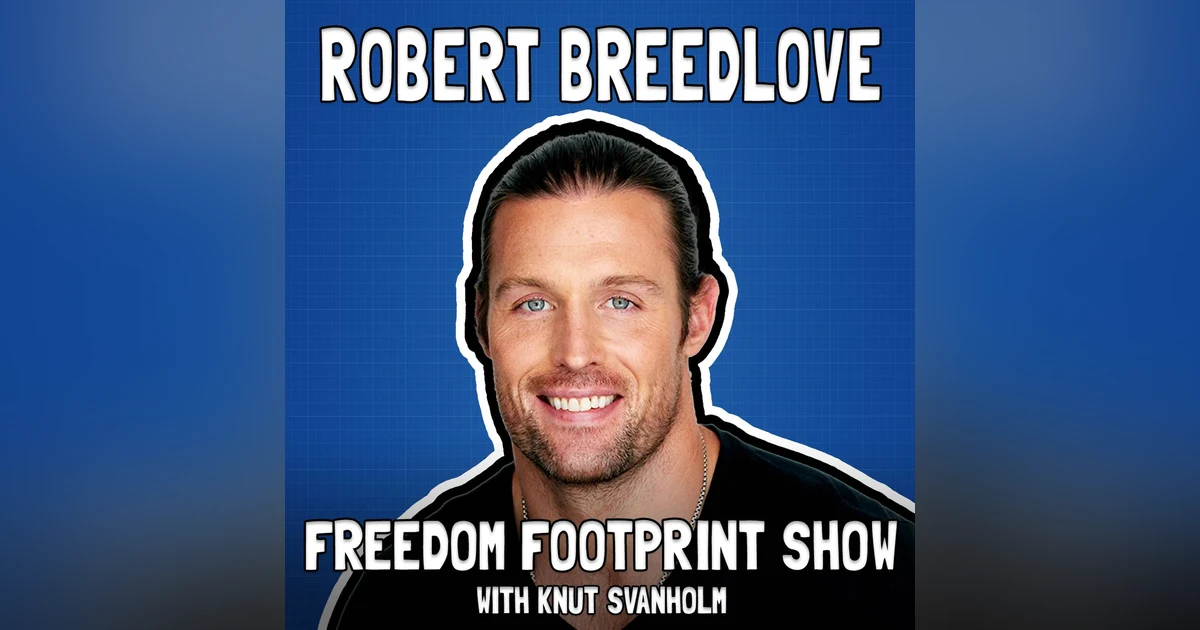
Money, Meaning, and Metaphysics with Robert Breedlove - Freedom Footprint Show 56


 Fountain

 YouTube

 Spotify

 Apple Podcasts

 RSS Feed
In this episode we are joined by Robert Breedlove, host of the "What is Money?" show - home to some of the best deep-dive series into the world of money and Bitcoin, including the Saylor series with Michael Saylor.
Our conversation today is inspired by many of the books that have defined our personal experiences and bitcoin journeys:
- Maps of Meaning by Jordan Peterson
- Human Action by Ludwig von Mises
- Economic Science and the Austrian Method by Hans-Hermann Hoppe
- Lila by Robert Pirsig
We also discuss value and its connection to praxeology; we reflect on communication, language and argumentation ethic; And finally we ask Robert for his answer to the age old question “What is Money?”
Connect with Robert on Twitter: https://twitter.com/Breedlove22
00:00:00 - Intro
00:02:07 - Welcoming Robert Breedlove
00:15:55 - What is Money to Robert Breedlove?
00:22:08 - Communication, Language, and Argumentation Ethics
00:27:54 - Voluntary vs Consensual
00:38:15 - ESAM and Lila
00:47:23 - Ownership vs Possession
00:56:09 - Opting Out With Bitcoin
01:04:38 - Bitcoin Adoption Under Hyperinflation
01:13:14 - Will Bitcoin Ever Stabilize?
01:20:48 - Wrapping Up
The Freedom Footprint Show is hosted by Knut Svanholm and BTCPseudoFinn. We are concerned about your Freedom Footprint! Join us as we talk to #bitcoin philosophers about how #bitcoin can expand your Freedom Footprint and much more!
The show is sponsored by AmberApp, the #1 Sat Stacking and Spending app on Earth! Their global launch is just around the corner, and they have loads of great features coming up, so stay tuned for those! The reason we've partnered with AmberApp is because of the great people - check out our episode with their CEO, Izzy, and you'll see why! https://youtu.be/nCSMzdp4_Co
Also check out their website to see all the great things at AmberApp: https://amber.app/
The show is sponsored by Wasabi Wallet, the privacy-focused desktop wallet with Tor and coinjoin built in. The coins you send to the wallet are coinjoined through Tor, so when you take the coins out they are private. Visit https://wasabiwallet.io/ and download Wasabi Wallet!
The show is sponsored by Orange Pill App, the social network for bitcoiners aiming to increase hyperbitcoinization in your local area. Download the Orange Pill App today! See https://www.theorangepillapp.com/ for details and connect with them on Twitter https://twitter.com/orangepillapp
The show is sponsored by The Bitcoin Way, specialists in cutting through the technical jargon of Bitcoin, so you can confidently navigate this complex world. They cover everything from Cold Wallets to Nodes, No-KYC Bitcoin Purchases, Inheritance Planning, BTC Payments, and more. If you're looking to expand your freedom footprint, securely managing your Bitcoin in self-custody—the right way, then booking a free 30-minute call with them is the next step to take: https://thebitcoinway.com/contact/
The show is sponsored by Geyser, the portal to the new creator economy on Bitcoin. On Geyser, creators can monetize their creations through their communities in a social and engaging way, and supporters can send sats to their favorite projects. Geyser has also recently integrated with Zaps and Podcasting 2.0, so every Zap sent to a Geyser address shows up on the Geyser page. We have a Geyser fund ourselves, it's the best way to support our show directly with Bitcoin. Check out their website for more info: https://geyser.fund/
Follow us on Twitter:
https://twitter.com/FootprintShow
https://twitter.com/knutsvanholm
https://twitter.com/BtcPseudoFinn
The Freedom Footprint Show is a Bitcoin podcast hosted by Knut Svanholm and Luke de Wolf.
In each episode, we explore everything from deep philosophy to practical tools to emit freedom dioxide to expand your freedom footprint!
00:00 - FFS056 - Robert Breedlove
02:07 - Welcoming Robert Breedlove
15:55 - What is Money to Robert Breedlove?
22:08 - Communication, Language, and Argumentation Ethics
27:54 - Voluntary vs Consensual
38:15 - ESAM and Lila
47:23 - Ownership vs Possession
56:09 - Opting Out With Bitcoin
01:04:38 - Bitcoin Adoption Under Hyperinflation
01:13:14 - Will Bitcoin Ever Stabilize?
01:20:48 - Wrapping Up
0:00 it's mind bending still to me that it's just this, " just", this monetary innovation, which is, I never thought it would be such a philosophical rabbit hole in so many different directions. And, I don't know, sometimes I catch myself like the things I'm reading about or thinking about, I'm like, how did this all, how did Bitcoin lead to all this? Welcome back to the Freedom Footprint Show. The Bitcoin Philosophy Show with Knut Svanholm and me, Luke the Pseudo Finn. In today's episode, we're joined by our friend Robert Breedlove, host of the What Is Money show, home to some of the best deep dive series into the world of money and bitcoin, including the Saylor series with Michael Saylor. Our conversation today is inspired by many of the books that have defined our personal experiences and bitcoin journeys.
0:45 Maps of Meaning by Jordan Peterson, Human Action by Mises. Economic Science and the Austrian Method by Hoppe, and Lila by Robert Persik. We also discuss value and its connection to praxeology. We reflect on communication, language, and argumentation ethics. And finally, we ask Robert for his answer to the age old question, what is money? Curious? Keep listening. But before we jump in, a quick reminder that the best way to support the show is to send us a boost or stream us some sats using a value for value podcasting app such as Fountain. If you're listening to this show as a podcast, check it out on Fountain. You can earn sats from listening and you can support us. And all your other favorite shows.
1:27 You can also support us on geyser or send sats directly to our lightning address freedom at geyser dot fund. And if you want to exchange your dirty fiat, you can support us on Patreon. All our links are in the description. If you're watching on YouTube, don't forget to like the episode and subscribe to the channel. Even if you're listening as a podcast, head over to our YouTube channel and subscribe to us there. It would be a big help. And finally, we want to thank today's sponsors. AmberApp, WasabiWallet, OrangePillApp, TheBitcoinWay, and Geyser. All their information is in the description. We'll be talking a bit more about them later. And now, without further ado, here is Robert Breedlove on the Freedom Footprint show.
2:07 Rob, welcome to the Freedom Footprint show. Thanks for joining us. Hey guys, thanks for having me. Happy to be here. Yeah, happy to have you on Rob. Um, I've been on your show three times, I think, so it's about time you come to ours. Yeah, I think so. I'm overdue. we met briefly in Riga. We were both busy, you a bit busier than us, as usual. And you did a bunch of interviews there. I mean, you're a... You work like a Terminator and look like one as well for that. I mean, you've been doing a ton of interviews and I'm really impressed by that work ethic of yours. Like it's, it's, uh, it's always on, it seems.
2:51 thank you. Well, I mean, you know how the podcasting thing is like when you're doing it, it's very intense. There's, especially when you're at events and everyone's there, you get a lot of juice for the squeeze by just really getting all the speakers or whoever's attending the event together and knocking out a bunch of interviews. But then you get to. You know, turned down hopefully for a few days after that. So, seems like it's kind of like sprint and then rest type of work, work frequency. yeah, it's a good lifestyle. yeah, um, so who did you interview in Yeah, we had Adam back. talked a little bit about the block size wars with him.
3:31 Uh, in addition to some other things they've been doing over at Blockstream. Talked to Dylan LeClair. Spoke with, um, I don't want to mispronounce his name now, the last Austrian economist in Austria, Taghisadigan. Rahim, thank you, had a good lengthy conversation with him, uh, and a few others, so yeah, it was a good time, and then it looks like, this isn't final yet, but it looks like I'll try to go to Lugano, Oh, excellent. We're coming to Lugano too. yeah, so we'll try to do the same thing there, get some people together, have some interviews, and then also, uh, I'll be at Jordan Peterson's event at the end of October, beginning of November in London, and so I'll be interviewing some of the speakers at that event there, so that'll be not, obviously that's not a Bitcoin event, um, But definitely a lot of people in the, let's say freedom focused universe.
4:29 Um, hopefully having them on for some in person interviews as well. So I'm super excited for all that. you gave me the perfect segue, Rob. Yes. Yes. so, so, so, uh, I'll just give you like a quick little bit of, of background, but like basically you and the you, you were my orange pill. Absolutely. Oh, nice. so. You know, first personal thank you for that, but the way I found you was when you went on Lex Friedman, and I'd been watching kind of all of his crypto and bitcoin related people at the time, but yours was, well, unique, and the thing that I latched onto was somewhere in the middle there you mentioned Jordan Peterson, and you called Maps of Meaning one of your most use cases.
5:15 Meaningful books, like the books you would recommend the most, I believe it was Human Action and Maps of Meaning were the two you mentioned there, and well, basically, I've been a Peterson guy for a long time now, um, helped me through my younger adulthood, Uh, so to say, I'm still young, but, uh, you know, getting there, um, but the, the main thing, I guess, that I wanted to, to ask or to, to talk to you a little bit about was, uh, so I'm rereading Maps of Meaning again, and, and it just kind of, it's all fantastic stuff, but can, can you tell a little bit about what you got out of that book?
5:56 What, uh, Maps of Meaning means to you? Thank you. Yeah. Um, yeah, the, the, the books that I mentioned on the Lex Fridman podcast were Maps of Meaning, Human Action, and then Robert Persick's book, Lila. And I think reading those three books together is one, a good way to dematerialize your worldview in the sense that you'll move away from being a materialist into someone that understands the world, uh, just through a different framework, right? A framework of value, a framework of Praxeology in the case of human action, um, and maybe even a different metaphysical framework when you use something like Lila, that the book that really posits that value is the fundamental ground stuff of reality in a way.
6:45 So I just thought those three books are very interesting to read together, which I just happened to do at that time. But maps of meaning specifically, I think Peterson, I mean, he's drawing very heavily on like Carl Jung and, and others, but he's. Basically putting forth, uh, a worldview that's non materialist, right? It has more to do with value, um, has more to do with, you know, what you value actually determines what, not only how you see the world, but what you actually see in the world. One of the experiments he often likes to cite is the selective attention experiment, where there's, uh, people are charged with the task of counting the number of basketball passes between these two teams on a video.
7:31 And When they do that, they fail to see the six foot man in a gorilla costume come into the middle of the screen and wave his arms around for a few seconds and walk off screen because they're so focused on the task of actually counting the number of passes. So the point being that when they value achieving the objective of counting the number of passes, that you actually fail to see six foot gorillas walking into the middle of your frame. Um... And so value, valuation, or the process of valuation is actually determining what you see in the world, not just how you see the world. And, you know, the bookmaps of meaning, I don't know that I'd recommend it to everyone. It's very dense. I think Peterson said he spent 15 years and three, three hours a day for 15 years writing it.
8:17 Something just... You know, just an absurd amount of work went into it. The sentences are very dense, but he, he goes down a lot of the, the psychological rabbit holes that Jungian psychology gets into. I really got, one of the most fascinating parts of that book for me was towards the end when he's talking about alchemy, um, and just the nature of what alchemy was said to be. You know, it was said to like. Be a process that paralleled the passion of Christ. It was the pursuit of the lapis philosophorum, which was the philosopher's stone, which was said to be the incorruptible substance that would serve as an antidote for tyranny in the world.
8:59 and I, you know, there were just so many parallels with Bitcoin there. Also like by interacting with the philosopher's stone, it actually makes you better. And so we often talk about Bitcoiners going down the Bitcoin rabbit hole and experiencing personal transformations. You know, I don't, maybe I, maybe I've drank too much of the orange Kool Aid, but I definitely saw a lot of parallels between Peterson's discussion of alchemy and the Philosopher's Stone to, to Bitcoin overall. And then, you know, where I think JBP, I guess, obviously saying maps of meaning, you could have also called the book maps of value in a way. And there's. A lot of talk about meaning and a lot of talk about value, but that, it, it sort of doesn't get into, it doesn't, he doesn't have Mises in his worldview, right?
9:48 He doesn't have praxeology, he doesn't have human action, so it's like, it fails to see this deep connection, perhaps even, you might even say value and action are like the same thing, right? All human action is an expression of value. Um, I'm not completely convinced it's just human though, like, I think purpose might be something that exists beyond just the human domain. Obviously that's more of a metaphysical debate. but I think that in JVP's work, it keeps the matter of value rather abstract and that he doesn't ground it out in the practical realities of, of actually, of actual human action. And I think that's where you get a lot of value by plugging in, reading the book, Human Action and Mises.
10:30 And then, uh, again, with, with Lila, you get this. Sort of metaphysical grounding, um, in addition to those two books that really just sort of rounds out the counterpoint to the materialist worldview, you might say, yeah, the density of maps of meaning is, is, yeah, it's, it's quite something. I've appreciated his, his lecture. series on that topic, uh, which kind of distilled that and made it a little bit more accessible. But when he, when he came out with 12 rules for life, I, I'd actually been hoping for like a, like a maps of meaning light instead, and sort of the rules for life series is that, but it's, it's.
11:10 Of course, it's couched in this framing that's supposed to make it ultra accessible. And yeah, that's, that's had maybe mixed success, I would say. But yeah, the, I really like your point, I guess, about the, that maps of value could be an alternate. And, um, certainly agree that, that his, his, uh, lack of the praxeological point is glaringly obvious when you've been looking at that, uh, side of things, but yeah, um, that was, that was kind of my, uh, comments there, but Knut, any, any thoughts on that? Curious. When did you last speak to Jordan? I mean, we've traded emails about the event, so, just over the past several months, but, spoken to him?
11:54 Actually spoken to him? I haven't spoken to him since we did our thing in Miami. Okay. So, so do you think he's properly orange pill at this point? You see, we see some hints, uh, back and forth, but then once in a while, he says something sort of counter to the Bitcoin ethos in terms of the, you know, internet anonymity and stuff like that. And he doesn't really seem to grasp the importance of, of privacy, or. Yeah. Yeah. Just have a different, different outlook than on that topic than most Bitcoiners. Um, so, so where do you think he is in his, um, rabbit hole journey?
12:34 Well, I would definitely say he is not properly orange pilled yet. Um, as we all know, that takes, whatever, X hundred hours to get to that point. Somewhere between one and a few hundred hours, I guess, depending on who you are, what approach you take, et cetera. Uh, I doubt he's spent that much time at all. Like it seems like he paid attention to Bitcoin in the bull market. And then when bull market ceased, he kind of stopped paying attention. Um, he still tweets things out though. Like can Bitcoin fix this? You know, he'll be tweeting out some Yeah. That's the last week, right? Yeah, something, something.
13:15 Oh, Australia moving people to a cashless society. I think they were just turning off physical cash, you know, and he's saying, Oh, can Bitcoin fix this? And we're like, Oh, of course, that's a counterparty, basically rug pulling you effectively. And so Bitcoin's money without a counterparty. So yeah, Bitcoin does fix that. no one's going to turn off Bitcoin on you, right? Whereas they can basically turn off physical cash. So, Uh, his curiosity is there. Where is he at on his journey? I'm not entirely sure, but he will be the first to admit to you that he doesn't have a strong understanding of economics in general. even the way he describes money, you know, he describes money as trust. And again, I think this is, you get very muddy with the language here because I would lean more on Nick Szabo's perspective of money being the trust minimized asset, right?
14:04 The thing that I can use in exchange with the least need to trust anyone, right? Least counterparty risk. And so, but again, the trust... is an ambivalent term, right? Because it's like, okay, there's a, there's the least need for interpersonal trust, but it's the same thing as saying you have trust in the integrity or credibility of the monetary properties associated with the money. It's like saying, okay, when I walk across a bridge, am I trusting an individual to keep or individuals to keep the bridge intact? Or am I trusting principles of civil engineering that were properly applied? You know, so it's, Interpersonal versus impersonal trust.
14:47 And so when he just says money is trust, I think it's very much ambivalent and not that useful. So there's that. And then again, you know, I would love to hear him really try to expand upon the question, what is value? Because I don't know what value is other than. What is expressed in human action, right? What else is value other than what is expressed in human action? And so for all of his focus on meaning and value, I don't think, I would like to hear what grounding definition he has for that. Because if you really come to understand that, then, um...
15:29 Uh, you know, a lot of the arguments he's putting forth would just plug straight into praxeology and then he would go down the Mises rabbit hole and then presumably he would get thoroughly orange pills in the process. So I we love to see Yeah, we would love to see that. Um, but who knows? You know, he's also, he's an older guy, you know, I don't know how many more rabbit holes he's, he's got left to go down. so on that note, what, what is, what is your answer? Your personal answer to the question? What is money? I wish I had only one for you. Um, the thing, okay, I'll say, I'll say this first.
16:10 That the most interesting thing for me on this three, almost three year journey now doing the podcast, the what is money show, asking this question to, I don't know how many we've had 360 something episodes, probably definitely over a hundred guests. You know, a lot of the episodes are long form series, so we have the same guests over and over, but I'd say we're, we've got to be over a hundred guests. And the fact that there are so many different answers to that question that make sense in certain contexts, um, it's like asking one of these other profound questions, like, you know, what is truth?
16:54 What is justice? What is beauty? What is love? You know, You would think that these very, essential terms that we use would have very clear definitions that might be your intuitive position. It's like, well, of course we should know what truth is. You know, it's like one of the most important things in the world where we talk about it all the time, but then when you actually get into it and you try to define truth, you see that philosophers have been debating it for Many, many centuries and it continues to be a debate and there's different forms of truth, right? There's pragmatic truths and transcendental truth, et cetera, et cetera. So money for some reason is one of those terms, apparently one of these very potent, uh, essential terms.
17:44 You know, it's an essential tool. Obviously everyone, every trading society. Has money or some form of money. Uh, you could also say that money's more of an attribute, right? Than, than necessarily a thing. Yeah, an adjective is what we said in the last talk we had, Yeah. An adjective, right? Because every asset that is traded in a marketplace has some degree of moneys, which is commensurate with its liquidity. And the thing that has the most moneys is the thing we call money, basically. so the, the very interesting realization that I've had or am having still is how.
18:28 Indispensable, let's say, let's say insufficient languages, first of all, for describing this complex fluid world continuum that we all inhabit, you know, we're using these little discrete data packets called words and trying to map it onto this fluid domain we call reality. So it's insufficient. Yet, it's also indispensable in that it is the best tool we have for, well, thinking, communicating, rationalizing, reflecting, you know, calculating, etc. So been my big takeaway, I guess, from doing the show. Not takeaway, I'm not, it's nothing to take away. It's something I'm still thinking about.
19:08 It's like, how do you describe the nature of language itself? And it's taken me into a lot of rabbit holes. Um, now to answer your question a little more directly, I still think. The most useful conception of money is as a storehouse or reservoir of time, you know, you might say human time, you might say lifetime, and it's not just money though, it's really capital, right? Capital is the result of human spending time, effort, and energy to create things That amplify the productivity of others or allow future consumption for themselves or other people.
19:52 So all capital is kind of like a, a stored form of human time, but then money is just the, the form of capital that is most liquid, most tradable. And so. It becomes a very close reflection of time, and you see that in just people's day to day use of money, right, in that you go to work, you trade time for money, and then you take that money back into the marketplace. And you trade that money for the time of others. So people will serve you at the restaurant or building you a house or making you shoes or whatever the thing is. So I think there's a lot of intuitive value in framing it as time.
20:35 And then I think it's also very useful for. Explicating the malevolent nature of central banking, where you're like, okay, if there's a currency counterfeiting monopoly, everyone's forced to use this stuff, they're stealing purchasing power through, you know, arbitrarily inflating the money supply. Well, what does that equate to? If money is time, okay. It's systematic time theft, right? People are having their time stolen systematically with every dollar printed. So, um, I guess that is still the answer that I lean on the most. I also think, you know, obviously Saylor bringing this whole perspective of money as energy to the table is a big deal because you could equally argue it's, well, money is time, money is energy, or As we've often said too, money is power, right?
21:25 And power is a product of time and energy, right? It's the, I think power is the capacity to move energy over time, right? Or perform work over time, something like that in a physics sense. So again, you ask this question, what is money? And you end up in very fundamental domains like physics and, um, You know, time, like what is time? Time is probably the most mysterious thing in the universe. So it's maybe not useful from like a very practical standpoint to say money is time, but I think it's very useful from a philosophical standpoint in giving people somewhat of an intuitive explanatory framework to deal with this very abstract, mysterious notion.
22:09 all right, so about communication and language in general, um, there's some points I have there, um, like, if, if we want to apply the non, non aggression principle, and if we want to Not use violence in any shape or form or fetch thereof, then in my mind, at least communication is the only tool we have left. Like it's, it's not only, you know, a tool, it's the tool that there, there are no other tools in the toolbox. Once, once you, once you, once you do not allow yourself to use force anymore. So that's the only thing we have. So we need, so clear definitions of words are crucial to that.
22:53 And that's why one of the things I like so much about Mises in particular, that he's very, very careful with words and the definition of them. And to, I mean, I do agree that truth is a, uh, a very hard word to define, but the word true, the words true and false. In a sense are the binary of any language because we define everything else by having these, this binary base layer of language, which is that is true. And that is false. I mean, is truth hard to define? Yes, that is true. I mean, there's always, you can always boil down communication to these yin yang ones and zeros, true and false.
23:40 So, so the word true, is, in a sense, easier to define than the word truth, and even easier than the word truthfulness, which is very hard to define. Um, because that implies some form of subjectivity, but what do you say to that? What are your thoughts? so there's a strange thing here. Okay. First of all, the importance of, and maybe this is why money is so hard to define as well, but I would say words, right? Language. This is a form. Words are a media of exchange, just like money is a, you know, Mises would say, money is a universal medium of exchange.
24:23 Well, I would say so are words, right? We're, we're just using them to exchange as a medium to exchange human conceptions or ideas. Whereas money we're using to, as a medium of exchange for actual goods and services, capital, right? The results of human action, let's say. So maybe it's because of these, these intermediary devices. They're a little bit hard to pin down and define. Um, I do agree with you that absent rationality, all that really remains is raw power, right? It's might is right. If you can't have... Precise definitions that both people have consensus on, which is obviously very important.
25:06 Your notion of the number 7 needs to match my notion of the number 7 for us to have rational communication about mathematics, for instance, which is another way of saying there has to be social consensus on each term. If you don't have that, right, if you have a lack of consensus or no language at all, no rationality, no rational argumentation, then what's left, right? It's just pure animality. Who, who can beat up who? Well, this boils back to Hoppe's argumentation ethics, which I find so insanely fascinating, because like, even if we don't have consensus on what the number seven means, We can allow ourselves to agree to disagree and like, there's where conversation ends, but as long as there's no, you know, property to fight over, we can still agree to disagree.
25:58 Well, you can, uh, you, you can agree to disagree to the extent that rational communication is possible between you. That's the point that I'm trying to make. Yeah. Yeah. Totally agree. And, um, what's so fascinating here about Bitcoin, Is that it's nothing but, uh, an agreement to disagree. Like, that is what Bitcoiners do. We agree to disagree, and because we know that it's, it's, uh, it's harder to, it's more expensive to try to cheat the system than to just follow the rules. And also, like, insanely fascinating that Bitcoin has sort of teared down that wall between money and language.
26:39 It is the same thing now, it is just communication, like we, we, provably so, we can exchange goods and services for a, for a number, which we can hold in our heads and, uh, we don't need anything but that, it's just communication and all the computers involved are just an extension of our mind and all this, uh, mumbo jumbo, uh, About all the time, like how you are your Bitcoin, like there's a sense they are information. There's no nothing separating you yourself from your Bitcoin. Really? It's just an extension of your mind. It's it lives with within you. And I think that that is what makes it so.
27:20 Obvious that it's communication. And if money is just communication, well, that changes everything. Like, so this whole notion that we're being robbed by inflation, is that really involuntary or did we put ourselves in that situation? Did we, did humanity like choose to trust these things? And was that a bad choice? Like how, how enforced were government? Issued currencies, really? And how much did we just fall for it, like, en masse? And back to the very, the importance of precise definitions here. I would say that, yeah, holding an inflationary currency or a fiat currency where you can have your purchasing power stolen.
28:10 VIA inflation is voluntary, however, it is not consensual, uh, and Mr. Kinsella, I can thank him for taking me to task on this. I used to always talk about voluntary exchange, how important it is. He's like, well, actually the definition of all, like he's the example of the mugger, right? When you. Get mugged in the back alley, someone puts a gun to you and says, give me your wallet. Well, you voluntarily hand the mugger your wallet, right? You control your arm and decide, you know, the cost of me saying no to this guy is higher than the benefit of me giving up my wallet.
28:50 So I'm going to hand him my wallet voluntarily. However, you're doing it under the threat of violence or coercion. So you're not. Surrendering your wallet consensually, although you are doing it voluntarily. An example of something that's involuntary would be a seizure or a heart attack, right? Something that you can't control. Just your biology just controls you basically in that situation. So when I look at central banking. You have a legal monopoly that preserves the currency counterfeiting, um, or arrogates the currency counterfeiting privilege to one group of shareholders and allows them to externalize that onto everyone else, right?
29:34 The guns are pointed out, as I always like to say. They're protecting the future. Uh, central bank currency counterfeiting monopoly, but the guns are pointed out such that everyone else is effectively forced to use it. now, again, you're not forced, like, again, it's still voluntary. We could all just choose to have used physical gold all this time and said, no, we're never going to use your paper money. but obviously, as a means of practicality, that doesn't work. It's hard to buy coffee with gold, right? It's hard to move gold around safely. There's all these. Problems with using gold for day to day transactions, um, in a way that's not, that's not centrally custodied.
30:17 So, any other commodity for that matter. yes, exactly. So to answer the question, it's like, yes, holding an inflationary currency is voluntary. You're doing it voluntarily. You could sell all your dollars and buy physical gold and put it in your backyard. Now with Bitcoin, it's even easier, right? You can just hold Bitcoin. so every time you do choose to. Trade something, $4 or hold dollars in an account, you're doing that voluntarily, but your purchasing power nonetheless, is being stolen from you non consensually, and that you're participating, even though you've voluntarily put yourself into this legal monopoly, you're not voting for, uh, the counterfeiting of currency, right?
31:02 You're not, you're not supporting it. You're not approving it. You're not really. I guess you could argue you're opting into it if you have the right level of understanding, but most people clearly don't. and that level of general level of understanding is intentionally kept low. I always like to talk about, I have a master's degree in accounting and finance, right? You would think I would know something from my mainstream education about central banking, about the nature of money. Something, right? It's literally just the language of business. everything we learn is about how money moves in and out of businesses, how taxation works. My focus was in taxation, yet there was not one single line of education given to me about Austrian economics, the nature of money, no talk about central banking, uh, no talk about the trade offs and opportunity costs that governments exist.
31:56 And bureaucracies and central banks face, you know, they're just treated as these. organizations inside of the textbooks, right? The government just puts new currency into circulation and takes new currency out of circulation. Like you don't, there's a black box there that the education system doesn't go into. So it's pretty clear that, um, the existing paradigm seeks to protect itself intellectually by not going into the nature of money, where it comes from, Austrian economics, et cetera. Um, so, yes, it is voluntary, but not consensual.
32:38 Yeah, funny, funny you should give that answer because I, I, uh, I love the Kinsella series you did, the series you did with Stefan Kinsella. Uh, and it influenced why I nowadays call myself a consensualist rather than a voluntarist. I mean, I think I went from... Libertarian leaning to anarcho capitalist, which is sort of too aggressive, and then voluntarist and now consensualist because I think consensualist frames it better. Like, I'd like as many interactions between human beings to be consensual as possible. Like, that should be the The guiding principle for your opinion on everything else, like if you have that.
33:23 It's like the apex of human rationality, right? It's like, of course, you want to respect that we're all rational beings and we're all capable of deciding for ourselves, so we don't need to be coerced into doing things. And I think this notion is pretty obvious if you look at the dating market, right? Now, there have been arranged marriages, there still are arranged marriages, there still is some degree of pressure, perhaps in some cultures, to put people into certain, uh, marital arrangements. But in general, I think the moral intuitions in the West are that we should all be free to choose our own. partner, right?
34:04 Or, or partners would date whoever we want, marry whoever we want, if we want to get married. it would be pretty hard to sell the idea of having a non consensual dating market, right? Where someone gets to coerce you into being, uh, their boyfriend or girlfriend. And you know, another way that I've framed this, and it's not always very popular, but the difference between a job and slavery is consent, right? You can quit the job, you can say no, and you can go get another job. If you're a physical slave in the traditional sense, well, you can't, there's no opt out, right? You're, you are enslaved against your consent.
34:46 Uh, the difference between a financial transaction and taxation or theft is Consent. If I can say no to the transaction, take my business elsewhere, as can you, then we're, it's good. We're all consensual, but if I refuse the transaction and there's a threat of coercion, well, then that's the same situation I'm in with a mugger in the alley, right? I don't want to give you my wallet for free. It's like, okay, well, then I'll shoot you. Right? So that's obviously theft we wouldn't call it a transaction ai Getting mugged or getting robbed. And in terms of the dating market, you know, the difference between sex and rape is consent, right?
35:33 Both parties need to be willing, able, and consenting to have a normal sexual engagement between two. Uh, willing adults, if that's absent on either side, right, if there's either party that wants to say no but they're forced into it, well, then we would call that rape. So, you know, consent is very, very, very important and I think we should strive to universalize it. I mean, it's the only way, it's the only rational way to deal with the reality that we are all rational beings and capable of choosing for ourselves. Yeah, this once again reminds me of Hoppe's argumentation ethics, which basically say that if you have to If you argue with someone, you have to respect their property rights, because property rights are derived from the fact that you own your own faculties.
36:23 If you don't accept that, that you're using your tongue and your vocal cords and your lungs and so on to talk to, so that you're in possession of them and you own them, if you don't respect that in the other person, uh, so, so if you argue about something, the ownership of something, or, uh, who's the rightful owner of something, and the conclusion... And you discard the conclusion and then choose to, to take instead. So like if you argue about taxes with a taxman, for instance, and the taxman agrees with you about everything you say, but then still chooses to, to, uh, to force you to pay the taxes, it's That's when the argument turns into mockery.
37:10 Like, it's not an argument anymore, it's just, he's just a bully. So it's not, the argument ceases to be, argumentation ceases to be argumentation once property rights are violated in any way, shape, or form. On this notion, like the thing you said about consent, like, I love another series of yours that I highly recommend is the Hillebrand series with our friend Max Hillebrand, where you talk about the books, the Rothbard book, The Ethics of Liberty, which is one of my favorite Austrian economics books, that one, and Max Hillebrand's books. Hoppus, um, which is another recommendation from Max, by the way, the, the, um, economic science and the Austrian method.
37:55 I think it's the title. It's, uh, yeah, it's, it's not a very click baity title, but, uh, but it's a great, very dense book. And those two books, I think they, they, uh, they frame this so well, uh, and. Just about the things you've been talking about here about consent and how important it I have a, I actually have some stuff to say about that book. Um, I, that's a really, really, really good book. Hoppe's got a lot of good stuff. Very unsexy title, as you said, Economic Science and the Austrian Method, ESAM for short. very short book, but like most of Hoppe's writing, very dense, very informative.
38:37 I, I was blown away actually that he. One of the points that I took away from that book was that he's saying that, like, the, the mind matter split, right, the, the Cartesian split that we all sort of inherited when, when Descartes said, I think, therefore, I am, as if there's two fundamental realities, right? There's the subjective thinking mind, and then there is the objective world. Hoppe makes this point that it's actually... That perhaps, actually, this distinction between mind and matter, or between subject and object, is a subcategory of human action, because it is only through human action where mind and matter come together, right?
39:22 It's almost like we're using this distinction is like an artificial distinction that's useful in many ways, right? We could say all value is the mind rather than a matter of the world, but somehow action is like above that. Even action is the thing that allows subject and object duality to even come into existence where many of us, I think Western materialist worldview takes subject object reality to be the most fundamental thing there is, right? That there is an actual split between mind and matter. Whereas in fact, it seems to be most things are continuous, right?
40:03 I don't know that there's an actual, out there, discrete split between mind and matter. So that, that blew my mind. again, just the, the primacy of human action and how it's... It's everywhere. And I think that again, ties nicely back into that book, Leela, where Persig saying it almost in a different way, that value is the ground stuff of reality. They're like, there's no substance, like value is the substance. And it's something Actually, would you mind giving us a TLDR on that book for anyone who's not familiar with it? TLDR on Leela. Um, yeah, I would mind because I don't know that that's actually possible. let me just say, so he's the.
40:45 The author of Zen and the Art of Motorcycle Maintenance, which was the most popular or best selling philosophy book in the West, I think in the 20th century, something like that. One of the best, maybe not the best. Uh, many people have read that one. Many people have heard of it, if they haven't read it. Almost no one's heard of or read the book he wrote 15 years later, which is Lila, which is much better. And Persig... Man, he's just like a next level genius. He blends fiction. So there's like a fictional story blended with some elements of autobiography. He's actually writing about himself and his life and some of his experiences blended into this fictional narrative. And then there's a non fictional, uh, philosophical exploration about the nature of metaphysics and, uh, value and quality.
41:33 He distinguishes between dynamic and static. Value, et cetera. Um, the TLDR, I don't have a TLDR. He just gets into like all the things we're talking about. We're talking about the nature of value, the continuity between, you know, an organic and organic reality. Let's say he gives different levels of value is the inorganic layer. biological, social, and intellectual, there's different patterns of value that basically interact. He describes how these layers interact, sort of like a software system, um, and it gives rise to basically a whole metaphysical framework that he puts forth that stuff and substance is not real, value and morality is.
42:24 So it's a, it's a very strong argument for the, the fundamental nature of, of. I guess you could say human action or value itself. And, um, again, the ESAM book just sort of dovetails nicely with that one, where it's like making the argument that human action is this. Has this primacy that most people don't understand. And again, if all action is an expression of value, then we're kind of dancing around the same topic here, right? When, when you hear many people invoke the word value is again, why I was hearkening to Peterson earlier, like, I'd love to hear his like deep definition. I don't see how you escape human action. Like it's the, to act is to value, right?
43:07 To, to express one's value. And so. Yeah, that's, I guess that's what I would say about ESAM in general, and then I, just to circle back to something you said earlier, Knut, about the tax man, you know, you're, when you argue with someone, which was Hoppe's point, I think, you're implicitly acknowledging the reality of individual self ownership, right? You are using your faculties to try and put forth a point. You're listening to another person employ their faculties to put forth their counterpoint. And the only way that process can unfold is if, indeed, you both own yourself, right?
43:48 Like, you, I own my faculties and I'm generating the points that I'm putting forth, you're assimilating that information, presumably, and generating your own counterpoint and putting those things forth. The only way we can do that is through this implicit acknowledgement of... Individuals owning themselves, individual self ownership. And once the tax man says, okay, enough of that, you know, even if he agrees with you, right, yes, we agree, blah, blah, blah, blah, blah, but still pay me, right, pay the tax, you're actually dis acknowledging, if that's even a word, individual self ownership. Cause all of a sudden you're saying, well, that's all good. You own yourself. We had this argument, we reached a conclusion, but give me your stuff or I'm going to hurt you.
44:32 Alright, so you're, you're, you're, you're actually, um, contradicting what argumentation confirms, right? You're disconfirming what argumentation confirms. Argumentation is confirming that individuals own themselves. When you result to coercion and violence, you're disconfirming that reality. And when you do that... I mean, you unwind the entire process of human civilization, rational discourse, etc, etc. Because if people don't own themselves, and it's just a free for all, then we're back to might is right, right? Who's got the biggest stick? Uh, who can coerce who the hardest? I think in Atlas Shrugged, There's a line, uh, she said, when force becomes the standard by which men interact, then the, the pickpocket loses out to the tyrant or the murderer, something like that.
45:22 So the race becomes who is the most violent, right? Who can coerce and commit as much violence as possible. Well, guess what that happened? Guess what that does to the world? Guys, when you commence that race, civilizations vanish in a spread of slaughter and ruin, I think, as she wrote as well. So, it's hard to overstate how important... Rational discourse and respect for universal respect for individual life, liberty, and property is to the human enterprise. Okay, we have some big news. We have a new lead sponsor, AmberApp. They're the number one exchange in the Southern Hemisphere.
46:04 They're rated for the best customer service around and their global launch is coming. But the reason we're partnering with AmberApp is because of the people. If you haven't listened to our episode with Izzy, CEO of AmberApp, you really should go check it out. You'll see why it made perfect sense to partner with Izzy and AmberApp. That's it. All I'll say for now, you really have to check it out for yourself. They have loads of great features coming that we're excited to share with you when the time comes, but for now, just check out the episode, check out their website, Ampr. app. You can see for yourself, why we're thrilled to bring Ampr. app on as our lead sponsor and partner. So go check it out. Next up WasabiWallet.
46:45 The privacy by default, open source, non custodial Bitcoin wallet with CoinJoin built in. It's the easy to use, comprehensive, affordable way to make your coins private. And the best part is, they've been making huge improvements to the app. They're really focusing on the user experience, adding advanced features for power users, they just keep getting better. You send your coins to your Wasabi wallet, and they get combined with loads of other coins using the Wabi Sabi protocol, so they're private on the other end. Your tracks are covered so you can work on expanding your Freedom Footprint without worrying about your privacy. So, check out wasabiwallet. io and download Wasabi today. Yeah, and on that note, I mean what what happens is that when when you have this class of people that that are able to Coerce and use force to extract stuff from other people.
47:40 Uh, that's why you get clown world because the race becomes to, to, you know, look good to these people so that you. They will pay you or they will hurt you less. and so, so I think, uh, what Bitcoin did, like, was, uh, just turn that upside down and, and like give property rights back to the people. So in that sense, I think Bitcoin is one divided by Clown World. It's the literal inverse of, of Clown World incentives. And I find that, that, yeah. That's my next equation. I need to put that somewhere. Bitcoin is one divided by Clown World. Um, so, so on, um, back to Rothbard and Hoppe because I love them so much, uh, and, and also, uh, Ayn Rand.
48:26 But congrats on that beautiful little video clip you did from, from that section about money in the book, by the way, it was beautiful. Oh, I take no credit for that. My editor is a genius. I just Yes, he is. it to him and he makes it beautiful. okay, okay, okay, anyway, uh, what was, uh, where was I going with this? Yeah, uh, about ownership, uh, versus possession, because I think this is, uh, on the same line of, You know, argumentation and mockery, it's, it's adjacent, like ownership is like a legal, uh, relationship with, with a, a thing, right? Because like, you can own a thing, but someone else may possess it, like the, the gold that is legally belongs to African countries in some central banks in the West, but the West refuses to give it back or whatever, like, but Bitcoin, What is owning a bitcoin?
49:25 Like, can you even own a bitcoin? Can you possess it? Or is it just keeping a secret? Like, are we on an even deeper level of ownership than, than possession? Like, is this even, even more robust? Uh, like, what's, what's your thoughts on that? Because that's something that's been, you know, tickling my mind for a long time now. Yeah. It's very, very mysterious. Um, I think it was you, someone that coined. The whole phrase, right? Like to with Bitcoin owning and is now knowing, knowing and Yeah, yeah, knowing is owning. Yep. but again, I would credit Kinsella here.
50:08 I used to think, Oh yeah, that totally makes sense. But he's like, well, actually you have to, you've got to, uh, decompose this terminology a little bit because ownership is actually a legal, a legally, um, enforceable claim on an asset, right? On a scarce. Uh, scarce asset, such that you can exclude others from its use. you could say ownership is like recourse to the legal apparatus of coercion to resolve a dispute, right? If someone steals your car, well, you might not be in possession of your car after they steal it, but you still own it, right? You have the title or whatever it may be, and so you can bring to bear force, right?
50:52 Legally to get it back, right? They can pull the guy over and arrest him and... Take the car and give it back to you. And that's fundamentally different from possession, which in a strict sense is just physical custody, effectively. and so Bitcoin, what can you own Bitcoin? You know, I, I guess you, it sort of has a foot in both worlds in a way, because a judge could pass. A judge could make a judgment, right? And say, Hey, this Bitcoin belongs, this Bitcoin that's in possession of Robert belongs to Knut, right?
51:32 Knut is the rightful owner of this Bitcoin. But if I'm in possession of the keys, um, that's, it's hard to enforce that, right? I can also have all this plausible deniability like, Oh, sorry, judge had the boating accident, right? You know, it's, it's all gone now. So I guess in a strict legal sense, you can own Bitcoin and that a legal apparatus can tell you, like, who is the rightful owner of a specific private key. I don't, again, I don't, I'm not saying that this is being done, but, um, it, it can be done, I guess.
52:13 But to possess Bitcoin is something entirely different, right, to actually have the private key, and even then you don't really have, you don't, you don't physically custody a piece of material reality, right, you've got an alphanumeric string, you've just got, uh, information, right, which as you're saying is like something like keeping a secret, and yeah, it's a great point, it's not, it's If, if, if possession meant physical custody, then you never really physically custody Bitcoin. You're just guarding that secret, which allows you to unlock, the, the ability to spend from that UTXO set, right?
52:57 So it's, it's different somehow. and I guess in that sense, it's kind of like just guarding a. Secret. I, I, yeah, I guess that's the best way to put it. And so no, can you own it? Yes, technically, but the ownership is largely unenforceable. I think in most cases. Can you possess it? Not really, because you can't physically possess the thing. It's just informational. So what can you do with it? Uh, you can keep your private key guarded and secret and use it to the extent that you can do that. Yeah, because I think we need a whole... A whole plethora of new laws around this, uh, if, if, or, or no laws at all, because like the, the, the current legal framework in different countries have different approaches to it, and they try to enforce like old words, world stuff onto this new thing.
53:53 But, but, but. Even proving that someone is in possession of a Bitcoin is, is impossible. Because how do you prove that someone knows something? Like, uh, you can't. And, and like, uh, it's kind of vulgar that they, those, these chain anal companies that, that try to do that. And they try to set, you know, legal precedents for, uh, for this stuff. When, when it, you, you, not only can you not prove that someone is in possession of it, you cannot prove that someone else isn't like you can guess the key. I mean, it's the, the chances of you guessing the right key are astronomically small.
54:37 And that's why, that's why we trust this thing to, to the extent that we do, but at the end of the day, there's no real way to prove that someone has. knowledge about something. And it's only when you put, when you put this like on a computer, on a hardware wallet, or, uh, you know, on a steel plate, then you turn it into a physical thing because then the letters are engraved in that thing. Uh, and then it becomes physical, but it doesn't have to be physical. And this is I find this so insanely fascinating because, like, you can think of all sorts of situations where this, where this becomes problematic, like if you have, um, if you fly with your 12 words, for instance, and you get stopped in the security check, what's stopping the security officer from just, you know, copying those words?
55:30 Or, uh, which is a whole new, uh, there's a whole slew of new problems there that come with, come with this notion of, of, uh, keeping a secret or not keeping a secret. And, and, uh, the, the thing. The thing it does, it invokes responsibility in people, because once you dive down in this rabbit hole, you realize that you have to keep the secret, and you have to figure out for yourself what the best way for you of keeping the secret is, because there's no universal answer to how to keep a secret. And so, uh, yeah, there's so much to unpack there because now I'm ranting on here, I know, but if, if it's just keeping a secret, they're a part of you and that's, so, and how, how big a part of you is up to you because it's opt in, so you can, you can have a hundred percent of your wealth in Bitcoin, or you can have 1%, but how much you have in Bitcoin in comparison to how much you live in the, uh, clown world.
56:39 you, you have a tool now where, where you can choose to opt out to a specific percentage of your being. Like this, 60% of me can never be coerced into anything. Like, I can, I can do that. Literally, I can say, uh, okay. I, I can put up with some coercion to just to, you know, have a police force and , you know, a fire brigade and whatnot. But, uh, I think I'm fine with just paying, uh, 15 percent taxes. I'll opt out of the rest. Thank you. And you can just do that. And that's true for everyone in the world. I find it so insanely fascinating and how the question becomes, how, how far off into the future?
57:24 I mean, how long will it take before everyone realizes that this is, this is already true? Well, that's a great question. Um, you know, I think always answering questions about timing is very important. I'm sorry, very difficult, obviously very important, but very, very difficult to say when something is going to happen. Yeah, it's a stupid question. I know. I mean, That's not stupid. It's very important. All right. It's like, well, when would be very useful to know, but I think it's equally, incredibly difficult to answer that question. So, uh, a couple of things, just to like things you said there, right?
58:05 It's astronomically difficult to guess someone's private key. Correct me if I'm wrong here, but I think the right term might even be it's, it's like beyond astronomically. Small the chances of actually guessing someone's private key. it's like the more, what is it? The chances like if you made a guess every second, you would need longer than the life of the universe, right? To guess someone's private key. So it's actually on average. small. Yeah. Yeah, so, so infinitesimal that we obviously trust it as if it's not even possible, effectively, to guess someone's private key.
58:45 and then the other like aspect I would introduce is it sounds like, especially people that don't understand Bitcoin, like, oh my God, that's a lot of responsibility. That's scary. I'm going to carry this secret in my head. And like, what if I get knocked out or if I get amnesia or someone tortures me to get the key? You know, all of these things. It's not a binary, right? It's not. You either trust someone else with your private key, or you hold your private key between your ears. There's all these other possible custody schemas. Um, you know, I think multi key or multi sig is obviously very important here. You can take that secret, chop it into pieces, into mini secrets, if you will, and distribute that among different people inside of your circle of trust.
59:32 And then you need a certain quorum of those mini secrets to unlock. Spending ability, right? A 3 of 5, etc. So there's ways to like de risk it. you know, even take, even ratcheting down the responsibility to some degree that you'd still have a lot of responsibility to keep up with 1 of 5, but if you lose it, it's not the end of the world. Whereas if it's a 1 of 1, well, it is the end of that world, at least if you lose your private key. And also that gives you some resistance against just the whole, against coercion, right? Against 5 wrenches or the guy stopping you in the airport, you know, trying to copy your, your seed phrase or whatever. You're not subject to a single point of failure.
1:00:14 So I always think that's a very important point when we talk about these topics because people get scared when they hear, What do you mean? I have to memorize my whole life's worth and if I forget or mess up, I'm, it's over? And so, important. can have all, all sorts of solutions at the same time. You can have a multi sig, you can have a single sig hardware wallet and a custodial phone wallet for different, different solutions for different purposes, right? So, uh, yeah, and I, I think that we need to educate people more about that, that aspect of it, that. Bitcoin can be extremely simple to use, but then they're somewhat at risk, and they can be hard, it can be hard to set up a really, you know, theft proof solution, but On the other hand, they're, they're probably, they will probably there be there forever.
1:01:12 Yeah, so it's like, you know, you put a few dollars in your pocket to go out at night, you know, that might be your equivalent to your hot wallet, right? You might have a few more, if you're traveling, you might have a few more dollars hidden inside your suitcase somewhere, right? This is kind of like your, uh, little account you'll draw from as you're traveling, you'll swap US dollars for local currency or whatever it may be, that's kind of like, uh, Maybe like a non custodial wallet, something like that. And then, you know, you're the vast majority of your wealth for most people, anyone that has, uh, any amount of wealth, you know, like well over 90%, you'd probably keep in a deep cold storage multi sig device, right?
1:01:56 And that would be equivalent to, I don't know, uh, A bank account for most people, which is not actually a good solution because there's counterparty risk there, uh, might be equivalent to gold in a vault or gold buried in the ground for others. But yeah, it's just to reinforce your point, it, it, you don't need one solution, right? You can have different solutions for different use cases and you can rebalance and reallocate as needed. your earlier question, though, like when... When the people realize this, um, you've probably heard me say this before, cause I say it all the time, but I just don't think most people move until they feel sufficient pain, right?
1:02:40 There's not a lot of nerds in the world that want to sit here and spend all this time going down the Bitcoin rabbit hole that are curious enough, that are intelligent enough, patient enough, To, to really try and learn all these lessons, right, or try to understand computer science and economics and incentives and, you know, all the different, uh, disciplines that Bitcoin touches or that you touch going down the Bitcoin rabbit hole, I don't think a lot of people have the patience or wherewithal to pursue. Go into that to, to get the Bitcoin, Bitcoin, orange pill epiphany. But what most people do have is a tacit experience of pain, right?
1:03:26 Like if their bank account is frozen or they can't get their capital out of a country or their currency is hyperinflating or they're a rich guy and. You know, living in Russia and Putin's going to seize their company or seize their yacht or otherwise redistribute their wealth forcibly, well, that starts to really give people the light bulb moments like, Oh shit, okay, my stuff is getting taken or my currency is failing or whatever situation I'm being subjected to under this duress, right? This actual pain, painful experience I'm living through kind of forces people to start evaluating their options. And as we've.
1:04:07 Discussed and laid out, there seems to be only really one viable option for an asset that cannot be forcibly taken from you, um, assuming you've custody it properly. So, I think, unfortunately, we have to go through more pain. We have to go through more hyperinflations, more forced asset seizures, more statism, before we see Bitcoin really start to shine in the eyes of. the majority just to play the devil's advocate here for a while, um, if I were to make a counter argument to that, that would be places like Lebanon or Argentina or Zimbabwe, where Venezuela, where hyperinflation is a real thing.
1:04:51 I mean, Bitcoin adoption exists there, but it's not big, like, uh, so, and that might be because these countries started to hyperinflate way before people knew about Bitcoin at all. Can we, can we trust that pain will turn people into hyperbitcoinization mode? Like it's, it's hard to formulate this question, but just curious about your thoughts. Well, I mean, the other thing is we have to keep in mind where we are in Bitcoin's monetization process, right? Like Bitcoin will not be purchasing power stable in the short run for a long time, right?
1:05:35 It's just, just too small of a market cap at this point. Maybe when it's in the tens of trillions of dollars in market cap, it's, it's short term purchasing power will be more stable. And that really tends to be what. People are looking for, particularly in hyperinflations, right, they want to get out of the purchasing power unstable currency, the currency that's plummeting in purchasing power day over day, week over week, and they want to get into a week over week. Short term purchasing power stable currency that tends to be the U. S. dollar, right? When Zimbabwe hyperinflates, people want to get into dollars. So the pain, I'm not saying it's like you feel the pain once and then all of a sudden you're like orange pilled and you're all in on Bitcoin, but if you could imagine going further into the future, sure, currencies that hyperinflate today, maybe they want to dollarize.
1:06:28 Um, and I would expect this to, this pattern to continue to play out, actually, as weaker currencies fail, you would see more of these economies or individuals in those economies looking to move their savings into dollars, um, just, again, as a means of gaining short term purchasing power stability. But what happens when the U. S. dollar, which is also being counterfeited rampantly, you know, I think we've increased the supply of U. S. dollars. To the tune of 50 percent or more in the past three years, I, I, the number 50 to 60%, I think of the numbers that I've heard over the past The best, the best number I've seen there is in 2021, 21 million were printed per Bitcoin mined.
1:07:13 So 7 trillion, like, uh, divided by the number of bitcoins printed. Right. And so that was in one year. And that was when the U. S. What M2 is probably in the neighborhood of, I don't know, 15 to 18, 20 trillion, something like that. I'm actually not sure, but 7 trillion were printed. I mean, it's kind of hard to define because M2 and M1, they're sort of diffuse terms, right? It's not the money in circulation, really. So it's kind of hard to describe it. what I wanted to get at is, is that it's a, call it a 50 percent increase in the money supply, whatever your.
1:07:58 Gauge you're using and someone can check my math, but I think roughly over the past three years, we've expanded U. S. dollar supply 50%, 5 0 or more. So, all these other countries that are dollarizing and um, you know, people would say, oh, this bullish dollar, this dollar is going to last forever, blah, blah, blah. It's like, okay. Well, what is the U. S. dollar? U. S. dollar is just the best of the worst, right? It's just another fiat currency that weaker fiat currencies are collapsing into. So what happens, and when you study the nature of fiat currencies, I think you'll quickly determine that they really only head one direction, right? There are massive incentives to counterfeit them into worthlessness over time.
1:08:40 So the big question becomes what happens when... Major currencies or even the U. S. dollar start to hyperinflate. Where do people run then? You can't dollarize out of a U. S. dollar denominated hyperinflation. So what do you do then? that's where I think the pain, the real pain that's going to wake people up uh, is going to come. And a lot of people will say, You know, uh, Santiago capital, Brett Johnson. He will just tell you this never going to happen. The U S dollar is going to last forever. We're just such a bad ass imperialist country. There's no way we'll ever let the dollar fall and blah, blah, blah.
1:09:21 Um, I just don't buy it. I just simply don't buy it. I think human beings follow incentives. The incentives of having a U S dollar fiat currency as a central bank is to just keep producing it and using it to extract wealth. Um, that ultimately leads to the debasement of the currency and eventually hyper debasement or hyper inflation of the currency. And I think there's also major incentives for foreign counterparties to dump dollars over time. And we already see the BRICS countries, right? Uh, Brazil, Russia, India, China, South Africa. talking about launching a currency that's orthogonal to the U S dollar, right.
1:10:01 And, and commodity based and all of these things. So we've already moved from this kind of unipolar dollar world to much more of a multipolar world with especially the. The beginning of the Russia Ukraine conflict, I would expect that to continue. All of that results in diminishing demand for the U. S. dollar, which is going to mean more dollar printing. and I, you know, I think we see U. S. dollar hyperinflation. Now, again, timing, very scary to talk about here, but I already put out a public prediction, so I'll stick with it. I think by the year 2035, we see the US dollar going into hyperinflation.
1:10:43 And so the big question for me is like, what then? What, what do you dollarize into at that point, right? There's, there's no, you've, you've used up all the options in the fiat currency stack, right? You've been scurrying up the liquidity hierarchy to the most liquid fiat currency to escape your local hyperinflation. Well, what happens when the point of escape becomes the point of failure? Where do people go then? Well, take the orange pill now or be forced to take the orange suppository later. That's That's right. Yeah, you could take the orange pill orally now, or it'll be forced as a suppository later, perhaps. exactly. The show is also sponsored by, Orange Pill app, the Bitcoin social layer app for iOS and Android where you can stack friends who stack sats.
1:11:30 You can connect with your favorite Bitcoiners on the app, make local connections, and even connect with Bitcoiners around the world. And a big feature on OrangePill app is events. You can see what's going on in your area and connect with Bitcoiners around you. I've been to multiple OrangePill app events and they brought Bitcoiners together from all over. The best part is you know it's high signal, there's no spam on OrangePill app because everyone pays to be there. It's just 3 a month. So download OrangePill app on Apple or Android and get connected to the Bitcoin social layer. Next up, The Bitcoin Way. Their mission is to onboard, educate, and remove barriers to taking self custody of your bitcoin. They cover everything from cold wallets to nodes, no KYC bitcoin purchases, inheritance planning, payments, and more.
1:12:15 Whether you're new to bitcoin or you're an experienced bitcoiner looking to expand your freedom footprint, Or you know someone who this sounds perfect for? The Bitcoin Way has something for you. They have a skilled team, well versed in the Bitcoin space, and their goal is to make all the complexities of Bitcoin as straightforward as possible for everyone. And the best part is you can get started with a free 30 minute call with their team. Go to thebitcoinway. com slash contact for more info. Our newest sponsor is Geyser. They are the portal to the creator economy on Bitcoin. On Geyser, creators can monetize their work through their communities in a social and engaging way. And supporters can send sats to their favorite projects.
1:12:55 Geyser has also recently integrated with Zapps and Podcasting 2. 0. So every Zapp sent to a Geyser address shows up on the Geyser page. We have a Geyser fund ourselves. It's the best way to support our show directly with Bitcoin. So whether you're a creator or a supporter, check out geyser at geyser. fund today. okay, let's, let's, let's just a weird thought. Uh, I love to try to extrapolate the thought vectors as far off into the future as possible as you know. So, so we talked a bit about volatility and. In your mind, does Bitcoin ever become stable? Because imagine a hyperbitcoinized world where everything is priced in Bitcoin and all the fiat currencies have died.
1:13:41 And you have, I mean, we're, us three dorks here, we're like the first generation of Bitcoiners. And people like us are going to lose a lot of Bitcoin along the way. We're not going to be able to like... Store them properly and so, so, so I think people are underestimating the SAT squeeze because of just people losing their keys here in their boating accidents and so on. So, so if that is the case and you get into this global sound money free market with increased productivity everywhere and purchasing power go up, like there's a point where like technology is adopted in an S curve, but.
1:14:23 I don't really ever see the top of this in necessarily in Bitcoin, because what would be the top like when all the people are on board? Well, there's still more money. Well, when all the money is on board, well, there's still more productivity. Like, does it ever end? And combine that with more and more bitcoins lost, like, This thing is, you know, it's the forever Laura thing, but the, the, the, the weirdness of the, the rate of forever Laura ness, if you will. Well, what, what are your thoughts on that? Oh, man, this is great. This is the infinity divided by 21 million, right? It's like, where, where's the top?
1:15:05 Well, we just call it infinity, right? So... It's very interesting to me because what you have, you know, assuming the Bitcoin thesis plays out is you have a guaranteed fraction, like to whatever degree money is being demanded as, uh, to be held as savings, as cash balances, right? It's going to be a reflection of the capital that's available in the marketplace. That capital is a reflection of how productive we actually are. And, um, I actually just listened this morning to, uh, Guy Swan read Alan Farrington's piece on the killer app of Bitcoin being.
1:15:53 It properly pricing capital. And I thought that was really interesting. Um, so Bitcoin is going to improve productivity a number of ways. One, and this would be Hoppe's point in a theory of socialism and capitalism. The degree to which private property is made less viable, which is to say that theft is more expensive, difficult, or risky is the same degree to which we are incentivizing people to produce rather than steal, right? It's like. There's two roads to wealth acquisition, I can make it or I can take it, and if taking is very difficult, if stealing is very difficult, well then I'm left with only the other option, which is making, right?
1:16:38 Creating things of value, trading with other people, consensually, etc. We've already talked about how Bitcoin sort of tilts the scales away from making and towards, away from taking and towards making, and that because it's expensive to steal. And if you start stealing people's stuff, right, if you start stealing my yachts and houses and whatever, well then maybe I'll just start selling everything else and putting it into Bitcoin and moving elsewhere where the government doesn't steal my stuff or have stronger property rights. So you get this self organizing dynamic in the world where people are going to be... More likely to engage in consensual trade, long term trading relationships, making in general, and less so in taking.
1:17:22 Now, Alan's point in his paper was interesting too, that we have a really hard time pricing capital appropriately under the current fiat paradigm. Um, and when you start to price... Capital appropriately, you actually increase productivity that people are actually able to figure out, you know, through a, a sound and reliable price signal or profit signal, which uses of capital are satisfying the most human wants, right? You get a very clear signal about where that capital needs to go, whereas in a fiat paradigm, you have more of this short termism, um, Just trying to generate the quarterly profit, you know, long term results be damned.
1:18:09 So I think Bitcoin, you know, again, I only listened to this once today and I can't expand upon it super intelligently, but to the extent that Bitcoin allows the proper pricing of capital, I think it also increases human productivity. And so all these expansions that Bitcoin's providing via its incentive system, To human productivity are, interestingly enough, also accretive to the purchasing power that Bitcoin represents over time. So it's like, uh, you know, the, the Ouroboros, the snake eating its own tail. This is like the inverse of that, right? It's like the snake feeding its own mouth or something. You know, Bitcoin's actually creating more human productivity through these incentives.
1:18:51 And then just fattening the snake and the purchasing power that Bitcoin itself is a reflection of as it monetizes. So what is the top of that? I mean, how can any of us possibly know? It's like asking what is the pinnacle of human development, right? What is, what's the final stage of human evolution? How far are we going to get? Are we going to the stars? Are we going to other dimensions? Where does human ingenuity hit a ceiling? You know, it's like the equivalent question. So I, I really have no, no clue, but it is certainly fun to think about. And if you, and if you frame it that way, it's like, okay, to hold, this is why Bitcoin is legacy. I don't want to say it's wealth, right? Money is not wealth necessarily, but it's, it's legacy.
1:19:33 Purchasing power preservation, because you hold a, a basically a claim on all the successful entrepreneurial enterprises that have occurred and will ever occur in human history for the rest of time. And you can own, you know, one, one 21 millionth of that, or 10 21 millionths of that, or 121 millionths of that, whatever fraction you want. And to your earlier point, obviously the. The denominator is decreasing, right? It's not 21 million. What, how many coins are there really? 17, 15, whatever. Um, so that's very, like, it's a very powerful framing for just how legacy altering Bitcoin can be.
1:20:18 Everything there is and everything there ever will be divided by That was, well, well, At most, 21 21 million. Yeah. Rob, I absolutely love the conversations we have. And I, I, uh, sincerely hope that we get to do more of them, uh, preferably in person, but also online. I mean, we just need to keep this conversation going. I think that's, that's the way forward. So thanks very much for coming on. Um, Luke, do you have any final questions for Rob before we round this out? Uh, well, I, yeah, I was just going to say that, uh, the last, yeah, I don't know, hour or so here, very bullish, uh, enjoying the energy, um, to, to be honest, I don't have anything specific, uh, anything else would be into a rabbit hole, but, uh, I've appreciated your, uh, your time and, uh, take on this, uh, any final thoughts, anything else on your mind these days?
1:21:13 what Rob, sincerely, you should have Luke on and, uh, on your show and talk about maps of meaning. That's, um, that's my I would love for the day. Yeah, I would love to. Um, I would definitely love to. So please feel free to like email me. What we usually do is a conversation outline beforehand. And then I'll just go through that and we can get a time to talk on the books. Um, and yeah, Knut, thank you for having me. Um. Always enjoy our conversations. I, you know, this it's mind bending still to me that it's just this, just this monetary innovation, which is, I never thought it would be such a philosophical rabbit hole in so many different directions.
1:22:00 And, um, I don't know, sometimes I catch myself like the things I'm reading about or thinking about, I'm like, how did this all, how did Bitcoin lead to all this? Yeah. uh, I feel very grateful, but um, also maybe even overwhelmed at times is how many different directions, Bitcoin takes the mind and so always really like, really like talking to you because it seems like you're on a similar path and. We always have fun things to talk about. Right. By catch you and, yeah. Came for the Lambo. Stayed for Zen, I guess. exactly. Exactly. Yep, I think I think that's a perfect way to end it on. So thanks again, Rob, for joining us on the Freedom Footprint show.
1:22:43 Thank you guys. Yeah. Like, subscribe and brush your teeth and click the little bell for notifications and follow Rob's channel as well. Actually, did you want to do an official where you want to, where do you want to to find you. Uh, yeah, I, I'm whatismoneypodcast. com, uh, or Twitter's my biggest social platform at breedlove22. Perfect. Thanks again. This has been the Freedom Footprint show. So what did you think of that episode with Robert? I really enjoyed digging into Maps of Meaning with him and his explanation of Leela has sent that book right to the top of my reading list. What was your favorite moment? Let us know. You can send us a boostogram on Fountain, leave us a comment on YouTube, or get in touch on Nostr or Twitter.
1:23:27 If you're watching on YouTube don't forget to like the episode and subscribe to the channel. Our show's sponsors are Amber App, Wasabi Wallet, Orange Pill App, The Bitcoin Way, and Geyser. Check out their details in the That's all for now, see you next time, and thanks for listening.