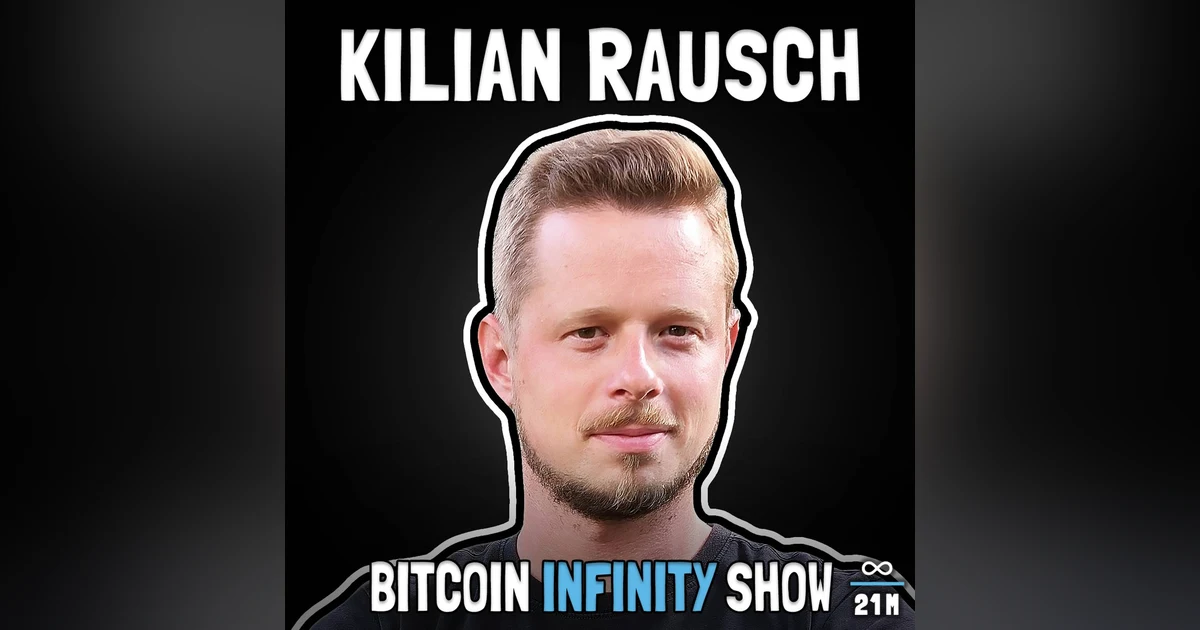
The Future of Lightning and Bitcoin Layer 2s with Kilian Rausch from Boltz


 Fountain

 YouTube

 Spotify

 Apple Podcasts

 RSS Feed
Kilian Rausch is the founder and CEO of Boltz, a non-custodial Bitcoin bridge, allowing swaps between Bitcoin and layer 2 technologies such as Lightning, Liquid, and more to come. We discuss the history of Boltz, the current state of the Lightning network, the future of layer 2 technologies on Bitcoin, and much more!
Connect with Kilian:
https://x.com/kilrau
https://x.com/boltzhq
https://boltz.exchange/
Connect with Us:
https://www.bitcoininfinityshow.com/
https://bitcoininfinitystore.com
https://primal.net/freedom
https://primal.net/knut
https://primal.net/luke
https://twitter.com/BtcInfinityShow
https://twitter.com/knutsvanholm
https://twitter.com/lukedewolf
Thanks to our sponsors - check out their websites for info:
BitBox: https://bitbox.swiss/infinity
StampSeed: https://www.stampseed.com/shop/21m-titanium-seed-plate.html
Bitcoin Adviser: https://content.thebitcoinadviser.com/freedom
ShopInBit: https://shopinbit.com/bitcoininfinity - Use code INFINITY for a €5 discount!
The Bitcoin Infinity Show is a Bitcoin podcast hosted by Knut Svanholm and Luke de Wolf.
The Freedom Footprint Show is a Bitcoin podcast hosted by Knut Svanholm and Luke de Wolf.
In each episode, we explore everything from deep philosophy to practical tools to emit freedom dioxide to expand your freedom footprint!
0:00 I'm on a personal mission to not let happen to ark what happened to lightning specifically that is being oversold as a solution to everything. The times where you can just open a channel and it will be open forever, and you have one Bitcoin of inbound liquidity for free forever. These times are slowly but surely coming to an end. And lightning has turned into this almost intermediate layer that really there's applications on top of it that use lightning as the mechanism of facilitating transactions. If you make an on chain transaction, that's going to be a rare thing in the future, and maybe it's not even that far from now. We had to shut down both services for, I think, four days in a row, because all our working capital of the capital that we used for was locked up in the mempool.
0:40 So get out of money, guys. Everything that is somewhat critical has to be open source software. We sometimes use the servers, we pay for it, but we want to be able to run it ourselves because we don't know what will happen to the service. Open sourcing everything and just selling the service is the obvious ethical way to go about things, and it's also the way to get the market signal if you're doing the right thing or not. Kelly and welcome to the Bitcoin Infinity Show. Thank you for joining us. Thank you for having me I'm excited to be here. Yes. Good to finally have you on Killian. I mean, I went up to Madrid to visit you and a bunch of other Bitcoiners, like, two years ago now or something. Yeah, something like that. It's like time flies.
1:20 How are things in Madrid? Good. So, actually, since you visited, I think we were at the stage where we're building up the local Bitcoin meetup. So two steps back. I arrived in Madrid around 2019 and it was pretty much nothing regarding Bitcoin. No meetup, no no people, you know. And I was like, damn that that can be the case for such a big city to to not have a regular bitcoin meetup, let alone even a meetup. So, I started it together with a friend and you have been one of our, our first, guests to speak. And, so the concept we always have is like, we're offline an expert or a, and the person that is dedicating his or her life to a specific thing in Bitcoin that giving a talk about it and then afterwards, you know, casual beers and meetup.
2:03 And I think we did that with us. All right. So since then it's it's been growing and it's been going, going great. So we have a core of let's say 40 people now that show up every single time we do a meta. We do it twice a month. Now. So things like good in Madrid, it's finally Bitcoin is moving. Good to here. So you either have an expert or someone like me. Your interpretation. Well anyway, that's good to hear. Well, since this is your first time on, I think, a little introduction is due to Mur and for our listeners. So don't know who you are, which I think is, a handful of them, at least. So can you give us the Tldr on, Kilian and what were your origin story, how you found Bitcoin and what you do now and all of that?
2:53 Sure. Okay, so I'm Kilian, I'm with Boltz and I discovered Bitcoin back in 2015, early 16 back in China. So my my story is maybe a little bit different than a lot of other than the story of a lot of others because I got into Bitcoin by starting to work in Bitcoin without having a clue what it is or how it works. So, what happened in in the end was, I, I was working at the large German automotive company in China and, decided that this big corp thing is not for me. Switched to a smaller Chinese supplier, which decided to go bankrupt within three months.
3:41 And then I was basically in the streets of Shanghai back then and was like, okay, well, what I'm going to what I'm going to do and, ended up going to a big fund meet up back in Shanghai. And that's where I met stepson and stepson Sam ho convinced me that my to come into office, the next day, he was working at PTC China back then, and a week later, I was working for them. So, that's basically how it happened. I studied at PTC China. Pretty early on. I've been with the mining pool. So taking care, you know, of the mining pool system, the interface, the website. Also actually, flew to Sichuan to visit a couple of mining firms that did a Docker, documentation with, TechCrunch actually find the link somewhere.
4:24 So we're filming, like the mining scene in China was pretty wild and interesting times. And over the course of 2016, I started working on a mobile wallet. So I've been pretty focused on on wallets until then. I think it was sometime late 2017 where I switched, switch companies to work on, starting to work on atomic swaps on a project that tried to build a Dex based on lightning. So remember, this was early 2018. So pretty ambitious to say, to say the least. Surprise that failed. But the good outcome of of that story is that we started bolts as a sidekick, of that lightning Dex, by the way, it was called Open Dex.
5:06 The website might actually still be around somewhere. So bolts was a little bit of a of a band aid of a, of a little thing that we did on the site in order to help open Dex to manage, lightning liquidity. Then it turned out that this band aid, this little hobby that we had on the site, turned out to be quite the thing. So, in 2023 is actually only last year. Michael Call, my co-founders, and I, we got together, and it's like, okay, guys, what are we doing with our lives? We looked at bolts. It's, was there running? We maintained it. We just basically maintained it all these years to be up and running. But it had organic growth. Even though we didn't launch any new features, it was really in pure maintenance mode.
5:49 And, we, we felt that it deserved more. So, that's where we then decided to start going full time and see how far we can get. And wanted to have you years later. I would say we we're in a pretty decent position where bolts is, is doing well and we saw a lot of integrations. We launched a couple of new swaps. If you talk more about it later, I guess. But yeah, that's basically my story, I guess. Yeah, yeah. We're going to deep dive into what what bolts is, a little later on. But like, I'd like to call back to this, you say you, you started working for beta sec in 2015. Early 2016, I think it was February 2016.
6:31 Yes, yes. And I think, well, most people don't know about this era in Bitcoin is that, China was super, super dominant, like it was almost, a Chinese project, like, they were. Yes, very much dominated by China, especially mining, but also other things. And I think, it BTCc was one of the only Chinese, mining. It's an ex mining or exchanges. Right. An exchange that also had a mining pool. Also had a mining pool. Exactly. Yes. That that actually could bridge that gap that had the that didn't have the language barrier because you had some English speakers, including you.
7:12 Yes. Yours truly. Samson. Right. Yes. Well, Samson, Bobby, the CEO, I mean, he's he's American as well. So it was really this hybrid that made BTC or BTC China, special back then. Yes. Yeah. And were you a part of of all of these, meetings like during the Blocksize force and everything? There's, secretive meetings between minus and, Oh, no, these ones. No. So I've been part of the meetings within BTC. See that we're discussing. Oh, I, I mean, it was it was wild times back then. I remember meeting of BTC management sitting down and, Jeff Garcia just released, his version of, you know, SegWit to X, and there was a series to speed, the pay debate of is this Bitcoin?
7:58 Are we running this? Is this the thing that we decide to be to be bitcoin or not? And it was highly confusing. And back then, I mean, in hindsight, everything looks so clear and you know and so I don't know evident. But back then it wasn't I, I was new to Bitcoin. But even people that have been in the game for, for many, many years, like Samson and Bobby, they were seriously confused of what to do, what to do with it. So high uncertainty if Bitcoin even survives this, to say to say the least. Right? So, I have not been part of any secret New York agreements, stuff like that. I've not been there and I'm gladly so. But within BTC, if I'm an exchange perspective, it was an incredibly confusing and frightening time because, you you clearly didn't know what to choose.
8:48 Yeah, I'm so curious. Because you say that you started working for a Bitcoin company without knowing what Bitcoin was, and I think you're you're you're not alone. Yes. For people that started working Bitcoin back then. And to be honest I don't think anyone really know was knew what bitcoin was back then or that you could make the argument that still no one knows what it is. Exactly. Like we're we're still trying to figure out what this thing is, but in hindsight, it's this David and Goliath story with, like, this thing of a. Yeah. For those that don't know, the Blocksize wars were on the surface about should we increase the block size or not?
9:32 But they were really about control of the network. And who was in charge of the network? And, it wasn't sort of, common knowledge at the time that that the users were really the masters of the miners and not the other way around. So I think a lot of the, a lot of the people at the mining companies thought that they had more power than they actually did over the network, which is. Just to. An extent, just to like all the big companies like the this New York agreement that everything like almost every big company assigned it, BitPay signed it, and, Jihan signed it and everyone signed it.
10:13 But it didn't go through because the users didn't want it. And the markets clearly showed that, like, we don't want this thing. We want Bitcoin to be decentralized. Otherwise it doesn't work. And increasing the log size, of course, would have set the precedent for doing so again, which would have rapidly destroyed that decentralization and put the put Bitcoin in the hands of a few, powerful players. So luckily that I mean, to me, I'm telling this story because to me, though, this is the the pivotal event in my, like how I discovered Bitcoin because it wasn't until this unfolded the way it did that I was convinced that this is the future, that there's no way this, this unstoppable, truly unstoppable.
10:56 So. So, yeah. 100% agree. And, with what made the this situation even more special, not only being in China, but also being in BTC was that you had, Samsung in that. Right. So Samsung was one of the vocal applicators, like the first thing, one of the first things I got from was a was I had no idea what it was. But then I started, you know, like informing myself, what the hell is going on here? But I was right there. The source of information and also from a corporate standpoint, the came from the rest of the management team that wanted something different. So there was an internal conflict, going on as well. So, highly confusing. But in the end, I appreciate so much appreciated so much that I had the chance to be there and actually have all this information right at that time.
11:43 Whereas I'll, you know, I think for, for many others, they just didn't have access to, to these kind of things. No, it's it's fantastic. You have like first hand information like you were there and I witnessed it from the sideline. I mean, I was witness it from, from my couch via whatever I read online, but the whole, I mean, even Samsung, Samsung has told me that his, his views on what Bitcoin was has changed a lot during that time. And even like even he wasn't like clearly on one side until until specific points and the events that unfolded. And it's it's so interesting because you have these developers which are mostly from the English speaking world, and then the hardware manufacturers and the the exchanges and the miners are mostly from the Chinese speaking world.
12:37 And it's it's pretty hard to, to like bridge the gap between the two. And, yeah, I finally find it insanely fascinating. And, yeah, people should study it more on and, the, the story should get out more. There's a good book about it. But I believe there will be more books about it in the future. Yeah. Thank you. Professor. Okay. Very good to know. All right. We'll see anyway, where are we? Yeah. Volts. Can you tell us a little more about volts? What is? Bolts? And, Yeah. How has it changed since you went full time? Sure. So bolts started out, as I said, like a like a band. So basically the initial idea of bolts was to create a service that would connect to your lightning note and take care.
13:25 The channels are in balance, basically. However, you wanted them to be like, have this amount of inbound minimum with this amount of abutment, minimum. So that's basically the idea of bolts. So it was really this tightly coupled lightning rebalancing service. We quickly, pretty quickly we, we opened it up, to the outer world though with with a website. So that's something that makes bolts very special that you not only technical people can access it on, but also it has a pretty easy to use, web interface, which is available at bolts that exchange. So it's a simple website with a, I want to go from lightning to bitcoin, and this is how much I want to swap.
14:08 And we launched a website already back in 2019. So, back then it was a little bit unthinkable to do all the crypto magic that is required for this, for this service to function in a, in a web app. But, it was definitely possible. So then we spent some time working around the, the UX issues and, yeah, make it make it really, a decent, a decent enough UX. That being said, the first website was horrible. It was. Utterly. Ugly. Yeah. Ugly. Beyond imagination. I think I still have, we still in our blog, still somewhat have, we have a blog post up, where we have the three different versions of three different iterations of a web app to look at, and that it's just funny if we look back and how things were looking back then, but it was functional.
14:52 That was the most important thing you could got moved between the, the Bitcoin main chain, and lightning tools to keep the channels balanced. And then this was basically unchanged until 2023. That was the, the premise to use people that the product had positioning and and 2023 when we looked at it and said, okay, we want I want to put attention, we're basically think, okay, what what's what's the next step? What else? What else could bots do to help to help bitcoiners. And, then 2023 happened. You know, ordinals and, let's just call it mempool. Congestion happens like, every time.
15:32 Go to WTF happened in February 2023. Very good website. Okay, I didn't know about this website, but yes. So that is that was the time where we saw the window of a window of opportunity for, for eclipse. So it became pretty evident that even for channel, especially for channel rebalancing, because that was that was the use case that we were talking about, okay, this was not functioning anymore. Right? So, we we increasingly noticed how the Lightning Network was becoming less reliable, because the rebalancing mechanism based on the mentioned was less reliable. It was not reliable at all. It didn't work right, which basically didn't work for an entire week. And you could notice how lightning payments were increasingly difficult to get through because channels were only imbalance.
16:17 So I said, okay, what's what's the solution to that? And then we we looked at liquid again. Because I'm saying again, we had the out of pure technical interest. We started, with a liquid integration already a year before. There was just never the motivation. And, you know, not being full time, just being a hobby, that was just never the motivation to push it across the finish line. But 95% of the work was done. So, then we had the motivation say, okay, that this is actually this might be quite the solution for for letting channel rebalancing in, you know, in times where we have these sustained high, high fee, levels. So we did and we launched it maybe like a week or one of the five weeks after after the fee increase happened.
17:01 So that impact was like, wow, these guys implemented all this in a week. And so it's not exactly true because we, you know, had this lying around for for more than a year. But this is where we launched it back. And I think it was end of May, May 30th or something like that, where we launched liquid swaps and went out with that. And then things started changing. We saw a lot of interest, porting and also criticism goes, you know, you you don't do these things right. If there's not a decent amount of criticism in the market. But, since then, I think what we changed the perception of, of the liquid network, we changed the way people think about it and how it's being used right now.
17:43 Because as of today, we are not only doing channel rebalancing, we've also enabled a new kind of, wallet to interact with lightning using liquid swaps. So that's something that has been wildly successful in the past couple of months. So these things were developing, and, and the since we launched liquid one roughly one and a half years ago, another add on that we're doing right now is, is the BTC pay plugin. So that allows you to accept lightning without running a lightning node. So this not running a lightning node is becoming increasingly popular. Not that's you know, we need to support lightning.
18:26 And we will always want to help lightning with rebalancing. But running a lightning node is simply it's not for everyone. And that's something we realized. And that's why we're increasing our product offering for for these kind of things. And it's also being accepted really well by the market, even though it's, better. So yeah, these are the, the, the things that we are that we're building out and the long term vision, that's probably how it should terminate with all of this. The long term vision of boards is to be the connecting the the place that connects the different Bitcoin layers. Saying between layers. Picture layer two is that's a different discussion we can have later. The different layers of Bitcoin. Yeah. So if you want to move your bitcoin from lightning to liquid to the main main chain and as of recently also to the roots looks like chain, bolts is the place to go.
19:17 The very special thing or the thing that makes bolts specialty is that all this is non-custodial. So we are retaining the control of your funds throughout the swap process. Cool. So like, yeah, this is so fascinating because it's in a way it's a response to to an attack. Like if you view the ordinals thing as an attack on, on, on the on maintain that or an attack on lightning, really. Because it reduces the functionality of like lightning. So it's an inner it's sort of a response to an attack in the from. That's a do you view, do you view the ordinals thing as an attack.
20:02 I'm not pro ordinals obviously. But I don't think I you few of them really as an attack. I don't think they were really intended as an attack. The result was right. So the result was large interruptions across the board. By the way, we had to shut down both services for four days in a row because all our working capital, the capital that we used for us was, was locked up in the method. So get out of money, guys. We you know, that that's, you know, replenish and replenish. It was okay. Like, there's a limit. We can't do that anymore. We have to shut off. So yeah, that was. And that we were not the only one. A lot of other services had the same issue in May 2023. That being said, I don't think it was it was meant to be this intentional attack.
20:44 And I maybe I'm naive, but I believe in people just doing the cutting around to doing things. But it resulted to be one. And but instead of complaining about it, we chose to work on something that might help. Yeah. Which was the response to the actual attack back in 2017 when when, Roger was promoting Bitcoin Cash and, like, clogging up the chain with like, this is before fee estimations and all of that. So, so you paid like $20 per transactions per transaction back in 2017, which, which a very, very obviously was an attack.
21:24 This this is not as obvious. It might, might just be, a consequence of, of decisions like, SegWit interpret this. This might be an unintended consequence of that, that the chain is now being used this way. And whether it's a deliberate attack or just a coincidence. What what is it called like? Occam's razor is one thing, but, the easiest explanation. But this, someone else's razor, which is like, never, never attribute to to malice that which can be explained by stupidity or stupidity is, they are stupid. I believe in that. Everyone agrees that they're stupid. Like, it's it's just, But but I find the similarities here, very fascinating that it's it it acts as, as a de facto attack, even though it might not have been an intended attack.
22:18 But the immune system response from the network, you being the white blood cells there is, or you being the immune system of the network, you and others, like it is similar to what it was back then where like, just build around this. The stuff. The the net. It's a net positive. Definitely. So, I, I, I appreciate these kind of, events to happen because even though you lose a couple of nights of sleep and everything looks like doomsday for, for for some time, Bitcoin always comes out top right, and it forces us to, to to think out of the box and work on solutions that will mitigate this in future.
22:59 So and mitigate a potentially even more drastic, consequences. Yeah. So, so, this takes us into this, question, about centralization. Like, how is bolts, helping decentralization rather than being centralized itself like it's bolts are so liquid, as you can argue, how centralized that is. But like, what's the arguments there and how much do you think about decentralization was what, issues when you make decisions in the company? Sure. First I want to say we are for profit company. Right.
23:40 So, bolts. Bolts is not a, project anymore. It is, serious for profit venture. And even with a legal entity, we're headquartered in El Salvador. We pay taxes there. So the this is this is a serious business venture since since one and a half years. So we have an interest and and making a profit and, and in my opinion, that much that that really should be okay. And it's, it's making us independent. More independent than if we were purely, based, you know, funding, funding ourselves by a grants or something with that.
24:22 So you see that, a profitable, a profitable business model that develops software, actually has. Yeah, has, has a brighter future than someone that is depending on the mercy end of the grant of of of someone else. That being said, even though we are, for profit company, we still decided or we especially decided to open source our code. And that is part of our decentralization, strategy. It actually the topic came up, when we were talking with breeze or when I was talking to Roy from Breece, to integrate bolts into their new, liquid SDK. So the the topic came up basically saying, hey, Killian, bolts are super cool.
25:05 It's a nice service, but what if it goes down? Or what if you decide to to raise your fees? Tanks. Like what what what am I going to do? I'm locked in. And after a couple of back and forth, it was clear that that we had to open source all our code, including the backend, so that if push comes to shove and we have to shut down, or if our service quality degrades and, you know, we're doing a shitty job in the end, breeze has to have the option to spin up, bolts backend by themselves and, continue to service. They have a pretty well connected lightning not already. So for them, for, for for companies and professionals like like breeze, it's, it's they can do that and they have the resources to do that.
25:48 I was also convinced actually by ourselves because we ourselves do not use any think fosters for mission critical stuff. Nothing. Right. So everything that is somewhat critical has to be open source software. We sometimes use the service, we pay for it, but we want to be able to run it ourselves because we don't know what will happen to the service. So it was really a no brainer in the end. So open sourcing was was step one and making, and, and ensuring that integrations that integrate, bolts via its API, can, can run the service by themselves, should they have to. The idea is, though, that they don't necessarily want to do that because it's not core to their their business. They're actually focusing on their business model. They want to be good in their business and use yours as bolts and basically have just the option as a, as a backup.
26:33 Nevertheless, that, it inspired, a couple of other technical folks out there to spin up their own backends. So right now, as of today, we have at least a handful more bolts backends running out there. And the great thing about, about this is, they're all maintained the same API key. So basically what you can do is just, you know, switch the domain to someone else and, you can continue operating. Should bolts not be to your liking anymore or should you go down so that that is possible as of today. And I'm very happy glad that this happened. Because now I have a good response to these these kind of kind of questions. So yes, Wild Bolts itself is centralized, right?
27:13 It's a centralized server. It's, it's a user interacting with bolts as a service. It's, an API call going to a central, central server. And that piece itself is centralized. And that's centralized for a reason, because there is no good way to, to centralize that. As of today, with the lightning and Bitcoin just being, you know, like how they are and, and technically it's just not really possible. That's how it is. But what we can do is we can decentralize, the control of the code, which we open sourced and then, you know, have DevOps, a little bit of an ecosystem of, of bolts around pools. Now, I absolutely love that. And I actually prefer, companies to be for profit than to be like funded by charities, because that, in my opinion, that is, has a higher risk of being like, hijacked, because you don't want to bite the hand that feeds you because you're afraid of not getting the grants, which.
28:08 Happens like we have seen it. We have swift seen it. So, yes. I wouldn't mention a specific company, but, I know of, you know, block explorers and stuff that have suffered this fate lately. Anyway, so, so, the, Or maybe I shouldn't throw too many stones here. But the thing is that this is the way to go from a, like, an anarcho capitalist ethics perspective. Open sourcing everything and just selling the service is the obvious ethical way to go about things. And it's also the the way to get the market signal if you're doing the right thing or not, because of course, information should be free.
28:51 But the information, the code is not the service you're selling. You're selling like the. But we had to realize that, you know, so that that was actually part of our journey was and in the discussion with Roy, I had to realize that we're not selling a service. Oh, sorry, not selling a software, but we are selling a service. We are selling we're and our USP is the operations that we manage our liquidity well, that we have good uptime. You know that things are reliable and stable, rock solid. That's basically what, what what we are selling. And not just a software itself. No. And this is this is what I love about the free market mechanism, because in the end it leads. It leads intelligent people to make ethical decisions because it wins out, especially now that we have a Bitcoin then that's sort of turbocharged.
29:39 And no, I just love it. Luke, I think this is the point where you come in. Yeah, yeah. And like a lot of this stuff is building from from kind of my, my perspective as a, as a user of bots in, in, a couple of ways, I guess just kind of digging into some of the, the experience of, of bots from a user's perspective. I, I have a starter question because because one of the, one of the ways that that I use bots personally is, is, yeah, this this swap in and out of, of lightning and that, one, one practical question I have is what direction, does, does everything usually flow into.
30:23 Is it, does it does it change over time or is it, is it the, going from lightning out? What do you see the, the most of in volts. So that changed over time. Not super significantly just yet. But, the, all the time where we've been mainly focused on lightning channel rebalancing, like, you know, as a service for lightning providers, we had, the vast majority of, of, of the swaps were, were going from lightning to the chain, meaning we were, receiving lightning and it was paying out, by the chain. So from a from, lightning, no perspective is the typical get inbound liquidity, use case. That was the majority of the volume.
31:04 Now that we have more use cases, going on that that's that's lightning, slightly changing, for example, with a wallet with a wallet integration specifically, if you look at one wallet integration, it's pretty balanced, actually. So in and out is in and out of balance. So namely you have the Aqua Wallet, which is a pretty popular wallet by now. So users are just makes a lot of sense if you think about it. They sent in the way amount that, that would they deposit the same amount that they're taking out. So, that's also the the reason why we, expanding our integrations to more use cases in order to balance, balance up the, the flow a little bit because, in balance flows always bad.
31:45 Lightning. So you want to do a lot to, to balance up. Yeah. I totally I totally understand this point. And I mean, I mean, this shouldn't come as a surprise, but our specific use cases, this isn't like mining secret or anything. We have a we have a web shop and we accept Bitcoin and we we need lots of inbound liquidity. And so and so I mean, the the process for that that that I found really easy was just make a channel to bolts and then basically swap everything everything out. Now I mean I get that, that, that sort of from, from your side that leaves a bunch of kind of liquidity, kind of stuck there. Right? Because if you, if, if someone opens a channel to you and then sends all the funds to you, it's not like you can leave it there indefinitely.
32:32 You've you've got SATs locked up. So have you closed that channel to get get rid of that. Then there goes the inbound liquidity. So how does that work from, from a practical perspective, if someone is is using this, is, is this even a recommendable way to, to get inbound liquidity? Yeah, that's a good question. So that is also evolving. So all these years it was the, the way to go. And a lot of people did that. The downside was that we were sitting on a lot of capital, potentially unused or especially the the unused capital that was sitting on our side of the channel, meaning our capital not moving.
33:13 That's always bad. What do you want in the end? Does this velocity. Right. So we want the capital to be used as efficiently as, as as it gets. We didn't really meant it. So this might be coming as a surprising fact, we didn't really manage much of the liquidity of our of our lightning notes, in the past, but we started doing so, maybe since 3 or 4 months. We are really actively, filtering. We also built internal tooling for that to detect that, you know, like, get alerts and then also close channels where, we have significant capital on our side of the channel that is not being used. Okay. So as long as, as long as you and that's, that's just a hard fact on lightning. As the network is transitioning and then my well, in my opinion about full swing already, transitioning to a more professional network, we have to live with the fact that unused channels, unused capital channels gets closed.
34:05 And and that's just how it is, the times where you can just open a channel and, you know, it will be open forever. And you have one Bitcoin of inbound liquidity for free forever. These these times are slowly but surely coming to an end. So right now I would not recommend bulls as a way to open a channel, then swap yourself inbound and then, you know, hope that it just stays there forever. There are actually lsps, so we're not an LSP. LSP that sell this as a service. So basically you pay the money for the capital cost to have that inbound liquidity open to you. So that is the way I would go in the future to to have that as reliable.
34:45 Hey there, dear listener, I hate to interrupt you like this in the middle of the show, but we'd like to tell you a couple of things about, for instance, the Bitcoin Infinity store where you can find our new book, Bitcoin The Inverse of Clown World. It's a great book. I think you should get it as soon as you can. And we have some other stuff too, don't we look. Absolutely. First, I think we just like to tell you about our great partners. First up is beatbox. They're our favorite hardware wallet, super easy to use, and they don't compromise on their security features at all. So we really recommend them. Check them out a bit. Box dot Swiss slash infinity. And by the way, you can use Code Infinity just about everywhere in the Bitcoin space. And probably you'll get a discount.
35:27 We'll see. And the other one is the stamp seed seed plate. This is something that has been really well received. This everything divided by 21 million seed plate. So check that out at Stamps.com. You can get our link in the description as well for another discount. And don't forget to follow us on X and Noster and all other places you can find on the internet. Exactly. In fact, we're on TikTok and Instagram and all these other places. No, no, no, look, we're not on TikTok and Instagram while we are on Instagram. We are on TikTok. Oh, we're on TikTok too. Okay, well, so follow us. Follow us there. If you want to help spread the word.
36:07 Yes. Brush your teeth. All right. Back to the show. Yeah. It's interesting like lightning in the sort of original sense of, of open a channel and then, and then you can and then you can split back and forth, you know, batching transactions and all this, this, this really hasn't been what it's, it's turned into in practice over the course of of time, lightning is, has turned into this almost intermediate layer that, that, really there's applications on top of it that, that use lightning as the, the mechanism of, facilitating transactions. But, but not very many people have their own lightning node and, yeah, it's, it's it's interesting that, when you talk about the professionalization of lightning, it's, it's it's kind of that if you even have a lightning node, this is going to be such a rarity.
37:00 It's, it's just the same kind of thing is, if you make an on chain transaction, that's going to be a rare thing in the future. And and maybe it's not even that that far from now. How do you see the, the evolution of lightning and what it's going to look like in five years, ten years? Yeah. Let me get my crystal ball. So no, I have I have pretty strong opinions about that actually. So I, I acknowledge the transition of lightning to, more professional network. I acknowledge the transition to, of highly connected, world connected, professional nodes, that spend significant resources and time and software intelligence software managing managing the nodes with us being one of them.
37:48 By the way, we operate one of the oldest lightning nodes of on the network, like I think our oldest channels, almost six years old. We opened it in 2019. So we we have significant experience in operating a lightning node, and I think it will be in the end. It will be these kind of players which will either be wireless by themselves, that will be exchanges or other platforms that, you know, I'll professional a need a professional lightning apprentice operation in-house, but the rest of the of of users and retail and users, I don't think that will be touching lightning directly in a sense. So I'll take this with a grain of salt, because I'm obviously biased here, but I think using lightning in a noncustodial way in the future, the only way to do that is by a swaps.
38:32 And it probably won't be swaps from liquid for forever, but swaps from other layers, right? So we we have a lot of other interesting new layers coming up. Ark being one of them. So I really see this, this vision of lightning playing out in a way where it is the transactional layer, where it is the connective tissue. That's how Roy always puts it between the different bitcoin, layers. But not, like I said, not people running their own lightning nodes and managing everything by themselves. So that's how I see lightning evolving. Yes, it's the rail between layers. Yes, it's it's the way to do payments because lightning lighting is awesome. It has awesome properties. You know, I'm like, for you as a merchant, you have instant transaction finality.
39:13 That's just unbeatable, right? So, folks pay you, you can be 100% sure, be sure that this is actually paid and there's no plaque reorg or something going on. Right. So you can release a good and and and be fine with it. So those are properties that make that make lightning really irreplaceable. And that's why I will always have its place. But the way we use it probably from from, you know, swapping in and swapping out as, as we need it. Yeah. This, this grain of, of salt you're talking about to take this with. I take it with a grain of salt from from chef co-owner tears because they are salty about the whole, like, the situation.
39:56 And this is one of the main criticisms, about lightning and, Bitcoin's scaling in general, I hear from chef corners is that, lightning is totally centralized and it's totally like not self custodial. And it's so tiresome because then they go on to talk about sharding or something. And, and the, the thing they're missing is that, yeah, sure. You can theoretically do fractional reserve, custodial lightning at some point, but it's still way, way, way better than banking. Like you can't do it to the same extent as you can in the fiat system. It's still a like, even if the worst case scenario, if volatile Satoshi decides to give out paper bitcoin to 10% of the users or something, they can't do it.
40:41 It doesn't scale the way fiat does where where you can create like 99.9% of all the currency and circulation is just conjured up the same there. Like you can't do that. So like it's still it's still such an upgrade for humanity. So they're like missing the point in my opinion. And Yeah. What what are your thoughts? I think there are viable ways how with a good UX, a really good UX, how we can use lightning in the future, being non-custodial. Right. So that's the situation right now, today. And I also don't see it that critical. But I, I'm very hopeful and very positive about the future of the, of the non custodial future of lightning.
41:24 And the main underlying primitives being what. Yeah. I had I bought some, inbound liquidity yesterday, for my newly set up I'll be hub, running. So I run bitcoin knots and L and D and I'll be hub on my start nine here. And like, I'm not very it tech savvy, but I'm, I'm fiddling around with it and like seeing what I can do and I enjoy it. And I'll be is one of those, like things services that are sort of forcing people to become more technical with it. Yeah. And I love that. Like they're steering you in the right direction.
42:07 Yes. So the that they are discontinuing completely discontinuing the custodial product is, is, is it's the right thing to do from a company's perspective because they just don't want to have custody. I certainly wouldn't want that right now. That's that's also part by the way. So it's not only bitcoin ethos and our personal ethics that, that we are putting so much focus on both being non-custodial, but also from a legal standpoint, as we have learned and learned in the past couple of years. It's probably a good idea to, to not have custody over of a user. So and I think that's also part of the motivation of algorithm. Absolutely. Because it's only when you do that you are really a financial company, isn't it?
42:48 Or a bank or something like if you don't ever touch people's funds then then again, I mean, attacks can come in either way, like The Pirate Bay was a link provider, nothing else. And they they got in legal trouble for that. So I guess that the risks are always there as long as the motivation for the assholes are. But but still. Yeah, I understand that motivation perfectly well. Yeah. And I also believe in, in our world, transitioning towards a world, unfortunately, probably a two tiered world. A world where you have places where you can be sure you're a safe, offering a service that is doing nothing illegally and not having control over for customer funds is the defining factor.
43:32 And then there will be another world where all just does matter. And if they want to, you know, basically legislation through there, through enforcement. But that's just really not the world I want to live in. Now. And I mean, the I think, I think the thing is here is that is that, lightning like anything on Bitcoin is, is, like a matter of, of degrees. But I think like what I said earlier is that, is that it's all better than, than the fiat system just getting some kind of exposure to Bitcoin somehow. And, and of course, if you use a third party or have a custodian or have some intermediary, there's there's some kind of risk there. But at the end of the day, having some amount of satoshis somewhere is better than having no satoshis anywhere.
44:16 And, and and so, I mean, I like this I like this trend. And I mean, I think all all, some of all advocates for, for, for bitcoin generally can can do is, is encourage people to get as deep into that stack as possible. But eventually it is just going to get to the to the point where the, the amounts of satoshis that people can acquire aren't going to, for example, enable, sending the on chain transaction to open a lightning channel to make payments in the the South, and the, the self-sovereign way. And so then it's going to start to get into other things, other solutions to, to enable people to do this, whether it's, yeah, sending, sending Bitcoin to, to some kind of, lightning provider or whatever, whatever that, that looks like, or it's using, things like liquid, these other layer twos that you've mentioned.
45:13 But, but liquid is kind of the, the interesting what I'm, I really started to use bolts, actually, when, when, when the liquid support came in and. Yeah, I remember the three of us were, were in Riga. We had a, we had a conversation two years ago in Riga, and it was shortly after or after the liquid swaps had had really started to come in. And, this is all the kind of the peak of all this. And it was really interesting, to me. But let's use liquid as this this way around the, the, the spam issue, basically. And what are your thoughts on, on the use of liquid generally in terms of, in terms of basically this, this layer to, to off load the on chain dynamics, and, and kind of get rid of that, not so much risk, but, but that externality and, and just keep transacting with, with Bitcoin, using it with lightning, using it with like what do you think of that?
46:13 I think that's the way to go. So, maintain blocked blog space is just one of the you made these scarcest resource next to the kind of stuff that we have on the planet, so we should treat it as such. So even though right now some of us might be forgetting about this because fees are relatively low, I think it's crucially important that we keep in mind, that building, anything that relies on Bitcoin mentioned block space is prone to fail. Right? So, that's, that's that's what you should have in mind. So using the main chain for something like lightning channel rebalancing thing is just not the way to go. And I might even go further than that by using the Bitcoin main chain might not even be the preferred way to anchor lightning channel itself.
46:59 Right? So, if you're looking at a couple of years down the road, we might also want to have most of the usage. So don't get me wrong, the maintained Lightning network will not disappear, will stay there. It has its place. But, it might be a good idea to actually anchor lightning itself on to another layer to specifically Ark. I'm very hopeful on and very positive about anchoring lightning. Like I gave a I gave a talk about this in the future was actually pretty, pretty cool. In adopting bitcoin, to two weeks ago, one and half weeks ago. So those are all ways how we can make ourselves more independent, from, from the Bitcoin mentioned. And that's an absolute necessity. So the Bitcoin mania or the bitcoin on the bitcoin mentioned really have to fulfill this, this, this one purpose of being the source of truth. Right.
47:44 So I have this trip to graphically verified 1 to 1 relationship between whatever layer and even the layer three or whatever is built on top. So let's say lightning on August, layer three is an arc. All has to trickle down to the same amount of Bitcoin, so we can make sure there's not more than 21 million, that that is that is the main purpose but not every transaction on the main channel that can be avoided should be avoided. And liquid right now is just the place to go. Because it is rock solid, it is up and operational without any major hiccups. Since 2018 it is a Bitcoin core fork. So running this is really easy for anyone that knows you could do it right. So, for, for, for corporate, for a corporation to run this and to even integrate it as a foreign exchange to integrate it.
48:30 It's it's that easy. That is unsurprising that the don't do that. Because, from a technical perspective, it's literally zero effort. It's really just managing the, the, the liquid, the balances. So yeah. So it's, it's, it's, it's it's very everything is stable and familiar. And that's why the moment it is, it is the place to go. But, no doubt that there will be other interesting, layers and places that can absorb, maintain activity in the future. Yeah. And, well and liquid and I, I agree with you. The, the usability of liquid is is fantastic. I mean, you can do other things with liquid.
49:11 And I understand that this is one of the purposes that there are other tokens and stuff. And of course, there's a, centralization to it. But at the end of the day, it's it's a it's a 1 to 1 peg with the Bitcoin underneath it. And, and so as far as I'm concerned this is actually to, to your point about, getting as many transactions off the base chain as possible that I completely agree with because, I, I gave a talk a few weeks back about that basically, the, the, the gist of, of what I was saying was that everyone has an allotment of about two transactions over the course of their entire lifetime. If we're talking the number of transactions that will be in the blocks over the course of a human lifetime, about 70 years or something like that, we get about two.
49:51 And that's not counting the human population changes or something. Shut up. Community. Yeah. But this is with the 8.5 billion people. That's. What did I just say? Yeah. Yeah. Sorry. Don't worry about this. And the the friendly banter is we we love it. Yeah. I force Luke to edit it out, so it's fine. Yeah. Basically. No, no. Okay. Returning to. So you get about you get about two, two transactions and, Yeah, that that's just, that's just not going to, to scale. Basically it is going to be through through layers that we scale and, and also the other side of that, that that topic was spam is not good. And let's try to avoid that as well, please. But but in terms of, in terms of liquid being this 1 to 1 peg, you can trust that you've got the you've got the bitcoin and you've got the, you've got the on the other side, you have that exact same number.
50:45 And of course you have to, to trust a third party. But then, but then the thing is really quite smooth. It's it's a transaction, sorry, a block per minute. And this, this brings me to kind of the, the UX of of using these these swaps and these payments. I think this is really the only actual downside with, with using a swap based system. I use Aqua Wallet. It's turned into my, my go to wallet because, and not for any specific reason, but it's the, the main thing is that I can, I can just swap for my liquid balance into my aqua wallet, and then I can pay for stuff over the lightning rails, over the liquid rails. I can accept the Bitcoin.
51:26 It's it's it's great. The entire thing. The only downside is that it's a bit slower than other Bitcoin wallets. Sometimes it takes 30s, sometimes it takes a minute, sometimes it takes it's I think it takes longer than a minute sometimes for the transaction to go through. And so it's not quite this lightning fast pun sort of intended as, as going from a wallet of Satoshi to a blank wallet or something like that, where it's just a custodial lightning provider, one to the other. So, so. What's what's the what's the solution. There? Is it is it always going to be just a little bit of lag compared to, to these other things just because, the swap goes through the, the, liquid rails or is there something else going on there technically that, that I don't understand.
52:14 Enlighten us please. Okay. So, agua in general has a little bit of lag, and Samson, is implementation related, so, the loading times and all that stuff. So that also makes agua sometimes still a little bit slower, but that's entirely fixable. And a Samsung Optima, they know about it. I actually sent him a long list of feedback after adopting Bitcoin because I use it as a as my daily driver there as well. What to fix. And, I'm confident things will be faster and snappier from, from the UX perspective for the lightning payment, itself. So what is happening under the hood when you do a lightning payment is, you send, liquid bitcoin into a swap.
52:55 So it's being locked up on the on and the lock up address on, on the, on the liquid chain and but technically it takes up to a minute depending on the time that you the time between two blocks that you got there, could take up to 60s if we, if we were waiting for, one confirmation. So actually on liquid the design and that's why we are in close contact with Blockstream is to actually keeps their account safe. So we know now. And we learned that, zero comes on the main chain as a no go. And, since mempool. Thanks. Peter Toth. Is is a thing we there's just no zero code anymore. And if you do it, then it's just a high, very high risk, and liquid to design. And the intention, of the technical design is to keep that safe and actually, quite the contrary, make it safer.
53:39 So we're working on certain internal tooling to actually, make liquid, silicon transactions for anyone safe to accept. And that is the upside of the centralization of the 15 functionaries that produce, the liquid blocks. And very simple terms. If all 15 functionaries tell you I have two transactions in my mempool, I will included in a block, it's pretty safe to accept that transaction. And that's basically you should leverage you should embrace that centralization of that actually leverage, leverage for that. And that's what we're doing. Right. So, we are accepting zero transactions still with an upper limit.
54:20 But we definitely can increase the limit and make these transactions maybe total round trip type, maybe like something like 2 or 3 seconds where you should be, having, your liquid, Bitcoin being accepted by bolts and then both start paying the lightning in was already so that is as far that should be technically as fast as Phoenix. In the future. Right now, there are certain delays for security reasons and each and every step. So you always end up you always end up with a with a slower time, but it will always be a native lightning payments. It will never be as fast as a wallet of Satoshi to wallet of Satoshi transaction, which is just a database transaction, right? So that one is always faster. That's unbeatable. We have to live with that.
55:00 But that's okay. Now of course. And well, and actually, I can say from, from experience, using the lightning side of, of bolts, swapping in or making a payment from, from liquid, the as soon as the, the like if I'm making a payment from a channel, a lightning channel, bolts receives it. And the process. Is it like I don't I don't even have time to switch the tab. It's already. It's already done. So, yeah, I can I can speak to that. Things that things appear to be really quite tight on the, on the bolts. And it's just using the different technologies in, in concert I guess. Kind of makes it complicated, but nice to know that it's, nice to know that it's improving.
55:41 Yes. And it will be. It will be faster. If I was to do a tldr on on like your back and forth over the last 20 minutes, it would be it 20 minutes, it would have been liquid is pretty solid, like. I would say. So yeah. I mean, I learned about liquid myself on the, right before we, you know, when we started integrating it, I had no idea what liquid was, and I had to read up stuff. And I was skeptical for, for quite some time, but also was the reason why we had this integration there sitting around. It didn't really finish it. We didn't have a reason for it and was like, okay, I don't know how it will will be perceived by the market, you know, like, but knowing no liquid and no knowing the, the people at work on liquid, I, I am of the opinion liquid is a pretty solid project.
56:31 So because the the amount of effort and research resources that Blockstream spent to make liquid, solid and reliable is immense, you don't see any of that on the outside. Nothing of that. But the fact that it didn't have a single downtime since I think one small incident in November 2018, there was a 19. There wasn't a downtime, right? So that that means quite something. And there's nothing oxymoronic about something liquid being solid at all. Yes. He always manages to find this. He always manages to find his isn't. Oh, okay. From one thing to another, that, jokes aside, like, there's I've met a couple of, rootstock advocates in, in Buenos Aires.
57:19 You mentioned rootstock before. I'm I'm very unfamiliar with the project. Still, they try to explain some stuff, but, yeah, a lot of that flew over my head. So, like, what's rootstock and is it solid? Rootstock is pretty similar to, to liquid. So to the solid part, let's come to it. Maybe in the end. So, rootstock is a sidechain just like liquid is based on the same principles. There are a couple of technical differences or maybe first of similarities. It is a sidechain. It has a federation that is custodian. That is a big multisig custody being the one to unpack with RPC helps called on on rootstock.
58:05 So bitcoin versus mentioned bitcoin same way liquid bitcoin versus the mentioned bitcoin. Yeah. It's a sidechain is a blockchain based. It has block intervals. It has 30s block intervals instead of one minute like liquid does. And one major difference is that in rootstock, the the federation that guards, the multisig, the RPC is separate from the block producer. So in liquid it's the same 15 entities called functionaries that do both to do the, the two card, the LTC pack, but also produce the blocks now have the mempool running and and basically put transactions on blocks and attach them to the chain and rootstock.
58:47 It's actually the actual Bitcoin miners that do that. The rootstock is being, secured. And block production happens on a, on a mechanism called merchant mining. So about I think right now it's about 60% is is changing because of new mining farms coming up and stuff. But around between 50 and 60% of the bitcoin miners, which is pretty decent hash rate, is securing, the, rootstock sidechain at the same time. And merged mining in simple terms, is interesting for miners to do that because they get a part of the piece, you know, the fees that are being spent on the on the roots of sidechain as their reward. So it's an additional and an additional income.
59:29 And that is important part without extra costs. Right. So merch mining is for free. And also they don't have to put up more power or more electricity in order to mine Woodstock, as well. The technical underlying concepts of rootstock are pretty sound, I would say. The PAC meta mechanism is, on a technical level, different than the one used. And and liquid, but is proven it's live since 2018 as well. Actually, before liquid launched, the rootstock launched I think in January 2018. So early 20. 18 and liquid launched some, maybe in November. So pretty much at the same time.
1:00:09 And fossil was really a no brainer to integrate rootstock as well because it's just the similarities. Are there. And additionally, rootstock has its own pond ecosystem. And that is that's probably a part of the technical difference that you won't like. Node. Is that it's not a utx O based chain. It is an account model. And the idea is to basically be compatible with the Ethereum EVM in order to make it easy for broader for projects to move, to move over. So the, the, the, the picture fruits like it's basically, poured over your DeFi project from Ethereum or some other EVM ecosystem to rootstock make everything be based on Bitcoin.
1:00:51 It's all RPC back. There's no, you know, other token, involved than that. And that's basically the premise. And to be very, very secure because of the high Bitcoin miner hashrate that is, you know, securing the network okay. So you you have these semi secure bitcoin securities like the rootstock Bitcoin the pegged ones as, as an anchor to whatever, stupid shit coin project you want to spew out from your crap. All right. So but but is, is there a risk there? Like what? Merged mining and everything. It sounds to me like that this is could potentially be messing with miner incentives.
1:01:34 Somehow, One way. Well, the, from my perspective, like, the the more the more pure the miner incentives are, like, the more their only incentives are to mine bitcoin and that for for the rewards, the subsidy and the fees, the better it is. Then again, I do believe that there's a future where miners will have to use their excess heat and stuff for other stuff in order to be profitable at all. So there's there's bound to be other incentives going into it. I just really, really, really don't like Ethereum and anything, connected to it's having like, messing with Bitcoin, the incentives.
1:02:22 But maybe that's not a risk. Like, Yeah. Good idea for something here. Yeah. Good question. So I never really did dig into that too much. So you are hinting at something like, you know, maybe, my restricted value being possible and mine is being distracted with Dan sometimes from, you know, the, the Bitcoin main chain. But then it's really it's separate to this to this ecosystem there. So yeah I don't think it should be messing with anything happening on the Bitcoin maintaining at all. What a good opinion. What a good analogy. Be like a gold miner digging for gold and also finding some other substance that they're using for something else.
1:03:06 Because they might as well dig for that as it's likely. So they discovered some silver as well to discover some other, you know, metal that is that is precious. And, yeah, I think that's, that's a valid analogy. Yeah. Even though the silver might be used for for selling, some, some crap to people. Well, well, anyway, I can't take that analogy any further because it doesn't really work with there's only one element zero there. There aren't stable isotopes of it. So like the. Yeah. Well and I think the, the follow on to this is that this this is exactly along with our thread recently we've been having some discussions about about this type of thing like, coins on Bitcoin and, and basically my, my view, our view I think is, is pretty much as long as they fuck off and they're not doing what they're doing on the main chain, like, if someone has to do a peg in okay, that's that's fine.
1:04:03 That's you're, you're moving your UT from one address to another that's completely compatible with, with Bitcoin in general. And then you go off on your side chain or your side layer or whatever you want to call it, and, and do your thing. And then eventually you can peg back in your bitcoin or not. And that's your choice. And I think that model is is fine because people think. That's the case for loops. So yes. So if if the definitely I mean if you have an IBM, you have, you know, Turing complete programmability then things, people will do things and you can prevent that. But that is, that is, that is, that is okay. Not in my opinion. Just let let them do it.
1:04:44 And if it's, if it's, confined to this, like I said, to this, space on this layer, why not let them, let them, let them fool around. What what really, excites me about this, though, and, I guess I guess probably one of the. No, I'm not sure how add how many other layers we will be looking in the next year, for example. But what really excites me about the programmability is that it actually could be useful for Bitcoin. Let me give you an example. I think I highlighted it even in the, at the blog post that where we launched the lightning to reserve swaps. And in the past couple of weeks, this lightning lightning has a couple of problems with, doing more advanced things.
1:05:25 One of those, for example, and I bet you you can easily follow the documentation here is, with prism payments or payments where you have to split up, one payment into multiple, for example, when you are publishing an article and there was three authors that worked together on this article, you want to have a way how you can split up one lightning payment of, you know, a paywall or some, some reader pay paying it, it automatically took to this through. So right now there is no good way to do that in a non-custodial manner right now usually is, you know, a lender, you all accept that. And then I push it out by a regular annual payment to these other. But the nodes in the middle and the node in the middle as trusted. A system like rootstock, you could use it in order to do that completely programmatically.
1:06:08 And that's non-custodial. If you, instead of staying on in the letting layer, is okay. PayPal user pays into, a rootstock swap on that, a rootstock swap pays out. Maybe not even all that lightning. Maybe some way lightning. Some way, some way. Via LBC. But the roots, the contract does its thing and it's not stoppable, you know. So I see potential and it's just the first idea that we have. But I see potential that this could be useful for lightning itself. Yeah. I mean, I mostly agree, I, I think that this the thing is. Yeah, sure. The ones that people are going to use their bitcoins for different things. Bitcoin is different things to different people.
1:06:49 I would prefer if no human being ever used their bitcoin for any illicit activity or any scams whatsoever. And Ethereum is a 70% pre mine super scam. So like I would prefer if it had no association to that at all. But then again, as Luke says, as long as it's just not affecting not affecting Bitcoin itself, then then I'm fine with it. Which is why, by the way, also, I, I'm not very fine with the ordinals. Good stuff and the, the spamming because it is affecting bitcoin, it is pretending that other things are as rare as the satoshis themselves and the other things has has no internal connection to the network other than like they're not connected to the mechanisms of the incentive game theoretical engine that it's bitcoin.
1:07:40 Other than to, to like distort the signal because the Satoshi itself is the signal within the network. Right. So, so like my, my, hope is that Bitcoin keeps that it is that Bitcoin's users are vigilant enough to, to to care about keeping that intact and keeping that as undiluted as possible. The, the absolute rarity of the Satoshi, how unique the uniqueness of that property and how it cannot be replicated. Maybe, maybe my competition actually works. Great. So what if I told you that we, create incentives for people that have this unbearable need to create these kind of systems, to not do it on the maintain, but do it somewhere else because it's so much easier there.
1:08:23 They actually have the freedom. You might even be supported, you know, you might even have wallet support. Yes. You know, you don't have to do these crazy hacks in order to make it happen. So if we create incentives to for people to actually move to other layers to do that better. Yeah, I'd prefer they were completely separated from the whole thing because I don't believe that there's such a thing as a digital token at all. Like I don't believe in intellectual property to begin with. So like, I prefer if they stay as far away from Bitcoin as possible. But if this is the only way, they're, Yeah, then okay, I'm fine with it. This, delicate questions and maybe I'm putting too much energy into thinking about these things. The problem is, as always, there other people think differently than you.
1:09:06 Yeah. Period. Yes, that is the problem. You're right. Killian, this is having a really great, conversation. Is there is there anything else that you that we haven't had a chance to touch on that you wanted to bring up? Oh, I don't know. Maybe in relation of some technical. That's not really an anecdote, but, you know, some even question taproot. Yeah. It's like, has it been the right thing to do? Was that really so smart, after all? And why why did we not catch the, you know, the things that had that enabled? And I just want to give another perspective on that.
1:09:46 So for us, taproot has changed things significantly in a positive way. And let me tell you how. So especially for wallets like Iowa, we had one property that was basically a no go, for for, for these integrations and that was that you had to wait, for refunds to arrive in your wallet when a let new payment failed. As we all know, lightning is never 100% reliable, no matter how hard you try. And payments can fail. So when we had an outgoing payment so people were swapping from the chain or from liquid to lightning and it failed, they had to wait between 2 and 4 days to get their money back. So on top of a failed payment, they had to wait.
1:10:28 And you can imagine what the cost, the frustration and the like. Even getting this communicated, which is my job, was was really, really hard. So with taproot and, you know, all the, key path spend, cooperative signing magic, that that enabled so we actually could do away with that. And, we can now, in simple terms, give back refunds immediately if the user or the users client like an Aqua wallet and agreed to cosign this refund, transaction. And that's what we do now. And, the fact was was massive for us, basically a drop of support cases of like 90, 95%.
1:11:08 And, actually, a wallet, like I'm not doing all that automatically under the hood is basically dot, dot dot a scan of code. Oh, payment failed because, you know, this node is not reachable, is offline or, I don't know, it doesn't have enough enough inbound. A press the back button at my refund is already back in my wallet. So that the taproot really, really only enabled us to build these kind of kind of things that otherwise would not be possible. So I just wanted to throw that out there. That taproot, yes, is being used, yet it's being used for very specific, sometimes called niche use cases. But in these new niche use cases, taproot really, really shines. So yeah, that's my take on that. No, I love that Bitcoin can still improve.
1:11:51 Like and if we if there's overwhelming consensus what it really needs it. Like if you flip that around that it sort of means that Bitcoin can only change for the better because we're all defined. We all. If we all agree, then that's sort of what we define better. As. You know, if it happened in Bitcoin, it was like the likelihood that it was for the better of betterment, betterment of mankind. The are very, very high. The odds are very high because everyone in Bitcoin agreed otherwise the thing wouldn't have happened. So that's the other way to see that. The yeah, we could go into the whole ossification of debate too, but that doesn't.
1:12:31 And yeah, yeah, yeah that's for another that's for another, conversation. But it's good to hear good to hear that taproot is working and, that it's, doing some good. It is. Awesome. Yeah. Killian. That. Thanks again. And as I said, this has been a great conversation. I think we're sort of at a natural, endpoint. We've heard a lot of great stuff about, bolts and, everything you're up to is is there anything you have, immediately on the the the time horizon that, we should know about or any where you want to direct our listeners to? I would encourage your listeners, especially the more technical ones, to reach to arc, you know, build up an opinion on that.
1:13:19 I think Arc is very, very interesting for, for Bitcoin as a whole, for Bitcoin scaling, as a whole. I'm on a personal, not a crusade, but on a personal mission to not let happen to arc. What happened to lightning specifically that being oversold as a solution to everything. So I think it's it would be very important and maybe there's some more work needed, from people like you and, you know, to, to, to educate on, on in simple terms, what, what Argus. The next couple of months so that people can form a concrete opinion. What I think about arc, that's based. Yeah, that's that's on the message.
1:14:00 Maybe I want to get out. Good. All right. And, anywhere you want to send our listeners, except for what? What was it? Bolts dot some. Exchange. Both for exchange. Yeah. Sponsored exchanges to my website. You have our we, our is linked. Our blog, usually contains all the features that we launched in the past. So if you want to, you know, read a little bit through about, last year what we launched at pulse. Some technical explainers. But also like some, you know, the vision a little bit. We also have, I think, the YouTube playlist collection of, of, you know, podcasts.
1:14:41 So probably this podcast will end there as well. Linked. But yeah. Cool. Yeah. I have an errand to Madrid here in the, like, somewhere within the time span of two months from from now. So I'll, I'll ping you when I know when I'm coming, and we'll go grab a beer or. Something, make sure it's a Tuesday, and then you catch our bit confused and meet up. Fantastic. I'll make sure it's a Tuesday. Kelly. Right. Thank you very much for coming on the Bitcoin Infinity Show. The, all the best. Good luck with everything. Thanks for having me, Luke. Yeah, thanks a lot Killian. It's been the Bitcoin infinity show. Thank you for listening.