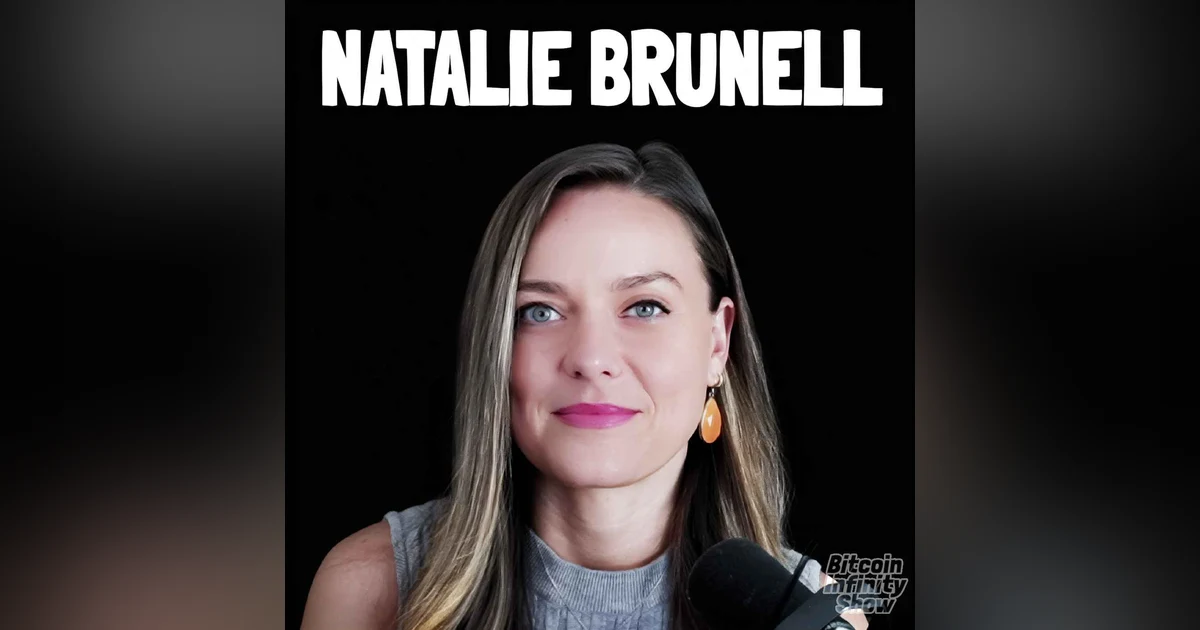
Bitcoin is for Everyone with Natalie Brunell | Bitcoin Infinity Show #180


 Fountain

 YouTube

 Spotify

 Apple Podcasts

 RSS Feed
Natalie Brunell joins the Bitcoin Infinity Show to talk about her new book Bitcoin is for Everyone, blending personal stories from fiat struggles to Bitcoin's empowering hope for skeptics and beginners alike. They explore sound money's role in ending victim mentalities, rebuilding confidence through literacy and Austrian economics insights, and why Bitcoin represents true capitalism and freedom for all. From inflation's hidden toll to Bitcoin 101 fundamentals, this episode unpacks how perfect money rewards value, competition, and long-term thinking in a world of weak fiat illusions.
Connect with Natalie:
Connect with Us:
https://www.bitcoininfinityshow.com/
https://bitcoininfinitystore.com
https://twitter.com/BtcInfinityShow
https://twitter.com/knutsvanholm
https://twitter.com/lukedewolf
Join the Bitcoin Infinity Academy at our Geyser page: https://geyser.fund/project/infinity
Thanks to our sponsors - check out their websites for info:
BitVault: https://bitvault.sv/ - Use Code INFINITY for 10% off!
BitBox: https://bitbox.swiss/infinity - Use Code INFINITY for 5% off!
Club Orange: https://www.cluborange.org/
Bitcoin Adviser: https://content.thebitcoinadviser.com/freedom
ShopInBit: https://shopinbit.com/bitcoininfinity - Use code INFINITY for a €5 discount!
The Bitcoin Infinity Show is a Bitcoin podcast hosted by Knut Svanholm and produced by Luke de Wolf.
The Freedom Footprint Show is a Bitcoin podcast hosted by Knut Svanholm and Luke de Wolf.
In each episode, we explore everything from deep philosophy to practical tools to emit freedom dioxide to expand your freedom footprint!
02:21 - Bitcoin is for Everyone
04:48 - Bitcoin Is Not Really For Everyone?
06:38 - What Compelled You To Write a Book?
11:39 - Jeff Booth and Lynn Alden
16:39 - Structure The Book and The Story
22:58 - Austrian Economics Books
25:37 - Capitalism for the First Time
27:36 - The Solution Without Comprehending The Problem
30:29 - Payments Layer and the Internet of Money
35:37 - Bring More People Into The Bitcoin Noah's Ark
39:48 - Bitcoin Change To Your Self-Confidence?
48:38 - Reading is For Everyone
51:31 - Original Idea or Thesis In Your Book?
01:07:03 - Where Can People Get The Book?
0:00 Now that I've written the book, my focus is actually going to be over the next year to put out a lot of Bitcoin 101 content, like the fundamentals, because it's great to talk about Bitcoin with the folks that are already orange pilled, but there are so many people we still need to reach. No one ever questions validity of money. They think money is real because they can use it to buy stuff and they don't think any further than that. I think it's a greater problem today that we can't take our hard-earned time and store that energy in something that doesn't get diluted and lose purchasing power. I don't know why as a society, we're so scared now of competition, right? I mean, it's like we have to level the playing field.
0:40 Everyone has to have a trophy. Everyone has to start on third base. Why? It's that meme, right? Like hard times create strong men. Strong men create easy times. Easy times create weak men. Think of how far we can go with perfect money that really rewards value. Everything's getting more expensive and lower in quality. And I didn't understand why until Bitcoin. Bitcoin is for everyone and Bitcoin is hope. Natalie, a warm welcome back to the Bitcoin Infinity Show. Great to have you back. Thank you so much for having me. It's great to see you. Likewise. What have you been up to lately? Oh, gosh. I mean, I wrote a book and it's finally coming out. So that's probably the most exciting update, I would say, and still trying to grow the show and educate as many people as possible.
1:26 Now that I've written the book, my focus is actually going to be over the next year to put out a lot of Bitcoin 101 content, like the fundamentals, because it's great to talk about Bitcoin with the folks that are already orange-pilled, but there are so many people we still need to reach. And sometimes it's a book that works. Sometimes it's a video. Sometimes it's a webinar. so I just feel like I want to get more involved in the 101 conversations again since I remember what it's like to be very new and skeptical and feel like I'm too late or you know there's something I don't understand about it and I'm trying to reach all the newbies. Oh that sounds great I mean Luke and I we see ourselves as conviction deepeners more than orange pillars so it's great that there are actual orange pillars out there too I mean and you've done a great job I think you've on the whole you've you've probably orange filled more people than most because you have such a large reach and everything. And your book is called Bitcoin for Everyone, isn't it? It's called Bitcoin is for Everyone. Yes. But there are so many people that came before me that are such great educators. Like I would actually say that Max and Stacey have educated more people than anyone the earliest, right? For the longest time. And I loved their show. The fact that they were actually, you know, on TV talking about Bitcoin when it was like $10 or something is so wild.
2:44 So I'm standing on the shoulders of giants. Yeah, aren't we all? And sometimes we're sitting shoulder to shoulder with giants. And that's absolutely amazing that you can do this in this space. I was on a spaces with Max and Stacey yesterday. Because I'm going to El Salvador next week for the historical thing. I so wish I could be there. I can't make it because I'm launching my books. I have to go to New York and I'll be there for basically that week. but I think it's going to be a great event. I'm so excited. I can't wait to see photos from it. No, it looks amazing. And yeah, Stacey mentioned, she was actually the first person ever to mention Bitcoin in any type of mainstream media. Yeah, I believe it. Which is just fantastic.
3:25 And this is 2011 or something like that. Bitcoin is like at 60 cents or whatever. Well, you know, and I give another shout out to Max and Stacey because when I went to my first conference with my best friend, Paula, It was 2021. I had just recorded a couple of episodes of the podcast, and I was still working full-time as a reporter. And no one knew who I was. And we didn't know anyone. We were really nervous going into the conference, but super excited to listen to the panels. And Max and Stacey were so welcoming. And they invited us to their event. And at that event, we met so many people who were orange-pilled by them through their shows. And they came in from all over the world.
4:07 and they were so grateful for Max and Stacey. And it was so sweet. And they've always just been so supportive and so great. And they're doing amazing things for El Salvador. So yeah, Max and Stacey are the best. We're lucky to have them. Yeah, absolutely. And I'm looking forward a lot to seeing them again and to return to El Salvador. I just love it there. There's an energy in that country that you don't find elsewhere, like this optimism everywhere. And I absolutely love that. So yeah, I've been saying lately on a lot of pods and stuff that Bitcoin is not really for everyone, but it's for anyone.
4:49 So what would you say to that? How would you debunk me? Well, you're not the first person from the Bitcoin community who has said that. And I kind of chuckle because I will tell you that if you're looking at a store shelf of books, it's probably more appealing for the average person who's not a Bitcoiner to read Bitcoin is for everyone rather than Bitcoin is for anyone. And it's kind of like, well, who are we leaving out there? I don't know. I mean, I do see it as for everyone and it's their choice, obviously, whether we can lead them to water. We hope they will drink. It's their decision. But there's no one that's excluded from the Bitcoin network and the Bitcoin ecosystem. If they want to get involved, if they want to invest, if they want to mine, if they want to participate, it's open to everyone, right? So that's why it's for everyone. And I really just feel like the message is so important today because a lot of people feel like they're too late or people think it's for one political party or another, or they're too old, it's too technical. And my message is just to not feel that way. The book is really a message of hope and empowerment that it's really early and all of us can embrace this new technology. And it's critical that we do, especially now with what's happening in the world. And it allows us to save for the future. And I think that that allows us to feel a sense of freedom and the ability to think more, right, about what we can do for one another and what we can do for our descendants and for our future. So it makes me really excited. Like the book has a very very positive message to it oh fantastic i i couldn't agree more and like i i
6:23 i've written five books at this point so so i have my my own version of what the process of writing a book is like but i have a sneaky suspicion that our processes are kind of different so so first of all what what what compelled you to write a book like what what what what's what's your driving force for getting this text out there? Well, I'd love to hear your experience too. I didn't set out to write a book. I was reached out to first by a book agent who is lovely. Her name's Maura, and she was already orange-pilled. She was a Bitcoiner, and she thought that there needs to be a very, very mainstream-friendly 101 book that can be published for the masses.
7:07 And my first reaction, which maybe some of the listeners are probably thinking, well, that exists already, right? Because I've read all the Bitcoin books. Some of them I've read multiple times. And so I was kind of like, they're already out there. And then I was approached by a publisher. And the publisher actually published one of my favorite non-Bitcoin books within the kind of business or finance ecosystem. And it's called Psychology of Money by Morgan Housel. So he found Morgan. And I love that book. That book was actually first given to me by James Lavish to read. And I don't know if you've, have you read it? No, I haven't read it, but I heard about it. It's one of those that are, that you see in airports, I believe.
7:48 Yeah, it's really good. It's sold millions of copies around the world. I'm like shilling this book instead, but it's really good. And it talks about the psychology behind investing and our relationship with money. And it has really interesting lessons and anecdotes from some people who are just average Joes, like for example, a janitor who just worked his whole entire life, this average nine to five job, but he was so good at putting away and investing that he passed away a millionaire and gave away his fortune. And it showed the power of compounding and just really interesting stories. And so when he approached me and he thought that there should be a Bitcoin book, the two of them with their support and encouragement, I thought, okay, well, why not? Why not give it a try? There are situations where I feel like I've given Bitcoin books to my girlfriends or family members and they don't get through the whole thing or they put it down or something loses them. And so I thought, I want to write a book that they will finish and sit down and have the same experience that I did when I read my first Bitcoin book, which was like, oh my gosh, how did I not know this? How did I not learn this in school?
8:58 Oh my gosh, this might be the future. I need to learn everything I can about it. And so maybe my book can be like an entry point for all the other great books out there in this space and the great content that's out there. Because for me, it all started with that. It started with a book and I sat back and I was like, oh my gosh, oh my gosh, now I understand the problems that exist all around me that I've been reporting on for like a decade. Now I understand why we're so divided. Now I understand why the prices keep going up. Now I understand why I can't afford anything. And now there's a solution that we can maybe get behind. And so that's the reason And I wanted to just share my voice and throw my hat in the ring and see if my book will help anyone.
9:39 I love that attitude because I think we need all of these different angles, right? And there's different approaches to explaining this thing. Because my books don't appeal to everyone. The Bitcoin standard doesn't appeal to everyone. So I love the fact that we had the fortune of helping Larry a bit with his book during his process. and Larry is a great success the book, he's doing great with it and he's doing great in general and going to DC to tell politicians that they're all thieves and that they should app off I love that Larry is doing his thing his way and I think he reaches a completely different audience than I do and I think your audience is completely different to Larry's or Seyfedine's or mine or anyone else's so I just love that we're getting more and more different angles, even though we're saying the same things, but with different words, I guess.
10:37 Yeah, but it's fun to see that once someone gets started and once someone reads one book, they tend to read them all, right? And like people have their collections and it's all the books, your book, Safe's book, Lynn's book, Jeff Booth's book, Larry's. It's just fun. And you're right. I mean, each book offers something so special and unique and some are more academic, some are more technical, some are more philosophical so yeah it's like it's great that we have so many of them out there yeah i know we both uh i talked to jeff in in uh yeah several times during the year i i had the pleasure of meeting him in in colombia and then later on in helsinki and he told me that he he talked to you about this book a couple of times and that you you got his input on it and like yes maybe a penny or two more dropped as they always do when you talk to jeff because he's so insightful right so oh yes he he had a great big impact on my life too and graciously wrote the foreword for everything divided by 21 million and helped me helped me put that together in a coherent way so i'd love to hear your story about that and what's what his role in this was yeah so i'm i mean i just i've always learned so much from every conversation and every interview that i've had with Jeff and he has such like a calm and positive way that he frames this world transition that we're going through. And so just being the longtime friend and mentor that he's been for me and how brilliant he is at explaining inflation and deflation. I just really wanted him to read
12:10 an early version of the manuscript and just offer me feedback. And so that's what he did. Lynn Alden also did that as well. She was extremely helpful because one thing too is I just, I wanted to be very accurate. And sometimes when you simplify things, you can lose the nuance or the details that might be important, right? And it's very hard to explain things like money printing and how the banking system works. People think Bitcoin's complex, right? When you break down how the dollar actually works and all the institutions and the money printing and the swaps and this and that between bank reserves, it gets very, very complicated. And when you try to simplify it. I wanted it to both be very approachable, but also very factual. And so it was really important to get feedback and make sure that I am telling it in a way that is simple and easy to understand for the average person who maybe has never been exposed to financial education or engineering or anything like that, but also doesn't lose the accuracy and the facts.
13:10 And Michael Saylor also read an early manuscript. So I'm just really grateful they all endorsed it and their quotes are on the back of the book. So very humbled and grateful. But the process was just, it was a really rewarding process for me because I've been a writer for so many years, but specifically I write scripts. And I mean, you might know this as a podcast host. Let's say we did our interview and then you transcribed it. It's like choppiness and filler words. And the way that you talk, the way you talk on TV or radio or a podcast is very different than the way you write a book. So I really needed some guidance and some help turning my script writing background into something that is eloquent and articulate on a page So that was challenging but in a very very rewarding way And yeah, I mean, it's hard because it was so hard to squeeze in everything I wanted to in like 200 pages.
14:08 Because Bitcoin is, you can write about it for a thousand pages, right? But I wanted it to be as digestible as possible too. Yeah, I mean, the way I see it, writing makes you a better speaker and speaking makes you a better writer. Like they fuel one another. Writing is a very good way to find a coherent thread. Like thoughts without writing them down are sort of like they're all over the place. And you sort of can connect the dots in your brain, but other people probably can't because you have no way of communicating how they all fit together. When you start writing it down, you sort of get this narrative structure or whatever it is, like coherency.
14:49 Is that a word? You get a coherent version of what you think about things. And it's very good for expressing yourself in other ways, too. 100%. I came from writing songs. I think that's the first thing I wrote, and song lyrics. And then that turned into tweets. So when I quit the last band I took seriously, I sort of needed other ways to have my creative constipation solved. So Twitter played a huge role because the thing I loved about that in the beginning was that the fact that you had to condense it to 140 characters, which made me like, it's like boiling, it's like a beef broth.
15:36 Like you have to boil it down to its essentials and you cut out all the fluff, right? so you so that helped me a lot with my writing i think like initially and then but but i'm curious about your process in general like since you were approached by other people to write a book so so you get this task and then you do it but how do you do it like how do you find the time to write and how do you find a way to focus on this thing and not get distracted like what's what's your process well that's why it took me a very long time i mean this book has been years in the making because you are, you're busy with your full-time job. And I think what helped is because my job is Bitcoin, I'm constantly reading about it, writing other people's work or reading other people's works, talking about it. So it was always front of mind. So it really honestly started with an outline. I had to kind of decide how I was going to even structure the book and the story. And for me, that was a really exciting process because I felt and I have always felt that until you understand the problem, you're not going to appreciate the solution. And so I really wanted to have a clear story arc. That's something that I really embraced in my TV journalism life.
16:51 And as an adjunct professor, I always believed a story arc has to be there. A strong kind of you know, something that pulls you in and it takes you down a journey and there's some sort of crisis or conflict and hopefully a resolution and like it takes you full circle. So my book starts with really kind of taking the reader by the hand and saying, okay, we know that something is wrong. We can both acknowledge something's wrong. Let's talk about the symptoms of the problem and let's get on the same page, no pun intended. And then I break down, how did we get here? What is the problem? So obviously, there's something broken in the financial system. Well, what is money? How does the financial system actually work? And so I go through that.
17:34 I explain it in a very, very, very simple way. And then by the time I get to Bitcoin, which is not until chapter 10, you're very primed to appreciate the properties of good money and what can allow us to save for the future and can allow us to, I think, be kind of better humans to one another, if I'm being honest. I mean, part of the book is also about your time preference and being able to dream bigger and being able to hope and what that brings out in one another to be more cooperative and be more productive. And it talks about, obviously, the human rights angle of Bitcoin, which I think is so appealing for so many people and was the thing that got them interested in Bitcoin in the first place. And then it ends on a very positive note of hope. So that's the journey that I really wanted to go on with the reader. And it was fun just kind of testing my own knowledge of how do I explain things like money printing? How do I explain fractional reserve banking and the history of money and how we went from the gold standard to the dollar and the dollars of reserve currency and how that's helped us in some ways, but also hurt us. So I take you through all of it fantastic and uh i love to hear this because it's so similar to to my process and i i i in my mind for some reason i thought our processes would be very different but for instance in the inverse of clown world the uh after after having written sort of the bulk of
19:06 the thing at some point i realized hang on this is like joseph campbell's hero's journey structured sort of but the reader is the hero so like i can structure the book in this way and like make it an actual hero's journey and just follow the steps and that sort of fill in the filled in the blanks for what what other chapters were needed yeah so so so then it became easy to write the the rest of the book because i knew what pieces were missing exactly so and and also this you say that you're like i'm curious how i would explain this or how i would explain that a lot a lot of the stuff especially in my older books, I just ask myself a question on top of the page and then just try to explain it as well as I could. To me, that's a very good writing process. And yeah, I usually write in the mornings before the rest of the family is up because I know that I'm not going to be interrupted. Not only do I not get interrupted, I know that I'm not going to get interrupted. And that's important to me to stay focused. How do you stay focused? Like, turn off all notifications and like, are you in a dark room? Like what do you do?
20:14 Yeah. I mean, that's one of the toughest things, especially with all the stimulation we have with our devices and social media, because it's, it really is important to focus whether you're reading or writing, you just have to have some quiet space. For me, I'm a really big note taker. So I have, I wouldn't be able to even count how many binders I have. I take notes on a lot of things. I've taken notes. People make fun of me for this, but even the Bitcoin books that I've read. I mean, if you took out my notes for the Bitcoin standard, it's probably 30 pages worth of notes. So I would take my notes, my binders out. I would go through notes. I would look at things that I've learned and observed. I save a lot of things. I'll write notes in my phone, or I'll screenshot things that I thought were really interesting. And I save everything. And then I go through it later. And I think it helps me just kind of distill it into sort of how I best understand it or would want it told to me or explained to me. So that's been really helpful.
21:14 And I mean, to your point, it's like, I mean, for me, I feel like I did a lot of work on weekends, like a lot of work on just weekends or late night, because during the day, things are super crazy with my regular work. It's hard too when you're traveling. I think that when you're working while traveling, it's just, it's so hard to not be distracted because something's always going on and hotels are not that great to work in. And if you're not in the hotel room, then you're in a loud lobby or coffee. Like there's always distractions, right? So I'm not my best worker when I'm traveling. No, same here. I would say I can't really work while traveling. Like I never understood how you can work in airports, like tasks that are like, for lack of a better word slightly retarded okay i can do them in airports but i couldn't be creative in an airport it just doesn't work like so i i usually take long walks to get the ideas for for for books and stuff do you do that at all i do some of my best thinking on walks and drives totally like i actually i love long drives because i just your mind goes to places and i don't know if you've experienced this but all of a sudden you get somewhere and you're like i don't even remember driving here i was so no zoned out thinking about something no i i love that and then i'm also slightly scared of it because i don't know who was driving the car it's all about reclaiming the driver's seat of your car and then you don't even know who's driving so that's the irony of it so so let let's get into the meat of the book a bit more like did you read
22:46 you said you read almost all the bitcoin books over and over again and took notes and blah blah did you read Austrian economics books as well yes like yeah yeah which ones oh gosh I mean I went down a whole rabbit hole probably probably a year after I read most of the Bitcoin books where I mean obviously it's like people like Seyfedine introduced me to Austrian economists that I had never heard of and I'm so sad that I didn't hear about them in school because I find their work really fascinating. So Rothbard and Hayek and Mises, you just go down the rabbit hole and start reading those books. I've really liked the works of Thomas Sowell as well. I mean, he's not an Austrian economist, but the way he explains economics, I've personally really found value in.
23:33 I read books like Economics in One Lesson, Anatomy of the State. Some of the books were tough. Some of the books were not easy to read. But because I think I had the framework from the Bitcoin books, it was easier for me to follow them and to really understand why there's such an issue with central planning. And I mean, if you would have asked me like 10 years ago, oh, you know, what do you think about Keynesian economics? I'd be like, I have no idea what you're talking about. Or Austrian economics. I'd be like, is that economics that they teach in Austria? I have no opinion, right? But it's so incredible that when you do read those works, it helps you frame the way that we've kind of oriented our lives within these economies around the world and how money has always been manipulated in some way. And someone has always had the ability to inflate the money supply.
24:24 And that has always had second, third, fourth order effects that have impacted humans and especially the working class. And we just kind of like go from one fiat currency to the next, and it rolls over in hundred year cycles. And what if we could have something better? Because obviously, if I learned all of this, but there was no Bitcoin, I would probably be a gold bug. And I would probably say gold is our best solution. But it has this inherent flaw that Lynn, I think, does such a brilliant job in Broken Money of framing it as a technology issue and how technology advances. At some point, you can't scale gold. You have to paper over it and abstract it because you can't send it across the world and have it settle.
25:07 You can't easily verify it and transport it. And that settlement part is so difficult. So you have to paper over it, essentially. And that leads to all of the issues that we've had, especially when you lose the gold tether entirely, which we did, right? So it's like Bitcoin solved for that. It solved it. It made money perfect for the first time. and it allows us to have capitalism for the first time. And I think that that's also so important. And that's what changed my point of view really on capitalism, especially because, and I've shared this, you've probably heard me say it on other shows. When I was a reporter and I had just started my career and it was after the great financial crisis when my family lost everything, I was not for capitalism. I associated it with the problems that exist. And I thought that we have to have a way for the government to check greed, to check our worst impulses of greed.
26:07 And I thought that capitalism was the root of a lot of problems. And I hear that now so much. And I'm like, whoa, whoa, whoa, wait, I don't know if you know what capitalism is, right? And that's one of the things that I think the Austrian economists really taught me was to understand what capitalism is and appreciate the fact that we've actually never lived in a world with capitalism, not real capitalism. We've gotten close maybe sometimes, but it would be a great world if we had a capitalistic form of money like Bitcoin and we allowed true value to rise to the surface and for value to accrue where it was originated and not because someone's close to the money printer apparatus. No, exactly. I mean, you always hear this phrase, that wasn't real communism or real communism has never been tried. Well, it has. That's the thing that has been tried the thing that hasn't been tried is real capitalism totally yeah because we've always had central banks or the equivalent of them even when we didn't have central banks there the bankers the private bankers were also giving out more receipts for gold than they had gold in their vaults so we've we've had that problem for thousands of years there's a great book by my norwegian friend uh rune ostgård called fraud coin where he describes like how this coin clipping and stuff was going on like a thousand year, thousand BC, like up in the Nordics.
27:30 And it's always been there. So it's just this. And I think that is, as you said before, like it's very hard to, ironically enough I was just on another pod saying the exact same thing Like it hard to understand the solution without first comprehending the problem Right And I think this is absolutely the biggest hurdle because no one ever questions validity of money They think money is real because they can use it to buy stuff. And they don't think any further than that. They think, no, what are you talking about? The money is fake. It obviously isn't fake because I can buy things with it. And the thought never goes anywhere from that point.
28:13 And the whole medium of exchange, yeah, this is a pet peeve rabbit hole here, but I don't like the term store of value since value is subjective and dynamic, as we know. So I think the whole store of value medium of exchange dichotomy is false. and is created by this, that gold was a good store of value and fiat was a good medium of exchange. It's sort of the dichotomy isn't really there when you have perfect money because it's medium exchange over time and space. Either you trade with your future self or other human beings. So one is over time and the other is over space.
28:56 And I think thinking of the two as separate is very dangerous. And that's why we get a lot of these fiat narratives around, we need to use Bitcoin as this or that. Well, both use cases are equally valid. And who's to say how many transactions are natural? I think in a Bitcoin-denominated world, we will have much more subscription services and one-time payments. And it's very anti-micropayments, really, if you think about it. Micro payments are a very fiat-y thing. Paying, putting a coin to, paying a couple of cents to get into the bathroom in a central station somewhere.
29:38 To me, that's a very fiat-y thing. On a Bitcoin standard, I think we'll have fewer payments in general. What are your thoughts around that? Well, I think we've never had a form of money that perfectly serves both of those use cases, right? I mean, because gold did store value well, but you can't transport it over space very easily because of the issues that we raised, right? Because of its physicality and it's very difficult to transport and settle. Paper money allows you to do that, but it doesn't store, I'll say, purchasing power very well, right? So the fact that you have both, I think, is so incredible. I explain in the book, I go into both, right? I talk about Bitcoin as a network and as a payments layer and as the internet of money. And I try to explain that simply.
30:23 but I start with the store of value aspect because I think that is the more pressing problem. I think it's a greater problem today that we can't take our hard-earned time and store that energy in something that doesn't get diluted and lose purchasing power. That to me is the critical thing we need to address right away as opposed to a lot of people regardless of what country they're in and what they're actually spending. The payments problem is not as pressing to me as being able to store your money in something that restores its purchasing power. However, again, with Bitcoin, you get both. You get both of the best worlds. My only approach to this, though, is that the payments aspect is the one that is more threatening to the institutions, to the banks, to the governments, right? They want to be able to print money and they want to be able to tax and they want to be able to maintain as much control as possible.
31:20 And I feel like as Bitcoiners, we will accomplish more of the world that we want to see sooner if we usher it in as a Trojan horse and usher it in slowly and politely and kindly, as opposed to getting in the face of governments and banks and saying, screw you, you're all going down. We're taking over. We don't need you, right? You attract more flies with honey. And I've really just taken that approach because, yes, Bitcoin is the perfect payments network. But we live in a world where there are some established monopolies and we want them to become Bitcoiners. I think everyone will become Bitcoiners eventually.
32:04 And I think it's easier for us to share our message with the world when we do it in a way that is understanding that things have evolved in a way that's behind walled gardens. And to break them down, maybe we don't need nuclear weapons. Maybe we can knock on the door and ask to kind of work together. And maybe that's like rose-colored glasses. But I don't think that we get as far when we say very, very dramatic, hostile things to the institutions that exist. instead of just being like, they're going to need us. And we're here and we're ready to educate them. And we're going to start using this and we're going to fight for our ability to use it and fight for our freedoms and fight for our property rights. But we're also not going to say like, burn it all down. Because I do think that there are good, good people that work in these institutions that just don't understand yet, or they're not incentivized to understand it yet.
32:58 But eventually they will. Eventually they will. We can, we can build a better world and the incentive system is there to transition us to Bitcoin. I just don't think we'll get there as quickly and as in a world that we want to live in and a transition that we would want to go through if we're just going to like go to war with everybody. No, I absolutely agree. A diplomatic route is probably a better one, even though I bash politicians all the time and stuff and talk shit about banks but it's mostly for fun i mean i'd say individuals is the key word there because all these institutions and all the states and all the institutions all the corporations they're made up of people so every single person in these institutions is a potential bitcoiner they're basically pre-coiners all of them and we can orange pill all of them and only an individual can actually own a Bitcoin.
33:53 Only an individual can actually self-custody a Bitcoin. And they're not there yet, but they may be at some point. And if not them, then they're descendants. Like we're playing the long game here. Absolutely. And sometimes you see these public figures and they're speaking on behalf of a very, very powerful institution. And you know that maybe you disagree or you don't trust what they're saying. If you had the ability to sit down in a closed room with that person and actually have a heart to heart with them, I feel like you can get on a human level, a better understanding of where they're coming from, what their experience is, if they're willing to listen. Like that's actually really important, right? Because sometimes I think what gets frustrating for us Bitcoiners is we want to have these conversations and we want to reach out and engage.
34:40 And oftentimes it's like the hand is stuck up to us and it's like, no, we don't want you at all. I feel like if these people sat down with us, whatever, you know, ivory tower they're sitting in and they had a real conversation about value, about time, about money, about opportunity, about freedom, they would probably be on the same page as us. They would probably feel and value the same things as us. And so I feel like that's like, how do we do that? How do we reach people in that way as opposed to all of us just like throwing, you know, insults publicly and we divide ourselves in teams and nothing gets said. We just talk past each other all the time. And that's what worries me because like we're missing them and they won't pick up your book.
35:21 to read it right they won't they won't watch your show because they just assume things about you and i just wish we would do things that would encourage more dialogue and conversation because then i think we would bring more people into the bitcoin noah's ark yeah yeah absolutely have you read 1984 by george orwell yes my favorite part about that book is the ending where there turns out that there is no big brother it's just the system that makes makes the and i see a lot of conspiracy theories thrive within the bitcoin space like people people tend to and i like the diversity of ideas don't get me wrong here and you shouldn't trust the science too much but but in the bitcoin space there's there's a lot of people who have this or that conspiracy theory to cling on to and that this is obviously an evil schemer doing this or that.
36:14 But I think that Orwell was right. You don't need the evil mastermind in the lair. You just need the flawed system to make the incentives in such a way that we end up chasing money and we end up in a skyscraper somewhere and we're really feeding the beast without knowing that that's what we're doing. And as you say, if we sat down with these people, I think we could get on the same page easily. People don't know that what they're doing is fueling something evil. I don't believe that. I agree. I always question, especially when I see leaders do some of the things that they do, is it ignorance or incompetence or is it malice?
36:58 And I do think there is, I'm certain there are people out there that are bad and evil, but I don't think it's as many as there are just people who are ignorant to what we now know and maybe incompetent. And sometimes incompetent people get to pretty high levels of power, unfortunately. Yeah, no shit. Like we have a system that doesn't reward competence or merit or value right now. We have a system that rewards people who are insiders. And I just think that that's one of the best aspects of Bitcoin. I don't know why as a society, we're so scared now of competition, right? I mean, it's like we have to level the playing field. Like everyone has to have a trophy.
37:40 Everyone has to start on third base. Why? I mean, I feel like one of the reasons why I've reached a level of confidence and the ability to endure difficult things is because I've struggled in the past and I've seen my family struggle and it has built character. It's that meme, right? Like hard times create strong men. Strong men create easy times. Easy times create weak men. And I think that sometimes people get into this fog of like, I'm a victim. You owe me some of what you earned. You owe it to me. Well, it's like, no, maybe not. It's not that I'm a get... I feel like charity should come from the private sector. And I actually think that we would be more incredibly charitable if we didn't feel like someone was taking from us all the time, right?
38:28 Because when I'm getting taxed, I'm just like, where is this even going? Where's this going? I don't see the value for this. Now, do I want to help my neighbor? Absolutely. But I have a personal relationship with my neighbor, right? And I want to help them and I want them to succeed and I want my community to succeed. But when people are just taking from you or saying like, you owe me, I think it creates resentment from people. And I think just in general today, the fiat world has put so much downward pressure on the average working person where they play by all the rules, they do everything right, they work really hard, and they're still behind. And so, of course, they're like, this is unfair. And they get into bad moods and they might resort to things that are more aligned with short-term thinking or with things that aren't maybe like positive actions within their communities because they're just feeling so desperate. And I wonder if we had a sound money at the core of our system that encouraged us to provide value and to be of service to one another and actually be rewarded for that properly in a form of money that actually accrues value over time. How many wonderful things can we achieve? I mean, we've gotten this far with imperfect money. Think of how far we can go with perfect money that really rewards value. That's the world I want to envision and try to build.
39:48 Yeah, the thesis with hard men create good times and hard times create good men and so on and so forth and good women. I'd like to ask you, did Bitcoin do anything to your self-confidence? Because it certainly did to mine. like it it changed my the the saying is if you don't believe in yourself no one else will and there's power in that i think so so what what's your journey there like what's your experience with i mean you seem like you were pretty confident before bitcoin too so so like what what would you say to that oh god i mean i could write a book about that i feel like the journey of confidence is one that is very layered and and a little bit like a roller coaster I'm really lucky that I had parents that tried to instill as much confidence in me when I was young.
40:46 I really did grow up believing in the American dream. And to me, what that means, and I share this in the book, because to me, the American dream is actually something very universal. But we call it the American dream, which is that you can come from anywhere, any background. And if you work hard and if you're a good person, you can achieve anything that you want. Like that possibility. It's filled with hope. It's like, if I do the right things, if I work hard, if I get that education, if I, you know, X, Y, Z, I can achieve my dreams. I loved that feeling and that possibility because to me, it gave me motivation to work hard.
41:27 It gave me motivation to strive. And for me, I really wanted to make my parents proud. I wanted to justify the sacrifices that they made for us to be able to come to this country And then I felt like I started to lose maybe not confidence in myself but just confidence in the system right I mean after the great financial crisis, I was like this, no matter, I could play by all the rules and I could be a good person and I could still end up with none of the things that I really want. And it just gets harder and harder. And I'm on this treadmill that just keeps getting faster. and I don't know what to do. And I looked at the future with one as one of, you know, not having a lot of hope.
42:07 I don't know if I can afford a family. How am I going to retire? Where should I live? Can I get a house ever? So I feel like that definitely hurt my confidence. And working in news as a woman, it's not easy for sure. It causes you to have a thick skin because people are very, people say things behind screens that they might not say if they're standing right next to you and to your face. So that was challenging for sure, because especially as a woman and you're working on a public-facing medium, we all have our insecurities, especially about our looks, things that maybe no one knows. But sometimes they'll email you or tell you or DM you the very thing that you're most insecure about.
42:48 And they'll be like, you're this or you're that. And it sucks. And it sucks to read. And it hurts. And you try to remember that that's not what matters. It's your character. It's your mind. It's your thought. It's your kindness. So I went through my own journeys with that as well. And then when I entered Bitcoin, I lost a lot of confidence in the sense that I realized I knew nothing. I knew nothing about money. I have to learn all of this. There are people that are so brilliant for me to be able to even interview them or talk to them. I have to put in the work. You know, I got criticized. And I think that that, again, I struggled, but it helped. It really did. All the feedback, especially the criticism, which you tend to listen to more, right? You hear a compliment and you're like, thanks, whatever.
43:29 But like the criticism, you're like, oh my God. And that helped me too. It pushed me. It was like, okay, Natalie, you really have to put in the work. You really have to read these books. You really have to pay attention. You have to watch things. You have to read when they make these, when they put out legislation, like read it. Take the time and read it. Just read it. And it challenged me in a really constructive way so that I did feel more confident. So by the time I was able to go on things like news programs and talk about Bitcoin, I had gained a little bit more of that, you know, my legs underneath me to be like, I do know what I'm talking about and I want to share it with you. I don't know everything, right? And I could still be caught kind of deer in headlights. But the stuff that's really important, I feel like I can communicate. And it's always a journey because there's always something to learn. And some questions are challenging and facing people that really are against Bitcoin. It can be tough. It can be tough because they'll ask things and if they're so convinced that they're right whether it's about capitalism or energy or this or that sometimes it takes a bit to really try to weave your way through the arguments now a lot of things to unpack there you mentioned family and the american dream or parents i know my my dad had this he could never be wrong about anything it was that kind of boomer you know that and it some of that uh spilt over to to me and my brothers like we used to play a lot of trivia games and stuff and like it was very if there was something we didn't know we immediately looked it up because we didn't want to he put it like i don't want anyone
45:03 to be able to ever sit on me and like lecture me about anything i want to know everything like be more well-read than anyone else in the room and that sort of caught on i hope if maybe maybe not to a big enough extent but but also like what you said about the american dream being universal I totally agree with that. And I think people who believe in themselves to that extent, that if you work hard and you're motivated, you really can get as far as you want, regardless of where you're born. You can just move and do the things. And it's the literal opposite of the victim mentality. It's the inverse of the victim mentality.
45:46 Like, I'm not going to be a victim. I don't care if I lose my legs to a landmine. Like, I'm still not the fucking victim. I'm going to fucking win. And I love that attitude. And if everyone had it, we wouldn't have any problems in the world, I think. Like, because everyone would be working hard for everyone else. And trade and everything would be fine. Well, and you brought up something important. You know, we are all built. We all come with, like, different skill sets. We come from different backgrounds. We can't choose where we're born or who our parents are. But today especially, most people around the world have one of these.
46:26 It's actually the statistics of how many people have phones, have internet phones around the world was shocking to me because I thought it would be maybe lower, right? But it's literally billions of people have access to more information than generations ago, like the highest of society did. Yeah. anyone can start to learn. And I feel like reading is something that is undervalued and underappreciated. Like reading teaches us so much, being able to critically think, and you don't necessarily even need school in order to start to do that and start to learn. And it makes me sad when I see the statistics of just about literacy, because you can talk about financial literacy. That's one thing that's like on a higher level, but just literacy in general, like a lot of people can't read past a certain elementary grade level. And you can't achieve very much, I think, in life if you're not a reader.
47:21 And anyone can do this. I feel like that's what is kind of a leveler. If people want more equality, it's like, well, I do think that everyone needs an opportunity to get an education. And we do have that. People can start to learn skills and trades and history and start to critically think. And And that's the base layer for me in terms of education and knowledge. And I just wish more people appreciated that because that would help so many things in society. I feel like if we had a more informed public that cared and that read and paid attention to what was happening, then we would have a public that might, you know, fight against something like tyranny as opposed to be led like sheep into the slaughterhouse.
48:10 And that's, I think, something that Henry Ford called out, right? Like if the people understood how the banking system worked, we would have a revolution by morning. Revolution before dawn. We don't. Before dawn, yeah. And you might be born the tallest and the most beautiful and the best, you know, primed to be the best athlete, but maybe not. But all of us can start to work our minds and read. I feel like that's a muscle that we can all use no matter where we are. And I just, I wish more people would read. Maybe you should write a book called Reading is for Everyone. But then again, the people who couldn't read, couldn't read it. So it would be kind of redundant. Anyway, yeah, I think it's a huge problem that people compare themselves to their peers, right?
48:53 Instead of comparing themselves to their past selves, which is all that matters. like if you're gonna compare yourself to anything like am i doing better today than yesterday like that's that's the only thing that matters like comparing yourself to others it's just completely it's a red herring at best like it it will give you no greater satisfaction with your life because there's always someone taller someone more beautiful someone more athletic someone smarter someone wiser you you can't like but i mean if if you compare yourself to your to your previous self though you can you can certainly see and if you have one set more than last year you're an absolute winner yeah yeah yeah and the most interesting people i've met are honestly the most well-read people like and and you can see it in our space too when you talk to some of these amazing minds, you're like that person, like Preston, Preston has read every book under the sun. Michael Saylor has read every book under the sun. When you talk to these people, you know how much they've explored. And it's not just been in their own ecosystem of what they believe just to reinforce whatever. No, they've branched out into all sorts of different areas. And You know, like Lynn loves sci-fi.
50:17 Preston loves reading about the brain. Like, it's just so cool that people are interested and explore and learn. And I think learners, like lifelong learners, are the most interesting people. Yeah. I mean, having an inquisitive mind can be annoying at some times because you need to look everything up and be like, maybe sometimes you're too curious. But it's also very rewarding. I mean, how else? better than watching kim kardashian yeah yeah i i wouldn't know how to not feed my brain with information at all times i don't know how people do that there's always something running in the background and sure i mean we all have our different areas of expertise and no one can know everything but my dad always used to say it's better to be a complete idiot than uh uh there's no real good english word for this but it's like an idiot within your your specific field that that only knows one thing it's better to be a complete idiot than the idiot so only knows one thing yeah yeah i tend to agree yeah so so is there would you say that there's anything in your book that is your like original idea like a thesis that is you don't find in other bitcoin books that's a good question i mean i i think that one thing that i wanted to share was just a little bit of my personal journey into this whole space because i relate to so many people who are
51:56 struggling today and who are skeptical about Bitcoin. And I tried to just demystify all the things that I worried about when I was first entering the space. So it's not so much that I guess it's very new, but just that I tried to make Bitcoin something that anyone feels like they can be empowered by and that it doesn't matter what they studied. It doesn't matter what their job is. And it doesn't matter how technical or not they think they are. It's something that really they can take seriously and embrace and start to learn at this point. It's just like a very welcoming book. And as far as... I mean, everyone has their own way of kind of explaining inflation and analogies. I hope that people find something new in the analogies that I make. I have analogies to inflation and I use the Monopoly game as a reference and just different things that hopefully will help people. I use different analogies when it comes to learning about Bitcoin mining and the difficulty adjustment. So maybe there's something new, but I don't know. It's just, I feel like, I feel like Bitcoin's a lot of, a lot of the same things just said a little differently.
53:05 A couple of funny asides here about the Monopoly game. Like, like if you have one of the first 50 editions of that game that was ever printed, the dollars in the, the in-game dollars are worth more than real dollars no way yeah i believe it it's just it's just insane and and also the the fact that the rules of monopoly explicitly say that if the bank runs out of money just write down numbers on pieces of paper print more money oh yeah i love it like it's it's it's so there are so many lessons to be learned there i know well this isn't related to monopoly but i actually just read today that early lego lego toy employees once they hit i don't know if it was five or ten years with the company they were given a lego block made out of 24 karat gold and it was almost an ounce and now each one is worth so much yeah not funny yeah i can imagine like yeah and lego lego is just used to be a very small company from a very small village in denmark yeah they they in Denmark there's I don't know how many inhabitants they have now but Lego started it's just a couple of thousand I believe so I like pretty cool pretty cool story yeah I like I love Lego yeah I so I grew up with an older brother and he's quite a bit older than me and so I always wanted to I always wanted a reason for him to want to spend time with me
54:39 right so I wanted an excuse to be close to him so I wanted to play with his toys I wanted to watch the movies he watched so i'm so into like his generation of movies and music and i'll never forget he had legos and i i would play with them even though it wasn't like i guess i loved my dolls too but i loved his legos because i was like oh i want it i want to be cool like my brother and you know lego is a good bitcoin analogy because it's backwards compatible it has never been hard forked like it's always it has only been soft forked that's true they're all those golden Legos, a modern Lego would attach to it. Yeah, that's true. And the word Lego, it's Danish, it literally means play good or play nice. Oh, really? I didn't know that.
55:26 That's cool. Leg is like child's play and go is like Oh, that's cool. I didn't know that. See, I learned something new. No, Legos are fantastic. They're getting more expensive though, when you see them in airports and stuff, which is, I don't see Legos very often, except for in the airport. I mean, when the kids were younger, they played with them, of course. And I remember my son could just sit for hours on end and build something and it's beautiful. Everything's getting more expensive and lower in quality. And I didn't understand why until Bitcoin. No, because you were using the wrong denominator. And if you're using the correct one, you can see that everything is actually becoming more cheap, like becoming cheaper every day.
56:12 Just have to view the world through the correct lens, right? Yeah. Yeah. So we've chatted for about an hour. Is there anything we haven't talked about that you want to talk about? Like, can you think of anything? i see your beautiful youtube placard there behind you what is that like 100 000 subscribers or what is a million views 100 000 subscribers yeah where i mean the next plaque up it's a big one it's like a big jump they give you one and i think a million after this so it's far as far away i have like 220 000 subscribers but it was such an honor yeah when i got that i mean i believe me i never i never set out to be a content creator. I didn't think it was possible. In fact, if anything, it was kind of like I probably saw it the way so many people see Bitcoin. I was like, well, I'm too late. All the podcasts are out there. All the YouTubers are already doing their thing. I just started my podcast just for fun and as a hobby. And I would have never in my wildest dreams thought that I could build something that means so much to me that feels so special and where I feel so rewarded.
57:18 And I'm so grateful. There's so many things that Bitcoin has given me that I never expected and i'm just so grateful no i'm well deserved like you deserve all of it like you really put in the work and you have a unique you have unique communication skills that most people in the bitcoin space are like light years away from most people and i have a theory that the earlier you were into bitcoin the more disagreeable you were so so you're like so in the beginning in the beginning, you get your Greg Maxwell's and your Nick Sawas and stuff and your Luke Dashers. And further along, like you get slightly more agreeable people and you get my generation, which is still kind of disagreeable, but slightly more agreeable. And then as you go further, you get your Natalie's and your Joe Nakamoto's and stuff that are much more agreeable and much better at communication in general than the early boys. And we sort of needed them to get this don't trust verify attitude into our minds.
58:23 And then we're the ones that are now a decade later, or I'm not in the, I'm sort of in the middle, but people like you can communicate these thoughts to other people. So I think it all serves a function. It's the vision of labor. It's how it's supposed to be. Well, I appreciate that. Yeah, I mean, I always wanted to be a storyteller. I did, and I share a little bit of that in the book. But it was interesting too because when I was working in media I never thought that TV would be disrupted by the Internet I would have probably studied something different just because there was so much change in the decade the 2010s in terms of just Facebook all of a sudden And Twitter and citizen journalists and everyone starting their own shows.
59:07 That's something I never, ever anticipated. And I think a lot of people didn't either. But it's so interesting to now look back because it's like fiat does put you in this frame of mind of just being a good soldier. You know, nine to five, work your job, get your 401k, just don't think outside the box. And it wasn't until Bitcoin that I realized I could kind of specialize in something and that that would be marketable. And I can take my background of communication and storytelling and apply it to this passion that I have that I think is so important and is an incredible mission. And I could create a business out of that. And that's what... So I really like... I use my story just to encourage people because I think everyone has something that they're really passionate about and maybe really good at and they can apply it to Bitcoin and serve the community and serve the mission of educating people.
1:00:00 And we just need so many more people to share this message with the world. Yeah, and the Bitcoin is money. You can use it. You can exchange it for every other good and service in the world. So start accepting Bitcoin for your goods and services and then you're in the game. This reminds me, another funny coincidence here. Like the, I, I was in high school when the internet started taking off right around 95, 96, something, and you get your Netscape navigators and, and all of this, like internet is new. Google is not there any yet. There is no social media or anything. And I sort of saw this. I remember like thinking, holy shit, all the computers in the world are going to to be connected now this is this is like gonna this is gonna change everything but not acting on it because you're you're a confused teenager like lazy and not really knowing what to do with your life so i didn't go into computing or or programming or anything even though i i i made little computer games and stuff as as a child and grew up with my commodore 64 and and did all these things but then pursued a different career and walked in my father's footsteps maybe and like studied to be a sea captain instead at some point i started studying electronics engineering but i was so tired of school that i chose this other path and when bitcoin came along like 20 years down the line i i had that same feeling again like i saw something that was going to change the world
1:01:33 but this time i was not going to miss the fucking train i was going to act because nothing will stop this train as you as we know so so i had to get on this specific train now i was not going to miss my shot this time like here i have asymmetric information i know something that i see something that other people don't can you was that a similar of course my story is different from yours but did you have a similar feeling when you when you when you saw it like what why aren't anyone else why isn't anyone else seeing this thing well i definitely feel that That way in terms of just my peers and the people I used to work with in news I think it because I reported on all the problems so closely So I was in the middle of the problem every day And my specialty like the thing I loved to do journalism on the most was public corruption investigations.
1:02:30 I was just like, I want to hold these people accountable. I just, it really angered. Corruption really angered me. I don't know why that was like my thing. That was my beat for most of my reporter jobs. And so it's like I saw the problem so clearly, and so many of my colleagues did too. And when I saw Bitcoin, when the veil was taken out from over my eyes, I was like, oh my gosh, this is why the problem exists. This is what the problem actually is. This is a solution. Hello, everybody, look, look, it's this. And I think it's what's wild to me is that people who have looked at Bitcoin a little bit could be like, no, no, this is like nothing.
1:03:12 I don't need to pay attention to this. And that's what I've experienced because obviously I do have people, not all my friends, because I've certainly gotten a lot of my friends into Bitcoin, which makes me really happy. But there's definitely been people that I've worked with or that have been in some of my life experiences where I've shared the message with them and they still dismiss it and they think I'm crazy or something that I've devoted my life to this. And I'm like, how do you not see this yet? I don't know. So maybe my book will help. I'll send them my book. But yeah, it's just sometimes shocking. And yeah, to your point, I didn't want to miss out because I feel like this is so positive. I spent the last 10 years reporting on the worst sides of humanity, everything from corruption to mass shootings to just the worst things.
1:03:57 The news van doesn't show up unless something terrible happened. And Bitcoin gave me such positivity, like such hope and this ability to think that things are going to be so much better if we just embrace this as opposed to a world where we just keep fighting and we keep feeling divided and feeling like we're not valued. and that's why i think it's so important to teach people because i don't i don't think people are bad maybe there are some bad apples out there but i really think that at the core people are just frustrated resentful they don't know what to do they're blaming themselves they're they're in victim mentalities and they need hope they need empowerment and that's what bitcoin represents yeah bitcoin is hope i mean it's it's 100 true i i uh rewrote the praxeology book uh a couple of months back and re-edited and made it more into a textbook.
1:04:53 And I added three more chapters. And the last chapter is called What's About the Roads? And in this chapter, I use the Shawshank Redemption as the analogy. So you've seen the movie, right? I haven't. No, it's on my list. I need to see it now. So anyway, the movie is about being institutionalized, basically. So they're prisoners and there's this guy. The protagonist is called Andy Dufresne, played by Tim Robbins. and his best friend red is played by morgan freeman and morgan freeman warns andy that hope is a dangerous thing because all it will lead to is you being disappointed and a miserable life and there one of their friends another inmate gets out of prison at 90 years old and he hangs himself two weeks later because he just can handle the outside world he used to his three free meals a day and every every rule and stuff and uh while the story is playing out and there's a lot of intrigues and this and that and he slowly but surely digs a tunnel out of the prison with a teaspoon literally so it takes him a decade to dig himself out of prison because he never lost hope and that's that's the the message of the movie and the message i want to convey in the book is exactly that the hope is an is the rational choice because the shawshank walls are only there if we allow them to be if if we let the totalitarians and the the the bad apples rule our lives then then they've won if if if we give in
1:06:29 so so you you're gonna die anyway so you might as well live with hope and you might as well be hopeful and you might as well live i act as if bitcoin exists and i'm gonna keep doing so because it does so yeah yeah well said well said natalie it has been an absolute pleasure to talk to you again as uh i don't know when we last met new year's eve probably we'll we'll see we'll see where we uh see each other next i i don't know where or when but i'm looking forward to it i mean keep up all the good work you too people where can people get the book where can they buy it for bitcoin well it's available right now at every bookstore i went through a publisher so we're still figuring out accepting Bitcoin because that was really important to me. So I did tell them I really want to be able to accept Bitcoin. It's a traditional publisher. So we need to figure out those rails for them because I don't think they've accepted Bitcoin for any book before.
1:07:29 So we will be the first. So that's important. It will be available for Bitcoin just right now, if you want to pre-order it, all the traditional bookstores. The publisher is out of the UK, actually. So if you're watching this, you're in Europe or you're listening, You definitely can get it at bookstores in Europe as well or on Amazon, Barnes & Noble if you're here in America. But yeah, we will figure out a way to accept Satoshi's. Yes, we helped Larry with that. Larry's book is available for Satoshi's on our Bitcoin Infinity website. So yeah, I don't know how this works when you're working with such a big publisher. Then it might be trickier, but if we can help, I'll be super happy to help. Well, thank you. I mean, we might start a movement for them, right? Maybe they'll accept Bitcoin for all their books after me. So we're working on it. We've got the initial seeds planted.
1:08:18 Sounds great. Anyway, thank you so much for this conversation. I enjoyed it a lot. I hope you did too. And yeah, good luck with the book. Bitcoin is for everyone and Bitcoin is hope. Thank you so much. Don't stop believing. This has been the Bitcoin Infinity Show. Thanks for listening. Like, subscribe, brush your teeth and all of that. And thank you, Natalie. Thank you. Thanks so much.