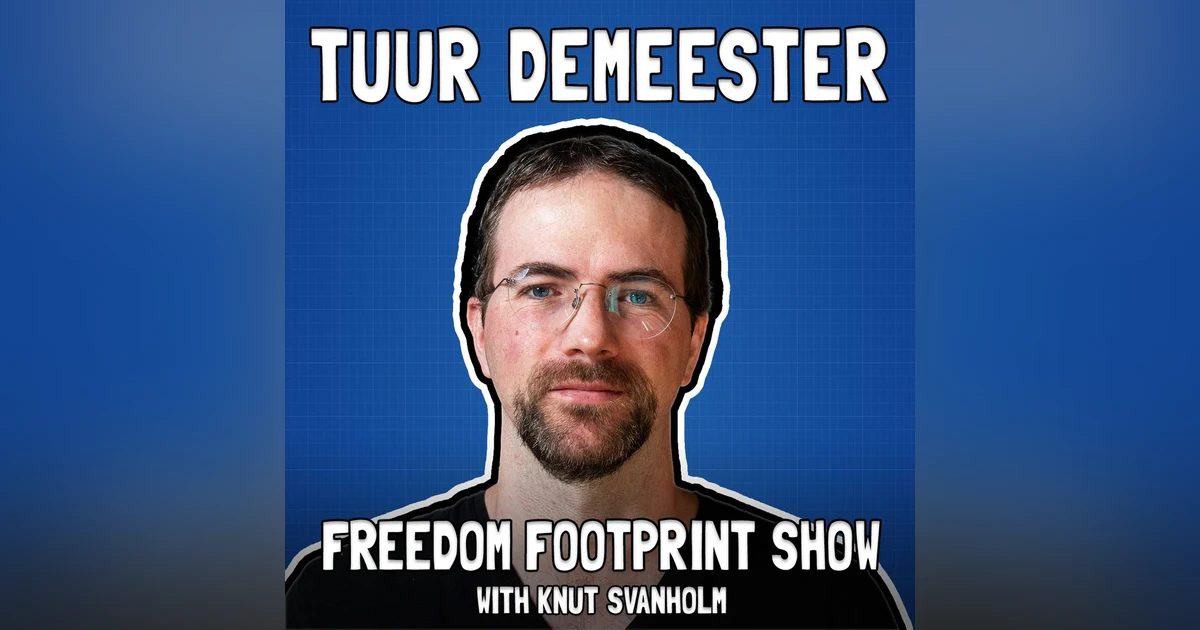
Bitcoin Adoption and Resiliency with Tuur Demeester - Freedom Footprint Show 51


 Fountain

 YouTube

 Spotify

 Apple Podcasts

 RSS Feed
In today’s episode, we’re joined by Tuur Demeester, editor-in-chief at Adamant research and longtime Bitcoiner.
In this in person, interview, recorded at Baltic Honeybadger 2023 we explore a wide range of topics. We discuss the connection between Bitcoin and Austrian economics, we explore trends in Bitcoin adoption, and we explore Bitcoin’s resiliency. We even cover how we can avoid the biggest long-term threat to Bitcoin!
Connect with Tuur on Twitter: https://twitter.com/TuurDemeester
Check out Tuur's reports at Adamant Research: http://adamantresearch.com/
00:00:00 - Intro - Welcoming Tuur Demeester
00:02:34 - Austrian Economics
00:09:42 - Hyperbitcoinization and Violence
00:16:59 - Freedom of Speech and Property Rights
00:20:08 - Austrian Economics and Bitcoin
00:25:08 - The Bitcoin Scene in Argentina
00:29:13 - Bitcoin Adoption
00:32:00 - Bitcoin Adoption vs Internet Adoption
00:35:12 - Bitcoin Resiliency
00:38:22 - Bitcoin is Backed by Human Action
00:45:18 - The Biggest Threat to Bitcoin
01:01:34 - Wrapping Up - Where to Find Tuur
The Freedom Footprint Show is hosted by Knut Svanholm and BTCPseudoFinn. We are concerned about your Freedom Footprint! Join us as we talk to #bitcoin philosophers about how #bitcoin can expand your Freedom Footprint and much more!
The show is sponsored by Wasabi Wallet, the privacy-focused desktop wallet with Tor and coinjoin built in. The coins you send to the wallet are coinjoined through Tor, so when you take the coins out they are private. Visit https://wasabiwallet.io/ and download Wasabi Wallet!
The show is sponsored by Orange Pill App, the social network for bitcoiners aiming to increase hyperbitcoinization in your local area. Download the Orange Pill App today! See https://www.theorangepillapp.com/ for details and connect with them on Twitter https://twitter.com/orangepillapp
The show is sponsored by The Bitcoin Way, specialists in cutting through the technical jargon of Bitcoin, so you can confidently navigate this complex world. . With a skilled IT team well-versed in the Bitcoin space, their goal is to make entering this dynamic realm as straightforward as possible for everyone. They cover everything from Cold Wallets to Nodes, No-KYC Bitcoin Purchases, Inheritance Planning, BTC Payments, and more. If you're looking to expand your freedom footprint, securely managing your Bitcoin in self-custody—the right way, then booking a free 30-minute call with them is the next step to take: https://thebitcoinway.com/contact/
The show is sponsored by Xellox, developers of the Yokis, your solution to protect your seed against everything life throws at your, including fire, water, corrosion, and pests. The Yokis package includes 3 stainless steel plates and a pen-sized electric engraver, so you write your seed like writing on paper. Check out the Xellox Yokis: https://www.xellox.io/yokis/ and connect with Xellox on Twitter: https://twitter.com/xelloxwallet
The show is sponspored by bitcoinbook.shop, the #bitcoin only bookshop by Konsensus Network. Check out https://bitcoinbook.shop/ for Bitcoin books in more than a dozen languages, both original and in translation. Use code FOOTPRINT for 10% off at bitcoinbook.shop!
Follow us on Twitter:
https://twitter.com/FootprintShow
https://twitter.com/knutsvanholm
https://twitter.com/BtcPseudoFinn
https://twitter.com/KonsensusN
Visit our websites for more info:
https://konsensus.network/
https://bitcoinbook.shop/
https://www.knutsvanholm.com/
The Freedom Footprint Show is a Bitcoin podcast hosted by Knut Svanholm and Luke de Wolf.
In each episode, we explore everything from deep philosophy to practical tools to emit freedom dioxide to expand your freedom footprint!
00:00 - Intro - Welcoming Tuur Demeester
02:34 - Austrian Economics
09:42 - Hyperbitcoinization and Violence
16:59 - Freedom of Speech and Property Rights
20:08 - Austrian Economics and Bitcoin
25:08 - The Bitcoin Scene in Argentina
29:13 - Bitcoin Adoption
35:12 - Bitcoin Resiliency
38:22 - Bitcoin is Backed by Human Action
45:18 - The Biggest Threat to Bitcoin
01:01:34 - Wrapping Up - Where to Find Tuur
0:00 one number that I've long looked at, like for a very long time is, just simple internet adoption. If you look at the percentages I think early 1995, it was 9%, and then it jumped to 16 percent in the next year. So to me, that is what I want to see in Bitcoin, where like, we can really say like, Ooh, this is a moment where we're really going mainstream. And I think it's coming this cycle. it doesn't mean we have complete saturation, but it does mean that the. The S curve starts to accelerate Welcome back to the Freedom Footprint show, the Bitcoin philosophy show with Knut Svanholm and me, Luke the Pseudo Finn. In today's episode, we're joined by Tur Demeester, editor in chief at Adamant Research and long time Bitcoiner.
0:40 In this in person interview recorded at Baltic Honey Badger 2023, we explore a wide range of topics. We discuss the connection between Bitcoin and Austrian economics. We explore trends in Bitcoin adoption. And we consider Bitcoin's resiliency. We even cover how we can avoid the biggest long term threat to Bitcoin. Stay tuned for that. But before we jump in, a quick reminder that the best way to support the show is to send us a boost or stream us some sats using a value for value podcasting app such as Fountain. If you're listening to this show as a podcast, check it out on Fountain. You can earn sats from listening and you can support us and all your other favorite shows. You can also support us on geyser fund or send sats directly to our lightning address freedom at getalby. com. And if you want to exchange your dirty fiat, you can support us on Patreon.
1:23 All our links are in the description. If you're watching on YouTube, don't forget to like the episode and subscribe to the channel. Even if you're listening as a podcast, head over to our YouTube channel and subscribe to us there. It would be a big help. And finally, we want to thank today's sponsors Wasabi Wallet, Orange Pill App, The Bitcoin Way. We'll be talking a bit more about them later. And now, without further ado, here is Thurde Meester on the Freedom Footprint show. Welcome to the Freedom Footprint Show. Yeah. We've, we've been, uh, eager to talk to you for a long time. Yeah. Or like, we've been talking about talking for quite some time. Yeah. And it's so nice when you can finally meet someone in person. Yeah. Yeah. It just, it's so much nicer than to do it over Zoom.
2:05 Yeah. Yeah. Yeah. And, uh, yeah, give us the, the T L D R on tour. Dester, who are you? And uh, what is your thing like, uh, sure. Yeah. Um, I mean, I grew up in Belgium. I, um, kind of was very undecided about what to do after, after high school. I tried like a million things. I dropped out of university. Um, I traveled. I, I lived in Norway for a year, all kinds of stuff. Um, eventually found, um, Some Austrian school ideas, like early on, like, uh, you know, Human Action from Mises and some other books that, and not just me, like, several friends of mine.
2:47 Did you read Human Action at an early age? It was it was, uh, it was Human Action. We were, I mean, not that young, like, you know, twenty... Maybe I was 22, 23 or something, um, but yeah, to me, it was very profound to encounter that stuff, because not only was it economic ideas that made sense, but like, the first part of human action is just, you know, hardcore philosophy, and he basically just, you know, wipes the floor with like, relativism, and a lot of things I had been struggling with, like free will, or like, you know, the power of the group, or like, all these kind of ideas that are, I Almost, like, subliminally passed on to you through public schooling, you know.
3:31 Mises was very, not only talking about them, but very decisively debunking a bunch of those things. And it was such a, it was very emotional, like, for me to, like, you know, be exposed to that. And, uh, and so from then on, I really, that became a big part of my life. Like, you know, economics, Austrian school, philosophy. Yeah, same thing happened to me. Like, I, I, I couldn't let go of the book. People think it's a hard read, but I felt, uh, I think it flows very well. And I mean, there are long sentences, but. Come on. And it's also, it's so quotable, like it's so dense. I love that. There's no fluff. You can just like... It's like 1, 800 pages of no fluff.
4:13 So that's why I wrote the Praxeology book, to like squeeze those 1, 800 pages into 130 instead. And like, uh, I don't know if I succeeded or not, but I, I felt there was a... whole in the market there for a beginner's level, of course. And Mises, like, he invents new words. I mean, clearly he is German in his mother tongue. I think he only moved to the US when he was 60. Yeah, and he was friends with Ayn Rand, or became friends over there, and they have, like, a similar story. His life story is fascinating. Yeah, yeah, absolutely. I mean, that whole rabbit hole is so, to me it felt like reading something like Newton or something, something very fundamental that was just missing from the entire school curricula, like, this is like, holy shit, why haven't we talked about this?
5:02 This is as important as mathematics, really, but, and I think it was Rob Breedlove who said in a, just a casual conversation that Uh, praxeology is to the subjective what mathematics is to the objective. And I, of course, I use that in my book because I think it's so, I think that puts the finger on what it is. I think Mises would be very happy with that because his brother was a mathematician, right? And so to like, to have that validation that people see his, his thoroughness as a, as being so Solid, that you can actually even compare it with something like mathematics. Yeah, and, yeah, because, like, mathematics is a priori, too, in a sense.
5:45 It starts from a set of irrefutable axioms, like 1 plus 1 equals 2, because we define 2 as 1 plus 1. Yep. Sort of, and, uh, yeah, this... Just a priori versus a posteriori or logical deductive reasoning versus empiricism. I think that's so much there, like it, for me, it put the finger on why, like, why science, empirical science. And empirical science by itself just isn't enough to understand the world, like you need to understand incentives to understand anything. Right, and empirical science has a lot of presuppositions that are not talked about, that are actually a priori.
6:29 Yeah, yeah, and also that it's never precise because the map can never be the territory. That's the a priori is precise and that's, that's why it's limited, but it's also why it's so more rigid, I would say. Right. Yeah. I think there is only one. It's hard to say if it's, I would have to study it more to decide, like, is it really a gripe for me with Mises? It's just that I personally lean more Aristotelian, you know, which is phenomenology and you're looking at more things from, from different angles, uh, rather than. The Kantian framework feels a bit more like, you know, this, this, this thing is on the board and then you kind of just reason within your mathematical proof, so to speak.
7:16 And I think sometimes you lose aspects of reality. Like, for example, the, you know, Mises, you know, being so emphatic that, um, economics needs to be wertfrei, like free from value judgments. I think he... Eventually you get stuck, like it gets too limited if you cannot talk about fraud or theft or, you know, and that's where Rothbard has a bit of a different take. But like as far as purely aesthetically or just purely as a, as an experience, I prefer Mises over any of the other, you know, it's, it's incredible to read, to read him. Did you read a Hopper book called, uh, Economic Science and the Austrian Method? I, I think I've read.
7:58 Parts of it. Cause at some point, cause he's, this is a method, methodology. It's a lot about methodology. Yeah. I've read parts of it, I think, a long time ago, but yeah. I love that book. That was also very dense. It's very much shorter than human action, but yeah, it talks a lot about methodology and like the differences and how significant they are. And does the, uh, go into argumentation ethics there? Uh, uh, If I remember it, because it touches on it, but argument, his argumentation, I think it's one of the most profound insights of the last century and it's never talked about and like, Yeah, it's, uh, it's very under, underappreciated.
8:38 I agree. It's so powerful. It's so powerful. Yeah. Um, and, and, I mean, who knows in the future, we'll see some, it would be great to have some debates about how, how it started and where, where, um, Uh, where, uh, Argumentation Ethics started, because... I think they were independently kind of uncovered, discovered, uh, both by Hoppe and then a little bit earlier, Frank van Doorn, but he wrote in Dutch, and so he had a whole, uh, the, the foundational principle of law, which he basically makes the argument from argumentation, um, And so they really complement each other nicely. But I agree. It's so, you know, it's so foundational.
9:21 Although I think, you know, if you're an Aristotelian, it's more like it's one proof, but I think you can find multiple proofs to kind of, kind of, you know, be going at the same framework eventually. Yeah. Yeah. And it's tightly connected to philosophy, as you say, like they're tangent to one another, the way I see it. All right. So, so, if we take the, uh, the deep hopium stuff about Bitcoin and that we will hyperbitcoinize and it'll take over everything, does that in your mind, does that remove violence from the equation? Almost entirely, so that what we have is, left is argumentation and just conversation and, well, peace, world peace.
10:04 Is that where we're going? Yeah, I, I, I'm afraid it's not enough. I, I really am of the camp that like, even under a gold standard, you had enormously bloody wars and, you know, and, and, uh, a lot of, a lot of issues. I think that, you know, there's a great. Opportunity here. Like that's what I had my talk about today. This is great opportunity because uh, if you think about the principles that allow for peace in society, one of those principles, I think there are four according to Van Den and I follow him, there's four. One of them is Restriction of access, you know, because if you have open access, if any kind of, there's no real property rights, right?
10:44 If your stuff and mine, it's all fuzzy and that then people live in this perennial uncertainty, anxiety, anything can be conscious. The Fiat regime is kind of like that. Because literally your bank account is just a free for all, you know, they can take value from it whenever, whenever they want, you know, banks or governments or whoever's, whoever can add to the money supply. And so Bitcoin. And of course, the cypherpunk movement as a whole, and encryption, all that technology allows you to restrict access, um, restrict the world from accessing your, what's yours, your property, and so it's a great engine for peace, you know, and it creates that certainty, so it's a super important and foundational But I still think we need more than just that to, to really go towards, um, a society where, yeah, I mean, ideally there is no war, right?
11:40 I mean, that's a pretty, pretty. What would that more be though? Yeah. So, so the other principles. One of the other two foundational principles, uh, is, is unity, which you could kind of dismiss because unity is the idea that if, if, uh, you know, you are sitting there with two, you're both thirsty, there's only one bottle of water. How do we prevent conflict? Well, we make sure there's only one person sitting there. So, so like physically, how do you do that? How do you create one out of multiple people? And I do think there is something to be said for Embracing the idea that you are part of something bigger, like that's why we don't murder other people, because we feel like we're part of humanity, right, it kind of, it kind of elevates us, or like, you know, people have certain ethical standards because they feel like, it's not just for me selfishly, it's just because it is.
12:32 It is. I want to be part of something bigger that, that is, that, that means something. And so that is like another, that, that sense of, of unity to be, to voluntarily, which is important, to voluntarily give up a little bit of your Individual preferences to elevate the greater good, I think is, uh, it's, it sounds very corny, but I think it's, it's pretty, pretty foundational because in a way, like some of the goodwill is, some of that goodwill is sometimes what people give up to invest in understanding Bitcoin, because they feel like, oh, maybe this is something that can make things better for everyone. Um, or, or even if it's against my career, I'm still going to have the intellectual honesty, just, you know, so that's just one, one other.
13:18 Example, and then there's a few more, but there they're more higher up. And it's more to do with like, uh, having a healthy debating culture, for example, like free speech. And, and, uh, I think, I don't think Bitcoin guarantees that. I think Bitcoin can facilitate some of it, but we still need to do the work to Well, can Bitcoin culture though that then like Yeah. Is, is Oh yeah. Yeah. But it's, but it, but that's something that is alive and that we also need Yeah. It's like a garden. You need to maintain it. Yeah. Yeah. You know, but that's the thing. For me, it's hard to make the distinction between the protocol, the money, the culture, like it's all part of the same organism in a way, and it's, I see it as, as like being just different aspects of the same phenomenon, which is just Oh, we found a way to communicate value with one another without third parties.
14:10 And that's so profound, like that means, that means peace. Like the way I put it in one of the books was like, when you cannot put a, when you cannot know how much another person owns. Which is true for everyone on earth right now, since they might hold a private key in their heads, and you cannot take it by force. The best way to enrich yourself is by interacting peacefully and trading with that person. And violence, the, the... The shelling point for violence, if you will, or like the incentive to, to aggress against another goes down drastically. But what, what I struggle with is like, how drastically, like, uh, game theory sort of says that you get half of the Bitcoin if you like torture the guy.
14:53 But, uh, but, but still, I think it's, I think it's more than that because the, the incentives to just be good to one another are. They get boosted as well. Like that, that vector is very, very powerful. Yeah. I mean, I, I hear you. I think it's very significant. Uh, I, where I would hesitate is just, you know, maybe it depends on how long a timeframe we're talking about here. For example, when, when the printing press was invented and, and, and, you know, gradually books became cheaper, like the price of a book went roughly from, A year's labor, which is in the Middle Ages, to the price of a chicken.
15:34 Like that's, that's how much drastically information became cheaper in that one century. Um, you know, back then, imagine realizing like, oh my God, information has been locked up for centuries and centuries. All of a sudden, it's liberated. Everyone is going to have access to these incredible ideas. They can make up their own opinion, you know. Uh, this is such a force for good. I would agree with that, but at the same time, over many generations, some of the appreciation for how valuable it is to have like a plethora of ideas, how important it is to have freedom of speech, because I think a lot of the enlightenment thinkers were really trying to Come up with theoretical foundations for why freedom of speech is important, because they, it was a fact, it was happening, people were interacting more freely than before, and so they needed new theories to try and justify that, and so, you know, I think still, the theory, and I think they You know, you could kind of debate on how successful the Enlightenment was in really elevating humanity and not throwing the baby away with the, because there were some good things in the Middle Ages, so, so that's, I think, you know, that's kind of our job, is to start working on trying to sort of live up to that.
16:46 Really, uh, treasure what's great about Bitcoin, help people understand what's great about Bitcoin so that the ethos of Bitcoin can really spread and people don't get confused in a couple generations. There's, there's a section in a Rothbard book called The Ethics of Liberty about freedom of speech, which changed my mind on it because like he, he, points out that everyone forgets to ask, like the, there's a word missing. Are you, are you pro freedom of speech? Well, the question should be freedom of, the counter question should be freedom of speech where? And you realize that it's only in publicly owned spaces that freedom of speech is important, because he argues that freedom of speech is only Necessary because property rights have been violated at some point, because if I own my house, I get to dictate the rules in my house from natural law and ethics, Austrian ethics, if you will.
17:46 Uh, so, so, so he argues that freedom of speech is sort of a facade in the sense that It needs to be preceded by a violation of property rights. I find that framework very interesting. Wow, yeah, I like that a lot. And you can think about a place like Dubai or even Saudi Arabia as compared to, you know, a European free speech maximalist place. And you could argue that, yeah, sure, uh, freedom of speech is suppressed here in the, uh, in Dubai to a certain extent, but, but the property rights are stronger and which one is more important because like in, in Sweden, for instance, you don't have the same level of property rights, but you have freedom of speech, uh, which leads to people burning the Quran and, uh, there's a big, um, uh, police escort for the guy burning it and there's a big riot and the media is there and they're turning this into this big news event and like what what's more important like property rights or freedom of speech or is is that dichotomy real or what are your thoughts on that yeah yeah Yeah, well I think property rights are more foundational.
19:03 I think property rights belong to, um, the, the layer of the restriction of access. And I think that is, that is just more foundational. Um, and then that enables, uh, the safety to engage in open debates, to have all these differences in opinions. Because if I know that you're going to respect my body, we're, we're, Get into argumentation ethics, almost. If I know you're going to respect my bodily integrity, well, then I feel safe to say things. If you're sitting in front of me and you're playing with your knife, and I know you have a history of assault, I'm going to be more careful. What's that quote? It's easier to get what you want with a kind word and a gun than with just a kind word. Exactly.
19:43 Yeah, no, totally. Yeah. So yeah. And so to me, that, that is also right. I mean, had, had Rothbard been around during the enlightenment and kind of like, you know, whip some sense into metaphorically into the philosophy of the day, maybe there would have been a stronger foundation for, for freedom of speech or, or just thinking about intellectual expression than we have now. I think, I think this is a really interesting line here when we, when we tie it into the Bitcoin of it all, right? Uh, I, I think the, the line between all we'll talk about here, the, the argumentation ethics, Austrian economics and all this.
20:24 What, so this is the first thing that you brought, brought up basically, like you found this stuff before mm-hmm. Bitcoin. Oh, yeah. Right. Oh yeah. And so, and so how did that influence your journey into Bitcoin and, and how you, uh, found it and, and how it impacts your life? Yeah. So, Austrian economics. Like we started the Rothbard Institute in Belgium. We translated some books, organized seminars, things like that. and, uh, I, I started to look for ways to, to use this somehow. I mean, I, I, I made a little tiny bit of money translating, so that, that kind of helps. Actually. You might know this book, uh, money Bank Credit and Economic Cycles by De Soto. Yeah, yeah, I heard about it.
21:05 I haven't read it. I translated that to Dutch. Oh my God. What's the title in Dutch? I spent nine months doing that. Sorry? What's the title in Dutch? Geld, Krediet en Krisis. Yeah, and it's, it appeared in a very low volume, but it's still out there. Um, the footnotes are just enormous. It was really hard. And actually, Koen Swenkels, another Bitcoiner, helped me translate it. Um, but so yeah, that was, that was work that I did. Um. And then, uh, with the Rothbard Institute, uh, yeah, we just wanted to connect with other communities in Europe, um, and so I remember, for example, going to the Libertarian Alliance Conference in London 2009, Sean Gabb organized that, and, uh, they had, um, um, David Friedman, he spoke about, uh, anonymous e cash and assassination markets, which is very, I mean, weirdly I just listened to it as a theoretical thing and then only thought about it much later, but I do think that, like, had a little bit of a seed for me, and then also, I, I needed to start some kind of a career because I was involved with little private schools and I was like, man, If, if I ever want to send my kids to a school like this, I need to find a way to make money.
22:17 Like I, you know, I need to be able to pay for tuition and things like that. Yeah. So I was like, all right, how do I make a career? And I started writing about the markets, 'cause the, the things started rumbling by 2006 seven in, in the, in the US markets. Mm-hmm. . And so I started writing about the crisis, the economic crisis. And uh, eventually, uh, in 2010, a publisher found me and he is like, Hey, you know, you wanna make your job out of this? I was doing it for free and he basically offered me an opportunity to become an author of a A financial and investment newsletter. So that's what I started doing. That became my career. And so then, because I was, you know, I had some history background of banking and finance and this Austrian stuff.
23:02 And so I was really thinking about how to find investments that will keep you safe during... A banking crisis or doing a very high inflation because I was worried about the euro or, you know, scenarios like that. So I traveled to Latin America to learn more about how people, people survive inflation in general. And, um, and so then, you know, in Argentina, I learned about Bitcoin. Friends of mine were mining Bitcoin in their basement, literally in 2011 and, um. Uh, I'm trying to think. There was some other touch points with Bitcoin early on. Uh, well, I guess, yeah, I was just looking for that gold. I was into the gold world and investing, uh, investigating mining companies and so...
23:46 It made sense. I had been, you know, downloading, I don't know, like, self help books with BitTorrent and movies and stuff like that, and so the idea of, like, a BitTorrent for money, it kind of made sense, you know, so. And when was this? I first learned about Bitcoin in, like, uh... I don't know, I think April 2011 or something. Yeah, pretty early. Yeah, very early actually. And, and, uh, and I had the time to just research it. And then by early 2012, I, I went, uh, I, I wrote about it for my subscribers, uh, and actually recommended it also as an investment. And then I went to a Bitcoin conference in London in 2012 as well.
24:26 And then I started making some connections in the Bitcoin world. So it clicked easily for you? Like, it clicked fast? I was just lucky. I was so lucky that I had, you know, some of the Austrian background, like, you know, and that also I ran into, I reached out to Pieter Goyle, core developer who was living in Leuven at the time, like, he's a Belgian, and I had, like, a long Skype call with him, which I transcribed into an interview for my readers. And then, of course, my friends in Argentina, like, they really... were really into Bitcoin, they really, and they also knew their Austrian economics, so it just, it just really helped to solidify things, yeah.
25:07 So, uh, Argentina, like, there's a Bitcoin scene there now, I don't know how big it is, but, but it's still kind of small as far as I understand. And why do you think that is when it's been around for so long? Like, why doesn't it take off in a place like that where it's, because people always tell me that it's easy to, um, uh, orange pill people. who have lived through hyperbitcoinization. And I've seen it firsthand. I mean, uh, so, um, so why do you think that is? Why, why is the community not larger? I think there's two, two things I'm thinking of. One is just Bitcoin is just incredibly volatile. And so for a lot of Argentinians, you just, you save in dollars, you save.
25:49 And I remember back in the day, the number was like 50 billion in paper money circulating in Argentina. I think it's now triple that or more. And so, you know, if you want to buy a house, you just, you know, just a suitcase with dollar bills. Like, so, so in a way, they are on a dollar standard in, in, in many practical, you know, sense of the word. And so Bitcoin cycles are so long. It is, you know, if you don't have a lot of savings, really risky to be very exposed to it, uh, for, for, you know, more than like a couple months. So I think that's one reason. I think the other reason may be that there could actually be more adoption, but there's not a lot of showing. You know, like, for example, in Belgium, I talked to some people, and I'm surprised, it's like, man, there's actually quite a lot of adoption, but people keep quiet, because they don't want to be seen as being rich, or, you know, and so, the thing is, especially in countries with high inflation, you just don't want to become a target, so, I think it could 500 billion worth of value around the world somewhere, and, um, Yeah, I don't know.
26:53 So I don't know if it's necessarily lower than in other countries. I do think the level of education and level of like, um, tech, you know, if a country is very tech savvy, you do tend to see more Bitcoin adoption, I think. Yeah. So how are you enjoying this episode so far? Before we dive back in, first a little bit about our sponsors. First up, WasabiWallet, the privacy by default, open source, non custodial bitcoin wallet with CoinJoin built in. It's the easy to use, comprehensive, affordable way to make your coins private. And the best part is, they've been making huge improvements to the app. They're really focusing on the user experience, adding advanced features for power users. They just keep getting better.
27:33 You send your coins to your Wasabi wallet, and they get combined with loads of other coins using the Wabi Sabi protocol. So, they're private on the other end. Your tracks are covered, so you can work on expanding your freedom footprint without worrying about your privacy. So, check out wasabiwallet. io and download Wasabi today. Next up, Orange Pill app. The bitcoin social layer app for iOS and Android where you can stack friends who stack sats. You can connect with your favorite bitcoiners on the app, make local connections, and even connect with bitcoiners around the world. And a big feature on Orange Pill app is Vents. You can see what's going on in your area and connect with Bitcoiners around you. I've been to multiple OrangePill app events and they brought Bitcoiners together from all over.
28:16 The best part is, you know it's high signal. There's no spam on OrangePill app because everyone pays to be there. It's just 3 a month. So download OrangePill app on Apple or Android and get connected to the Bitcoin social layer. Next up, our new sponsor, the Bitcoin Way. Their mission is to onboard, educate, and remove barriers to taking self custody of your bitcoin. They cover everything from cold wallets to nodes, no KYC bitcoin purchases, inheritance planning, payments, and more. Whether you're new to bitcoin or you're an experienced bitcoiner looking to expand your freedom footprint, or you know someone who this sounds perfect for, the Bitcoin Away has something for you. They have a skilled team, well versed in the bitcoin space, and their goal is to make all the complexities of bitcoin as straightforward as possible for everyone.
29:02 And the best part is you can get started with a free 30 minute call with their team. Go to thebitcoinway. com slash contact for more info. Alright back to it. Don't forget to like, subscribe, and brush your teeth. We, um, recently Found out a number, uh, talking to Christiana, the, the founder of the B T C X. The, the oldest Swedish Exchange. Yeah. And he is, had around 300,000 customers over the years. Is this all Swedish? Uh, almost all Swedish. Yeah. Wow. So, so, and if you add the other big exchange there and the fact that people buy from others and accept Bitcoin and buy from, you know, Kraken or whatever, Coinbase, uh, the, we, we sort of estimated them.
29:44 There might be a, um, Half a million people owning Bitcoin in the country, which is a 10 million population. Yeah, so it's it's 5 percent of the population Yeah, and then you realize that All of these people can pay other people in Bitcoin, and 100 percent of the population can receive it within a minute by just installing something on their phone. Yeah, and all of a sudden, Bitcoin standard doesn't sound so crazy anymore. No, so, so, so, and the way, uh, yeah, my experience, like, traveling to all these conferences around the world and seeing the communities and meetups and stuff, it's that... It's sort of small everywhere, but it's literally everywhere.
30:25 And every one horse town in every country, there's a Bitcoiner somewhere. And like, so I feel this like undercurrent, it's, it's just waiting to explode. Uh. Then again, it has felt that for quite some time. So like what, what's your view on that? Like, is is that a accurate representation? I think so, yeah. Do, do you think there is Bitcoiners in like North Korea or the Vatican or both? Oh, that's, that's hard to tell. I mean, the, uh, yeah. In North Korea, I, yeah, definitely. I would think so. Yeah. Uh, the Vatican is, uh, significantly smaller. Yeah. I, many, there's not a lot of people actually living there. Right. They're, they're quite conservative there, right here really are.
31:07 That's the first thing I hear about it. So, I don't know. Uh, very tied up in the fiat system as well, I believe, so, yeah, their, their own version of it. I mean, I mean, in terms of portfolio, they have a lot of art, they have some gold, like they have real estate, like. I mean, don't trust verify, it doesn't sound like a, like a mantra that's, that's compatible with the Vatican. I don't know, I don't know, like the Catholic tradition, you know, the, the, the scholastics like Aquinas, they believe like through, through reason, you could, you can reason your way, you cannot. Through reason, know everything about God, but you can at least prove that he exists and, and, you know, discover parts of his nature so well. There's a, there's a, you know, I'm not convinced , it doesn't mean that there's still, you know, but I mean, you know, there, there's at least, there's at least a, a pathway.
31:52 Yeah, yeah. For, for reason, for sure. So, but I, I forgot your question. I'm sorry. Uh, I don't even know if there was a question in there. It was, it was, uh, the, the situation, I guess, on hyperbitcoinization generally, since we're, we're maybe at some kind of inflection point, maybe in terms of the number of people who now have, have had or used Bitcoin, it doesn't take long to, I mean, maybe we're in a bacon number situation, if that makes sense, like the, the number of people who are, who know a Bitcoiner is almost getting to all the people, right? So, so, so what do you think about that situation? Yeah. I mean, one number that I've long looked at, like for a very long time is, um, is just simple internet adoption. Like that trend, um, you know, you, you, you also remember in 1995 being such an important point in time where all of a sudden it went from how do you do this, what is the internet, to like, okay, here's a box, you press the button, and we are online.
32:51 Like, that was the Windows 95 moment. Like, all of a sudden it came together. And, uh, and, and if you look at the percentages, adoption went from 9 percent in 1994, I believe, or maybe it was 1995, and I think early 1995, it was 9%, and then it jumped to 16 percent in the next year. So to me, that is what I want to see in Bitcoin, where like, we can really say like, Ooh, this is a moment where we're really going mainstream. And I think it's coming this cycle. I really do believe that. I, it doesn't mean we have complete saturation, but it does mean that the. The S curve starts to accelerate. Yeah, yeah, yeah. I, I, uh, uh, remember 95 and 96 vividly and what I was doing and like, seeing the potential of the internet.
33:35 Like, uh, guys, have you seen this thing? Like, and so many people like not getting it or like not seeing that. Yeah. And for, for me, that was, that experience when, when I discovered Bitcoin, it was like. I see this now. This is 1995. I should be in this. I should be doing this. I should be acting on it. Because at the time in 95, I decided to like, not go into it. I also felt like I knew a secret, but I didn't know. I mean, I was maybe a little bit younger. I was, I think I was like 14 or 15 when 1995 happened. Yeah, it would be. Yeah. I think you were a couple of years younger than me. Well, and also I only had my first own, my own computer when I was like, 20 years old or something.
34:15 So in a way I always felt like my friends were far ahead of me because they had that access. Like Pietro Bello told me he started programming at age 10. Yeah, so did I, but I gave it up for a long time. So like, I had a Commodore 64, if that counts. Like, I wouldn't, I wouldn't really count that. But, but it certainly gave me a... A basic understanding of what a computer is and what it can and cannot do. And one thing it couldn't do was, you know, keep a secret or, or make something uncopyable. Yeah. So that's, that's the aha moment for me with Bitcoin. Like, holy shit. Yeah. Something that cannot be copied. That was, that was my big...
34:56 Point of doubt. When I first learned about it, I was like, wait a minute, how do you actually create, like, I was suspicious. How do you actually do this? So that's where talking to the engineers was like, okay, like there is actually, they thought about this. So for me, the, the denial of the Seg two X hard fork was a, a, an important point because that's when I realized that holy shit, this really, really works. That like, that's the evidence I needed for, for this to be like full blown 100%. This is the thing. Yeah, yeah. To fight for this is the hill to die on. Like, and then that was why I think the year 2015 was so different from 2017.
35:40 Yeah. Because. The year 2015, there was so much doubt about like, but what if we get an attack? Are we going to survive? And then 2017, we're like, man, like, we can do this. Yeah, we got this. Yeah, yeah. So. So, have you seen something similar? Similar in anything else to something similar to the Seg two X, hard fork denial , like that kind of proof of resilience in in literally anywhere else in the world? Yeah. Uh, Well, I haven't seen it in shitcoins and I don't think you have either, but, but in, in any, can you... That's a good question. Uh, that's a really good question. I was actually just listening to a podcast about a guy who was a big, big...
36:24 LSD dealer in the 70s and he even sold like LSD to Steve Jobs and like, you know, and he was talking about how they would have 50 gallon jars full of LSD pills, like just enormous. Just oceans of this stuff was made and the shelf life was about five years and he remembered they were talking about it and like thinking like five years is forever and so their plan was they thought and he said later I believe I was wrong but they basically thought that using this chemical they could make everybody become peaceful, right? That was the hippie idea and that's why there's this story of um, you know, They were going to lace, um, Nixon's coffee.
37:08 Like they were going to slip some LSD in there. But so he's saying like, that was our plan. Like we would just kind of, you know, LSD pill the world. We had so much supply, we could just do this. And, uh, and then he said, yeah, eventually I discovered that if someone who's in a certain kind of mindset. They just won't change, like they will have this experience of near death or ego death and then they will just kind of still say the same. Um, but so anyway, I'm just thinking out loud, you know, like is there maybe, maybe a parallel to where like, you know, that experience that we had was so... important that we, we think like, Oh, now we're good.
37:49 Right. Whereas like in the seventies, like we created all this LSD, like we're winning. Like that's what they thought. And so I'm not saying that there's exact parallels here, but it's like, it's kind of the avenue where I would, I would want to think about, like, you know, are we that safe? And I, I just keep going back to trying to double check all the math, right. They're really trying to like, which I'm sure we're all doing right. If you're in Bitcoin, you're like. Am I having survivor bias? Like, do I feel like I'm invincible because I survived 10 years, or is this really as sustainable as I hope it is? Yeah, yeah. And that, like, that, LSD parallel, and especially the ego death. Parallel.
38:30 Like the way I I view that is, uh, like since, since all Bitcoin all owning Bitcoin is, is keeping a secret. So like the, the first thought I had was, holy shit, if you, if you memorize your seed phrase, you are your bitcoins. If, if that seed phrase is nowhere else, but then when you think deeper about that, like, uh, all seed, all. Everything that unlocking a Bitcoin is, is like someone keeping a secret. So even if you have the seed phrase written down, if the attacker doesn't know what he's looking for, there's no way he knows, like it's just words or it's just numbers or it's just ones and zeros and whatever.
39:11 So, so viewed through that lens, all Bitcoins exist within people's heads. And also the, all the nodes and all the miners that they're not really the machines, they're the people who decide. To take the deliberate action of firing them up and running them, um, because they require a human being to do that. They, yeah, they, so it's, it's backed by human action and not energy in that sense. Yeah. And, and, and, uh, a computer, a minor, and Luke is laughing because he's heard this a quadrillion times, but, uh, uh, a minor, uh, all it does is guess a number and, uh, do.
39:54 Mathematics. So a computer is just a fancy abacus that helps our, it's an extension of our minds. So it is us. It's, it's nothing but us. So, so the entire network is us. And I, I, this is how I see that it connects people on this, this profound level, like, because we are the same entity now. So, so that might be the. Like, ego death, LSD sort of thing. Like, do you think there's something to it? Like, we're all part of something bigger, right? I mean, we are kind of, this is a new way to connect. It's a way that didn't exist. A more profound way to... I think that's, I like that. I think that's very true. Um...
40:34 I like that a lot, yeah. And also, when you take into consideration the lowered time preference, so we, you know, to a large extent, value quality over quantity and all this, and saving and stuff, and we're also all, we all want Bitcoin to succeed, so we're incentivized to help. other bitcoiners. Yeah. So we're just, and you, I experienced this every day in this space that people are just awesome to one another. Like there's, there's no, there's no resistance to, the resistance is futile in a sense. Yeah, there's this virtual side of, um, uh, what do you call it? No, virtual, um, virtuous cycle. Yeah. Yeah, exactly.
41:15 Yeah. And, and at the same time, maybe that's where I'm coming from is that I think that in order to, maintain the, where we're, you know, we're, we're doing good, but in order to maintain things. We need that productive paranoia, I think, where you have some vigilance of like, Hey, you know, you know, things, things are not guaranteed to go great. Cause then you can get into dogmatism and you can get into routine and then you get sloppy. And then what if we start... Oh, maybe it's not that important to always remember your secrets or, you know, you know, so and then people start custodying with a centralized custodian and, you know, so, so the vigilance, I think, is important.
41:57 Yeah, but the way I see it, it's the vigilance that enables the trust between people. So ironically enough, the don't trust verify attitude of the hardcore core of this thing is enabling people on the outer layers. Just to trust one another more. Yeah, absolutely. And that's so weird because it's like... It's counterintuitive. Yeah, it is. Yeah, and I think I touched on a very related topic when today in my presentation I talked about, um, this is one of the other kind of... Foundational principles of order is that continuum between, um, diversity and consensus. So diversity means you're just, not only do you disagree, but you're entrenched in your disagreement and you start boycotting the other or you start attacking them.
42:43 And then consensus is actually a situation where it doesn't mean you have to agree. On the topics, but, um, there is a healthy debating culture, like the Greeks, the ancient Greeks. We agree to disagree. Yes. And so, because that becomes the peaceful situation. Stalemate is fine. And we, in Bitcoin, we have to explain this all the time. People are like, yes, but my Bitcoin improvement proposal, it's important and it's urgent and we need to do it now. And then we say, I don't know, maybe not. Let's just wait. And then they're like, but, but, but. And so. Even though there's this heated debate, there's no violence, there's no coercion.
43:23 So it's totally, it's a very important overlooked thing in game theory. People think like, either you agree or you disagree, but you can also agree to disagree. And so it's such an important engine for peace, I think. It's argumentation ethics. Agreeing to disagree. That's the basis of that. Yeah, I didn't think of that either. Exactly. We just reinvented our invention, at least. And by the way, I don't think you ever have actually said the phrase that Bitcoin is backed by human action. I don't think you've actually said that. I think I've said that in a talk or something. Not on the pod, though. I don't remember you saying that while I was listening. That's what I was actually smiling about.
44:03 I think that's a really good... Way of framing it, right? Yep. That, that you have to have the human actions that, that, that, that trigger all of the things that make Bitcoin. I think that's really important. And of course, like human action requires energy. Like we are energy consuming creatures. So, so in that sense it's backed by energy, but more. By the energy in our foods, right? Than the electricity in the miners, in that sense, you know? And it's very synergistic, like how, uh, I don't know, like, we live synergistically with fire, for example. Like, it's happened for, you know, millions of years. And, and, and, and there's so many things that we... Maybe take for granted, but they're actually not technically, physically in our bodies, that are in the outside world, but that are so intertwined with, with our society and our lives, um, you know, sources of water, we're drinking water, like in a way we live in synergy with water, and so I think similarly, yeah, we, we live in synergy with Bitcoin.
45:01 Wonderful phrase here. And, uh, now I kind of want to come, come to a different point here. Uh, the panel that you, that you had actually just now that, uh, yeah. That you wanted to write after. Uh, it, it had the provocatively bullish, uh, when, when 100 k basically. Uh, but I, I wanna know, do, do you see any threats to Bitcoin? Like what would be the biggest threat to Bitcoin that you, that you can think of right now? Yeah, I really tried to go over that in my last report, because I think it is always at the end of a bear market, people have a long list of like, here are all the bad things that are going to happen to Bitcoin. And so I wanted to take it seriously and go over, you know, go over some of the worst scenarios and, and And, and, and because that's ultimately what happens is that when you go into a bull market, um, slowly the worries are debunked.
45:50 Like you start to realize like, oh, well, we don't actually don't need to worry about that, but what about this? And then you get the wall of worry where you get the, the sell offs and, and eventually in the long run, it's just all a big uptrend. But in the moment you're like, oh no, we're going back to where we started or, or lower. Um, so, so in terms of biggest threats to Bitcoin, I think. I think Binance going bust is a pretty big one, um, as, as a, as a potential scenario. Wait, what? Long term? No, no, no. Oh, sorry. You mean long term? I thought I meant for this cycle. Oh, I definitely meant long term. Oh, I see, I see. Because I think long term, it's a necessity. Oh, yeah, yeah, yeah. Creative destruction, right? Yeah, of course.
46:30 It's the great shitcoin purge. Yeah. No, absolutely. That's continuously happening. Yeah, no, no, no. No, we're totally on the same page. Long term, the biggest threats, I mean, in line with what you're saying, right, if Bitcoin is backed by human action, then complacency is the biggest risk, where we forget about the values, forget about what standards we have to hold up, for example, if all of us forgot how to apply rules. How electricity works. Literally, all humanity had amnesia. We don't, we forget how electricity works. That sort of happened here in Europe. Oh yeah, I mean, yeah, right? I mean, so then, then the infrastructure would start to crumble. Like the machines don't work on their own.
47:11 We need to understand this. Yeah, yeah. So to me, that's, that's always been the biggest, uh, the biggest one. All right. I'm going to go, uh, down one of my little rabbit holes for a second. And Knut's smiling because I, I do this every once in the Vikings. Well, no, not this time. The Egyptians. So, so, so I, I am a big fan of the idea that, that, uh, there, there was a civilization, uh, long before civilization theoretically was like, um, 11, 600 years ago, younger Dryas, uh, impact hypothesis that a comet came down and basically ended something in civilization that there's Plenty of evidence for that. And the, the result and, and I'll, my, the, the source I'll give here briefly Sure.
47:53 Is, is Graham Hancock. Yeah, yeah, yeah. The, the fingerprints of the gods, uh, magicians of the Gods American before Great books to, to check out on this topic, but the, the point, the thrust of also now on Netflix. Right, exactly. Uh, ancient apocalypse. Yeah. Yeah. Very good. So, so, so the, the. The point though is that, his point is that we are a society with amnesia, that this actually happened to us, that the, we don't know necessarily what this society was capable of, but we have some of it. evidence of it and these massive monuments such as the pyramids and and other, uh, other things that we're starting to find that are vastly old. These are the, the bits of evidence and it's not to say aliens did stuff like that, it's to say humanity was capable of, of Extraordinary things.
48:41 And so this is just to bring it back to the complacency point. Yeah. So, yeah, it's so interesting, you know, and this is related to your general point I just read and I don't know how credible it is, but apparently there's new, a new research paper coming out arguing based on just DNA evidence of human beings that, and this is a longer time frame, but that about 800, 000 years ago, the, the, the human population pool shrank to about. 1, 200 individuals and it stayed there for like a hundred thousand years. Insane, right? And so we're all inbred. Well, yeah, I guess. Yeah. Who knows how we got out of there? Um, but also how much amnesia must they have had?
49:23 Like, imagine if humanity shrank to a thousand, this is only so much information you can hold. And so, yeah, I, I, I like the, you know, Younger Drives impact type, a little, I mean, amateur as I am about this stuff. Um, uh, to me, the most compelling is the, I like watching the Ancient Architects channel on YouTube, the British guy. I think he's British. Um, and uh, just, you know, I forget there's also this Australian researcher who often travels to Egypt. Uncharted X. I forget his name actually, but yeah. Yeah, that guy. You know, I think it's really compelling when he talks about how this stuff was actually made. Like, you know, lifting these enormous stones inside the pyramids.
50:04 Uh, and then like how this, uh, what is it, alabaster? How, how all that is. Carved with this incredible precision. Um, and then these like, uh, these simple bowls that they find, right? And you try and you analyze and it's incredibly symmetrical and it has, not only is it like symmetrical, but then it has perfect handles on them. And this is in like a very brittle Extremely hard material. Like basically stuff they cannot replicate today. Like to me, that's already evidence of amnesia, right? If we find something we can't replicate, well, we must've forgotten, you know? And then, I mean, there was also the more like mainstream accepted stories of like, Oh, the Greeks, they had the, uh, I think it was the, maybe the Romans, they invented like the steam engine and then they just shelved it.
50:46 And, you know, so I think it happens. Like, I think the big thing I actually have been wondering, like that Graham Hancock theory. Even regardless of if it's true or not, but it's compelling. It's now hitting the mainstream like Netflix and places like that. I think it's kind of breaking the idea that, that of progressivism. Like, oh, yeah, yeah, yeah. Things always get better. Therefore, we just listen to the politicians because they know what we need to do. We're just going to follow because who's talking about a cliff? We can never fall off a cliff. And all of a sudden we have COVID. All of a sudden we have inflation. And here's this guy saying that. You know, we had an amazing culture and it went to shit. Like, you know, maybe we need to rethink some things.
51:27 I think the amnesia is you don't need to rewind the clock 8, 000 years. I mean, amnesia in society happens all the time. Like, uh, like Austrian theory. Sorry, but like Rahim, for example, like he's the last. Austrian, Austrian economy. Like Austria forgot about economics. Yeah. And not only that, but Marxist policies, policies get voted in over and over again everywhere, even though they've been like debunked for years and like, does anyone remember the lockdowns? It seems like there's a big dose of amnesia going on there. Like it seems like people for. Forget. So, yeah.
52:08 Quickly what, yeah. What led up to all of these things like, and where the, where the, uh, where the enemy is and what the enemy is. I think it's part of why I'm like a really big believer in, in, um, um, Mental health, like education and the pursuit of mental health. Cause I think a really huge driver for why people forget is they just get overwhelmed. They just cannot control the emotions that come up when they think about what it was like, or what, you know, what was impacting their life or how, how things changed. And, um, and, uh, and, and oftentimes people. People go to crazy lengths to avoid feeling ashamed.
52:48 You know, why did, you know, all the policies that Russia is doing, for example, a lot of it is to protect the national honor and, you know, prevent, you know, if you think about the, um, the, the humiliation that happened around the first world war and like, you know, the, the reparation payments and like, so it's weirdly Crazy things happened because of simple emotions. Anyway, so it was a, that's a different rabbit hole, but I just No, it was very interesting, like the, yeah, I, and I think that's, you know about this Belgian, um, psychologist, ma Mathias Desme, I think is his name. Oh, I'm not familiar. No. Uh, yeah, he was, he had a, a, a big rise to fame during covid. He talked about mice mass psychosis and mass for, he didn't call it that because it's sort of a triggery word, but mass formation, I think is the word he used.
53:35 And how, how humans in a flock behave a certain way and when, when something becomes a virtue signaling mechanism, like following, like I'm doing my part, the, the Starship Troopers thing, like, uh, when you've, um, so, so during a. During the lockdowns, uh, the further into those years we got, the weirder the rules got, and the more often they changed. So it became a virtue mechanism to know the most recent rule and follow that. Yeah, exactly. And I'm playing my part, you know? And how societies get out of that is like, well, humor plays a big role.
54:19 Like, if you ridicule people for doing stuff, then all of a sudden... People seem to wake up of it and it just disappears, just like the East Block here in Europe. It sort of disappeared overnight, almost, in comparison to like the Roman Empire. So, yeah, I think there's a lot to be learned from like group psychology in that sense. Yeah, I remember my parents telling me that they were like celebrating, I think this is 20, hmm. 2020 maybe? I think they were celebrating, they were definitely celebrating um, New Year's Eve and one of their friends had to go home before midnight because there was a curfew. Like insane, right? They were not allowed to go on the street before midnight, even on New Year's Eve.
55:01 Just crazy stuff, like how does it even make sense to have an outdoor curfew, it's absurd, right? Total absurdity. Yeah, and I guess, I want to learn more about, yeah, mob mentality, there's a little book that I remember, um. Reading. I don't think I read the whole thing, but it was fascinating. Written by Boris Sidis or Sidis. He was the father of William James Sidis and, um, and William James was like, uh, one of the, the, the real famous prodigy children back in the, the same time of, um, um, Uh, William James, the psychologist, actually, because this William James, the prodigy, was named after the friend of his father, uh, the psychologist.
55:44 So, anyway, so Boris Tsidis was, uh, grew up in Russia, and, uh, he was, uh, sent, I believe, either to prison or to the Gulag, uh, for three years because he had... uh, taught some farmers how to read and write. Like, that was his crime in Russia. And, uh, and so he then later was a very passionate psychologist and he wrote about the psychology of the mob because he had witnessed it so often. Uh, and, and just really writing about how dangerous it is, you know, when people get whipped into a frenzy. And then you have, you write that virtual signaling or it's almost like, and you see it in cults as well, where, where it's almost like You know the environment is crazy, you know that somebody is going to pay, there's going to be a punishment, somebody is going to be made the example, and you want to not be at the bottom, so you want to be the one running away from the bear that's a little bit farther away, and so you just, in North Korea, you see it, right, where there's somebody dies and everybody's trying their best to cry the hardest, because the one who cries the least, even if it's already crazy, they're going to get in trouble, so yeah.
56:52 www. Insanity. Yeah. Absolute insanity. And it was so, wasn't it surreal to witness it in real time? Yeah. It was. I've never in my life seen that. And like, it's a reminder that, uh, it's, it's never safe with humans. Like the, we, uh, complete craziness can happen at any point, like, and it's, it made you, makes you more vigilant and pick up on these little... And, uh, I recently read the white pill by Michael Malice. It's about the, the Soviet, the history of the Soviet Union, basically. And, uh, um, in that there, there are examples of, of people who committed crimes in, in, In late Soviet, late Soviet era, that knew that they were innocent, but that willingly went to the gulags anyway, because they wanted to defend the system.
57:44 And like, so, so, so, so deeply entrenched into their minds that, that the system was the important thing to uphold. Wait, wait, so, I don't follow. It's like... Ultimate collectivism, when you, you, you know that you're innocent, but you play along anyway, because the system says so. It's a lot of practice. It was a series of crimes, they were accused, but they didn't do it, but they just went along with it. Yeah. And, and, and it was, but they were accused, but could they... Was it even an option to defend themselves? Uh, yeah, okay, this is from memory and according to the book. But there were obvious cases where they could have just said, no, look at this evidence, I didn't do this.
58:25 But it was futile to a certain extent. But still, just having a chance of not getting into the gulag would be... Wow, yeah, really, like, it's like the frog jumping back in the pot or something. Yeah, yeah. Yeah, wow, hmm. So what can we do to avoid this complacency, this scenario? We're doing it right now. I, you know, I think this is really important to, you know, just keep, um, remembering the past, talking about Just universal, immutable principles, trying to, trying to be vigilant there too, where you don't get stuck in being complacent and just assuming, you know, always go back, do the math again, go over the proofs.
59:11 Um, yeah, I, I believe a lot in interdisciplinarity. I really believe that, you know, that, that we can build bridges between, and, because in a way, Science, in the broadest sense, has gotten very fragmented because of how everything is subsidized and become bureaucratic. And so I think there's this great project where we can bring things back together in a more unified way and, um... And so that more people can become part of this conversation, like there were times in history where, like I mean, even the ancient Greeks, like we, now what we find back is like about 1 percent of the stuff they actually produced, with in terms of plays and books and all that, and even with that, this overwhelming evidence that, The percentage of intellectuals, the percentage of people who really were very aware and, and engaged and, and, and just brilliant was incredibly high.
1:00:05 And these people didn't have different genetics than we do. So it is possible to just have much more, a much higher percentage of the population get like alive and activated and be part of that great discussion. And so, yeah, it's like we're, we got to keep the flame alive. Right. I mean, absolutely. Yeah. So you heard it from the man. If, uh, so if you want to avoid Armageddon, don't forget to like, subscribe, click the bell for notification, brush your teeth and all that, you know? Exactly. Amen.
1:01:35 Thanks. I think this, I think this is a good. Just thought to maybe tie this one off, but can you tell our, our viewers and listeners where they can find you and what you're up to these days and that sort of thing? Yeah, I would say just Google my name, Thurde Meester. Um, it's a bit of a weird name, but, um, just do that and you'll see my Twitter account. We like weird names. Oh, sure, yeah, yeah, yeah. Uh, my last name has four E's in it. Anyway, uh, but so my, my company is adamantresearch, A D A M A N T, adamantresearch. com. So if you go there, you'll see an archive of all my, uh, my reports going back to 2012 and also a link to my latest, which is free, it's called How to Position for the Bitcoin Boom.
1:02:20 20 pages, very dense, and it's literally what I sent to my own friends and family. Yeah. Fantastic. Thank you very much for a very good conversation. Yeah. And good luck with everything. Thank you. So, what did you think of that episode with TOR? I always enjoy digging into big topics. The importance of avoiding complacency is my biggest takeaway from this one. What was yours? Let us know. You can send us a boostergram on Fountain, leave us a comment on YouTube, or get in touch on Noster or Twitter. If you're watching on YouTube, don't forget to like the episode and subscribe to the channel. Our show's sponsors are Wasabi Wallet, Orange Pill App, The Bitcoin Way, Zelox, and Bitcoinbook. shop. Check out their details in the description. That's all for now.
1:03:00 See you next time, and thanks for listening.