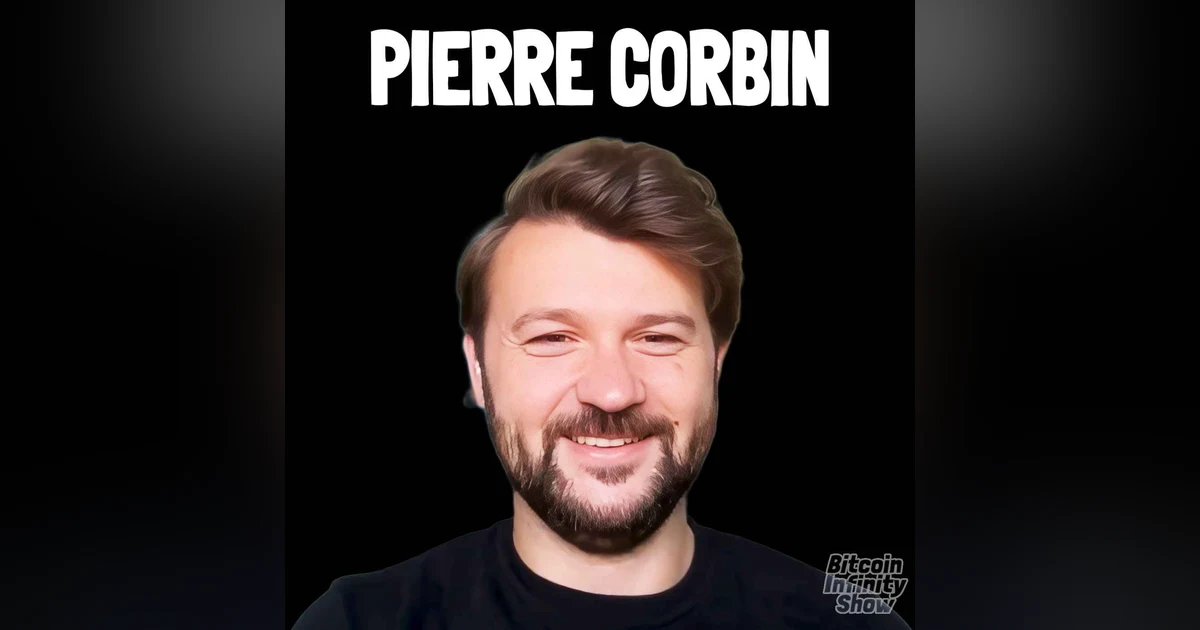
Building Bitcoin Tools for Business with Pierre Corbin | Bitcoin Infinity Show #200


 Fountain

 YouTube

 Spotify

 Apple Podcasts

 RSS Feed
Pierre Corbin joins the Bitcoin Infinity Show to talk about why most corporate Bitcoin reserves might be paper Bitcoin, how AI is accelerating the collapse of fiat currencies, and why Bitcoin is the only asset built to survive a world where everything trends toward zero. They also dig into copyright in the internet age, Nostr as proof of authenticity, and how Pierre's company Flash is helping businesses build real Bitcoin treasuries through self-custody.
Connect with Pierre:
Connect with Us:
https://www.bitcoininfinityshow.com/
https://bitcoininfinitystore.com
https://twitter.com/BtcInfinityShow
https://twitter.com/knutsvanholm
https://twitter.com/lukedewolf
Thanks to our sponsors - check out their websites for info:
Firefish: https://firefish.io/ - Use Code INFINITY!
Bull Bitcoin: https://app.bullbitcoin.com/registration/infinity
BitBox: https://bitbox.swiss/infinity - Use Code INFINITY for 5% off!
Bitcoin Adviser: https://content.thebitcoinadviser.com/freedom
The Bitcoin Infinity Show is a Bitcoin podcast hosted by Knut Svanholm and produced by Luke de Wolf.
The Freedom Footprint Show is a Bitcoin podcast hosted by Knut Svanholm and Luke de Wolf.
In each episode, we explore everything from deep philosophy to practical tools to emit freedom dioxide to expand your freedom footprint!
00:00 - Welcome Pierre Corbin
01:10 - Bitcoin Film Fest in Warsaw, June 4-7
02:33 - Pierre Corbin: From Consultant to Bitcoin
03:52 - Talk to Satoshi: A Bitcoin AI Project
05:16 - Flash: Bitcoin Subscriptions and Payments
05:48 - Strategic Reserves: Real vs. Paper Bitcoin
06:55 - The Future of Companies on a Bitcoin Standard
11:05 - Flash: A Treasury Platform Overview
14:11 - Flash: Fiat, Bitcoin, and Stablecoin
16:14 - Competition and Collaboration in Bitcoin
20:41 - Predictions for Nostr's Future
28:31 - Copyright Laws: Are They Doing More Harm Than Good?
38:00 - AI-Generated Content and the Battle for Attention
01:00:10 - Flash Treasury Platform and Contact Information
0:00 Pierre, welcome to the Bitcoin Infinity Show. Nice to have you here. Hey, Knut. Thanks a lot. It's very nice to be here. Yes, we go way back. When was the first time we met, actually? I think it was 2022, I think. Yes, actually, I do remember. So I released my film in January 2022. And there was the Bitcoin conference in Miami. and you were kind enough to join for the screening that I organized and also join a post-screening panel together with a couple other people. Oh, yes. I think I was on stage with Svetsky, if I remember correctly. Maybe it was... No, no, it was John Ballas.
0:43 Ben. No, Ben from BTC Sessions. Yes, you were on stage with John Ballas as well, but as part of a Bitcoin Film Fest event, and that was in Madeira. Okay, okay, okay. So I'm mixing the two up. Yeah, it was me and Ben. Yeah, and talking about the film and everything. Yeah, that was a beautiful film. And after that, you've done the Film Fest for a couple of years. That's right, yes. And that's happening again this year, as I understand it, in June, right? Yeah, that's right. So the first edition was in 2023. And I think so, yeah, 2023. And now is June 4th to 7th as the next edition of the Bitcoin Film Fest, which I'm pretty excited about.
1:24 Yeah, cool. is it still in that uh gotham city looking building building in the middle of warsaw yeah that's right yeah the palace of culture and science yeah it's still right and they're right in the middle yeah we have a great cinema partner so uh yeah happy it can happen there yeah as no as warsaw is super cool it's such a mixture of different eras and uh that building in particular is uh both scary and beautiful at the same time yeah well and actually i know that this year the priority was you know because because every month the first time the film film has happened was in in march then it was in april then last year it was in may and this year it's in june uh trying to you know get make sure that there will actually be full sun and nice temperature outside is kind of what the team has been chasing yeah probably a good idea but uh i i know you're not as involved with the the film fest this time around uh but you are involved with other stuff can you like and i don't think you've been on the show before so so let our listeners have a listen to a tldr on pierre corbyn please uh other than our brief history yes yes definitely so you know i used to be a management consultant working for big corporations i quit that in 2021 because i just wanted to focus on bitcoin whatever that meant i guess that's kind of what we all go through. Yeah, the first thing I did was just a Bitcoin documentary. I always was very much into filmmaking and wanted to do my own things. And so, you know, after thinking too much about Bitcoin, and I guess like many Bitcoiners wanting to just talk about it, I decided to make a full film.
2:59 It released in January 2022 and it was quite a hit. I mean, now it's one of the most watched Bitcoin documentaries on YouTube. It's got overall channels over two and a half million views, which I'm very proud of. Yeah, in doing that, I got into the Bitcoin community. I met different individuals that, you know, helped me just build more things as well. I started another documentary project and started the Bitcoin Film Fest, like you mentioned, with a great team here in Warsaw. And, you know, one thing led to the other. A friend of mine reached out saying, hey, Pierre, let's try and build something. There's opportunity here. I said, okay, but let's try and do something in Bitcoin.
3:40 So the first thing we did was that actually you were also involved in that because you kindly allowed us to use your books and you shared them with me so that we could upload them to an AI. That was the first Bitcoin AI called Talk to Satoshi. I don't know if you remember that. Yeah, is that the spirit of Satoshi or Talk to Satoshi? No, it was before that. Yeah, Talk to Satoshi. We had it ready for about four or five months. Yeah. Yeah, so my books have been used for two different AIs at this point. That's great. Yes, yes, yes. And so those are a really fun project.
4:20 But then essentially as part of it, what we added was because we were covering all the API costs when it comes to all the AI elements. And so we thought, okay, let's add a tipping mechanism, allowing people to just send us sats directly. So, you know, you could like send tip and it would generate a QR code that was a lightning payment. And that was cool. That was exciting. That's the first time that we programmatically added Bitcoin payments onto a platform. And so we thought, okay, well, maybe that's, and it was complicated. Maybe that's something that we should explore and try and simplify for others. And so, yeah, many different projects came along, to be honest. But one major technology that we were very excited about back then was NostroWallConnect.
5:03 It allows for direct debit and just made easier the entire flow of generating this QR code as part of an interface. And so we launched Flash with the use of this technology first, trying to bring together different payment methods. The first more innovative product that we had was subscriptions, allowing for Bitcoin subscriptions native, allowing for peer-to-peer payments directly, thanks to this tech. And yeah, we're kind of in a transition phase now, shifting priorities, but in the space of payments, just bringing in more treasury management as we see that this is the real problem that businesses are trying to solve, even with accepting Bitcoin payments.
5:43 So that's kind of, I think, the TLDR. All right. So what is your view on strategic reserves in general? Like, what's your take on that? And is it real Bitcoin or is it paper Bitcoin? What is this? I can't tell. My guess is there's a mix, right? I feel like it's difficult for a big company in particular, right? Because there's different types of businesses that will hold different types of reserves. But I believe that if what a business is accumulating is only ETFs, if all they're doing is buying on these big platforms and only relying on custodial solutions, And I'm pretty sure there's a high chance there's fake or so-called paper Bitcoin in their hands rather than actual Bitcoin.
6:32 Because the only way to actually have your Bitcoin and making sure that it is real Bitcoin is to hold it in self-custody, right? So I think it's likely a big blend of the two. What do you think? Yeah, I absolutely agree. And also, the way I envision the future and post-hyper-bitchronization, a company is just a group. That's all a company needs to be because all of a sudden you don't need to do accounting and all of this other stuff anymore. Not in the same way as on a fiat standard because you don't need to pay taxes anymore. At least this is the utopian vision I have. And all of this is possible right now. You could just do stuff with your friends.
7:14 Of course, that's kind of hard to scale in the world we live in, where there are fiat hurdles to everything. But I think the end goal is to just get everyone on a Bitcoin standard and make collaboration, which is really what the company is. It's just people doing shit and collaborating with one another. And making that simpler is one of the end goals of Bitcoin. Like that's if you have uncensurable money that no one can touch you and no one can even know about if you use them properly, then I mean, to me, that's where we're trying to get. We're trying to get away from all the fiat rails.
7:57 So when I see strategic reserve companies that buy on Coinbase and all of this and they get vetted by this and that authority, it's sort of missing the deeper points of Bitcoin. It was inevitable, I guess, because we're living in a fiat world. We're living in a world with big institutions and big government. And if you want to be a big company and have a big impact, you still have to play by those rules. But I think gradually and then suddenly that will disappear and we'll go more into people just doing stuff. And I mean, I always have this analogy that what I'm looking forward to is the final scene of Fight Club, where he's just shot himself in the face and he stands there with his girlfriend and all the credit card companies are crumbling.
8:44 Their skyscrapers just fall down and there's this great Pixies song. Pixies in the background. That's what I'm looking forward to, not the credit card companies being on a semi-Bitcoin standard. Yeah, no, I understand. And I agree. And I think, you know, that's the goal. And essentially that's kind of the future state that we're already living in, right? It's the reality that we're trying to build for ourselves and to build for others as well. Unfortunately, it does come with a big transition phase and these regulators in power are not so keen on letting go of the control they currently have trying to reproduce it in this digital world. But I think these are elements that over time are likely to change.
9:28 After all, as long as what we focus on is being able to get businesses or individuals, of course, because it's all the same, in self-custody, I think this is the important part is being able to move away from custody to self-custody because this allows people to have full control. And beyond full control is also, you know, the benefits that you were talking about when you're saying that, you know, everything can just be a big telegram chat is essentially because of the natural auditability that comes with Bitcoin, right? It's the fact that you don't need accounting because it's self-audited every 10 minutes, essentially. And all of this, especially in a world where the AI can be just automated in such an easy and efficient way, providing more visibility to everyone at every single step of the payment process and where payments are actually flowing rather than the black space that is the fiat payment rail that you send a payment out into the world and you just kind of hope waits until until it happens you can't you can't see it you can't track it and and I think that that's the kind of visibility elements that we're really trying to focus on at flash right now because this is you know what we're seeing businesses struggle with is being able to understand where their money is and what kind of decisions they can make with with this money now of course most businesses they still get paid in in fiat and so you know we have to be able to help them to get this fiat over into Bitcoin and then into self-custody as well.
11:00 So we can just, I think, bring this goal closer. Okay, so give me an overview of how Flash works. Like, what is Flash? Like, maybe the, what would that be? LDR, not TLDR, but it can be long. Like, how does it work under the hood? Yeah. So, I mean, under the hood right now, as I said, you know, we're moving over to a treasury platform. So this is early access. So we're only working with a handful of businesses. We've got five onboarding now and we're opening for another five. And then, you know, so next month, and then finally another 10 before we start to scale this a bit more. And what we're onboarding businesses onto is a new platform completely where they can just create an account and they need to go in order to accept fiat payments. This is one of the things that they can do. They can, you know, they go through a simple KYB process.
11:53 We have a great partner that also just walks them through that, adds this visibility. Same thing, you know, the KYB processes of you just throw your information out there and you don't know what's going to happen with it. Well, that's one element that we're selling thanks to this partnership. That is, it is there for this process, explaining why this or that information is needed and walk businesses through it. And essentially, once a business is on our platform, well, they can connect a Bitcoin wallet. So just in putting their on-chain address or an XPUB, they can connect their Lightning address as well. And they're capable of generating invoices. And it allows them to receive payments in Bitcoin and also in Lightning, as well as in the US, fiat payments, which are ACH transfers and credit card payments.
12:38 So all in one invoicing kind of properly built in. Now, the difference with what we're doing now, the public platform and what we're transitioning away from, is that this is a treasury platform, meaning that the dashboard is only about how much Bitcoin you have on your on-chain address, how has it been evolving, what purchases you had, what income you had, and being able to monitor all of this in one place and control it. The end goal that we have is, of course, allowing businesses to receive a fiat payment and have a portion of that automatically converted to Bitcoin. Because, again, one of the issues that businesses that accept Bitcoin payments are having is that their goal is to accept Bitcoin payments to accumulate more Bitcoin and build their own small treasury reserves, regardless of the size of the business here.
13:29 But they're now receiving these payments at the level that they would want to. So, you know, the goal is, well, if I start accepting Bitcoin payments, well, then 10% of my payments are going to come in Bitcoin. So 10% of my revenue is going to be accumulated into Bitcoin and this growing over time. But the fact is that in the end you know they go through the whole setup and they get one or two payments in a month And so their goals aren being met here And in talking with our users you know we ran different surveys different conversations and over 80 of our users said that they would want a tool that allows them to automatically convert some of their fiat revenue into Bitcoin. And we thought, okay, that's a big number. We have to go down that route and talk with more businesses about it.
14:11 Now, on top of that, there's also the fiat payments, the fact that there's big demand for stablecoin payments as well. So over 90% of our users also said that they wanted a platform that allows them to have fiat, Bitcoin, stablecoin all in one place together with automated conversion. So that's what we want to be able to help businesses with. All right. And are you collaborating with any other similar services? I know there's a handful of companies doing similar things. Musket, for instance, in the UK, I think, are onto a similar thing. And other payment processors.
14:52 How's the landscape there? Are you guys talking to one another? That's just one example. No, of course, yeah. I think there's more. There's also in the US, there's Castle that I think are interesting. And even Square, in fact, are allowing to do something like that, right? where they allowed to convert these payments directly into Bitcoin. You know, the difference that we're trying to build here is that it's, you know, it's not a plugin. It's all built in and it's treasury focused. Payments is just what powers it. But payments come second, right? Customer journey that we want to be able to have is a business comes over to the platform. He buys some Bitcoin, you know, unlocks his first level of trust.
15:35 Okay, I can actually buy Bitcoin and take it into cold storage if I want to, then they try an invoice or the other payment tools that we're going to be bringing over to the platform. She's okay, I can get paid, whether it's in Bitcoin or in fiat, these payments do end up in my own wallet or in my bank account. And then the next step is, okay, let's now unlock some automation. And so that's the full journey that we can offer that is different than the one that these others are trying to approach because they're going from payments first, whereas we want to be able to talk about treasury first. Yeah, I have some interesting questions about attitudes towards competition in Bitcoin, because if we get a bit more on the philosophical side, so the power of the free market is that you have competition and therefore all prices are dropping forever. If you're using the Bitcoin lens, you can see this happening in real time and you can see that the true nature of the free market is deflationary, right?
16:35 So we love competition because it lowers prices. But on a Bitcoin standard, I don't see why Bitcoin companies, that's like the free market with a turbocharger because Bitcoin companies are actually incentivized to collaborate and help one another rather than compete because we all want the same end goal, which is number go up. and Bitcoin's being worth more in the future. So anyone holding any stack is sort of incentivized to help everyone else in the space. Is this something you think about as a company and when deciding who not to collaborate with?
17:17 What are your thoughts around this? I mean, essentially, yeah, I think that's very important. And I agree with this completely. If we manage to build a product that adds more value or simplifies access to Bitcoin, well, then, of course, we're adding value to the Bitcoin network and community. And other businesses doing the same thing are also, of course, bringing this extra value. So at Flash, we've had a lot of different collaborations in the past where we've tried to build things with other businesses and bring it together, especially very community focused companies. companies. So if you think of, for example, Fetty, they've got these mods that can be added, right?
17:59 So we already had a point of sale solution. So that's in what's currently public, where it's only really focused on payments. So we had a point of sale solution directly, can have an online store, all of this. All we needed to do is make sure that it is, and that's, of course, after conversations with the guys from Fetty, all we needed to do is make sure that it properly accepts Lightning addresses, which is super simple because before that we were only focused on Lost and War Connect, as well as being able to make sure it is properly mobile responsive. And so Flash is installed as a mod inside of Fetty, allowing for anyone to just accept payments this way. And in this case, it's completely free.
18:39 In fact, we're not taking any kind of fee and there's no subscription on our side or any way. It's really just, you know, the guys from Fetty said, OK, we're trying to bring more value to our communities. What can we do about it? Well, yeah, let's build a point of sale solution that is completely compatible with your application. And so, you know, we're looking for different collaboration opportunities like that because it just, you know, if we can bring more utility, then it just makes Bitcoin more useful. And when it comes to our more direct competitors, generally speaking, yeah, we do try to talk with everyone. I think, you know, what's interesting and what I think is always great with the Bitcoin community is that, you know, you can go to a new place, join a Bitcoin meetup and you know that you'll be friends with these people because like, or at least you're going to get along because we've got this, you know, shared philosophy about the world and how things work.
19:28 So it simplifies these, you know, first level conversations that you can have with people. And it's true also among founders. And so we often, you know, exchange with different founders, see what, just catch up, of course, seeing what they see in the market, how are things evolving, whatever the topic, communications, applications, application traction, different technology and how this evolves. And we're kind of all trying to understand our way around that. So, so much changes, right? We started Flash focusing really on this one tech called Nostra Wild Connect. And in this new platform, we haven't even integrated it at all for now. It's going to come obviously because it unlocks subscriptions, it unlocks, again, direct debit in Bitcoin, which we think is very interesting.
20:13 But at this stage, we, you know, we even realized, okay, well, that's not actually solving the problem that businesses have. So that's where we need to be able to go around that. And a lot of that is learning through conversations with other founders, including competitors. So I think it's great, you know, because we all have this positive attitude towards, well, we're actually all trying to build something useful for the market that we're working in. Yeah. And speaking on Nostar, what are your predictions for Nostar? Where do you see Nostr going this coming decade? Is it just treading water? What's happening on the Nostr side? Well, yeah, recently I've been a bit more detached from Nostr directly, so I don't necessarily go on to Nostr.
21:00 I'm just used to using X, right? So although I have to say that X has changed compared to when I recently joined X, which So I joined in 2020, I think, and I joined just for the Bitcoin space. And so I was like my ex accounts and feed was only about Bitcoin stuff. This changed a lot. I don't know, algorithms, maybe also my profile involved. But I feel like the community is now more scattered than it used to be. And I'm sure part of that is also on Nostr. But I mean, yeah, I just I don't take the time to log into Nostr rarely. So as a social network, I think it's going to take some time to evolve. But I believe that in the end, if the other aspects of Nostr are adopted, then I think it will also work as a social network.
21:49 Now, what other aspects do I mean? I think one that is very interesting and I think is going to be much more important, especially now. And I've been predicting this for a while now, but I think especially with the world of AI that we're seeing now, AI content. And so essentially what I think is very interesting with Noster is that you have your identity. You have a public key that only you can sign events for using your private key. And so this validates that this is me and I confirm this is me. And I think that being able to have this identity and take it wherever you want, logging into different applications. So a shared user management essentially is extremely high value.
22:30 especially again in a world where content now like how do you know content is real how do you know that you know the content you're watching even this podcast you know that it's really knut spanholm and chair corbin that are having a conversation here there has to be a way for us to give a stamp digital stamp that's you know actually proves this was done by me and i think I don't see right now another, you know, social identity technology, something that like has the potential of adding this feature into it. And so I think that's what I see where Nostra can have very, very strong power.
23:10 And then, of course, if you've got this identity just to validate ownership of online content and not only ownership, but also validating the fact that it's real, right? it's you who produced it, not some copycat or whatever using your image. Well, then I think this is an identity that is worth taking elsewhere and using on a day-to-day basis. So that's kind of the vision that I have for Noster. I don't know. What do you think? No, I have similar thoughts around it. I think it's sort of died out a bit as a social network. There are many users like me that see it as a lifeboat rather than the titanic itself right so you use it as a it's a good to have in case you should be like banned or anything else on the more centralized platforms however i don't think it has the conflicted about how it scales and if it ever has a chance to scale the the same way as a centralized social network does.
24:16 Because how do you monetize it? How do you incentivize people to do the different things, to run their own relays and so on and so forth? There's a lot of problems yet to be solved in it. Yeah, I agree. I think it'll be a decentralized network that is run by centralized actors. I think that's kind of, so, you know, anyone can participate, kind of like email, right? Anyone can participate in this messaging layer, but there's a few centralized players that everyone actually is using. Yeah, and that's sort of the risk too.
24:56 Like, I mean, email is decentralized on paper, but no one runs their own email server. It just simply doesn't exist because the tools that these bigger centralized platforms give you to make your email life easier are so powerful that doing it on your own never takes off. And I think Nostra has sort of the same risk. And having said all that, I'm super happy that it exists, that there is a way of producing and signaling absolutely uncensurable information on the internet. And this is great. It was made for that. So, yeah, but sitting on the sidelines and just waiting for it to take off is like sort of the thing I'm doing at the moment.
25:44 I don't have time to look into it more. Yeah, no, I agree. I agree. I think it's very interesting tech. I think it's essentially Gmail, but with all the social Gmail email, but with all the social elements and content type that is missing inside of native email. Is that something that's going to be able to take? I don't know. That's where, you know, one thing I'm much more convinced of is, yeah, like I was saying, the fact to be able to prove authenticity of content online. And I don't see another candidate right now that, you know, can actually put this stamp in such a neat and controlled way.
26:24 which I think is interesting because the stuff you're seeing on AI now, I mean, there's even actors that are putting a trademark on their image just to make sure that AI doesn't just use them and like overall copyright kind of issues. And yeah, I mean, I think it's crazy, crazy times. You should check out firefish.io The open market for Bitcoin back loans where every single user stays in control Cause their security is all in the code While you're at it, go to bitbox.swiss The hardware wallet, cypherpunks cannot diss The Nano 2 is something you cannot miss Knowing that your sats are safe is a bliss BoBitcoin is a non-custodial exchange Their wallet's pretty based even though it's half French Francis, Dave and Madex and I are good friends So check them out, they're cool and super not gay And the Bitcoin Advisor is great Go secure your funds before it too late Multi inheritance planning can wait When you got some shrimp on the barbecue, mate.
27:57 so go check out firefish.io bitbox.swiss bullbitcoin.com and the bitcoin advisor and use code infinity everywhere brush your teeth yeah and i don't know your opinion on this but i think copyright laws definitely do more harm than good uh information journeys to be free and And like, yeah, what are your take on copyright laws in general? So generally speaking, I agree with you. I think, you know, I understand, of course, the concept that, you know, you spend time, effort, money to produce some content and then someone can just steal it from you.
28:44 This can hurt. But I believe that that's also, it's the wrong mindset, essentially. It means you're not monetizing where you should for today's world. and I think that's the real interesting part but then it raises a lot of questions how do you monetize that though and so you need to find the right opportunities here I know HBO was very famous because Game of Thrones in fact even HBO had thanked the Game of Thrones torrent community because it's thanks to torrents that Game of Thrones became so popular and it brought more people over to actually paying to watch it So I think that's the kind of mindset shift that is interesting and that more people need to be able to realize.
29:31 But again, comes the question of, for example, your books. Well, it's nice to be able to have them fully available and being able to do more content, podcasts, etc. is the kind of founders that add this value over the long term that can bring people over to your book as well which is just you know a great way to communicate more and build build a brand your own brand and all this right but at the same time where where do you monetize in the end that's kind of a big question mark that businesses need to think about well it's definitely not from mass producing books. And all my books are available for free. So it might be a little tricky to find them. And that's a thing you can do if you're into that. But go ahead and steal them. I don't view it as stealing because I don't believe in intellectual property. And this goes back to Austrian economics, that the recipe for something is not that something. And if I copy something that you have. I haven't really taken anything from you. And both of us benefit from owning more stuff. So there's no real reason to the fact that you were able to get an income by pretending that copying was, pretending that this resource is scarce, which is the information. Information is not scarce. It's infinitely copyable. And you pretending
31:05 it's being scarce and therefore making money out of it does not, in my mind, justify a law saying that that has to be absolutely true. So the way I see it is that the 20th century was really the anomaly. Because before the 20th century, sure, the printing press was there, but you couldn't really make money by making infinite copies of information-based things. So you couldn't make money. You couldn't make records, for instance. You couldn't make podcasts. Maybe you could make money selling copies of books. But if you exclude books, they were also very much harder to produce before the 20th century, of course. And then during the 20th century, you get all of this.
31:48 This is the anomaly, as I said, because all of a sudden you get pop stars and film stars and stuff because you can make a lot of money selling copies of movies and books and CDs and DVDs and whatnot, the latter part of it. And then you get into the internet era where all of a sudden information is free again and it wants to be free. So all the copyright laws and all of the patent laws and stuff, they were made for an era, which is really just an in-between era from not being able to copy anything to being able to copy everything. So I think that's the big thing that people miss here because they refuse to take the timeline, have a helicopter view that these laws were made for an intermittent era of humanity or of civilization and not for the end era.
32:41 or not for, they're not made to last forever because they couldn't foresee that all information and sending it, the cost to that would trend towards zero, which is the world we're living in now. Exactly, but I think it's just, it's very interesting how, you know, it's not only how this content was produced, for example, writing a book that was, you know, harder, more expensive and so on, and the distribution itself that now is much easier. but it's also the fact that you know how just the mindset of what it is to build a business was also completely different right and this has been also just moved forward so the idea is you produce something you sell it well same thing with a book you write a book you sell it right but in the end uh anyone could you know copy this book if no one knows who you are anyone can copy this book put to their title sorry their name as the author and start selling the exact same book and there's kind of not much you can do about it.
33:40 So that's where I think intent is important here because it's kind of what you're doing too. You have an entire brand that you're building. You have a podcast that you're running. The kind of elements that show that while your intent isn't just to produce a book, sell the book, you're really there to educate, to talk about it some more. And this adds legitimacy and confirms the fact that, well, this book is your book. You see what I mean? And so it's a different job and pricing and monetizing strategy altogether right but of course i'm not sad that people put this equation and everything divided onto the twitter handles it has helped me immensely because it popularizes the thing sure i saw people with tattoos of it yeah yeah yeah i have a sub folder in my everything divided folder with like 30 pictures of people with tattoos so so it's So, of course, I'm not sad about that.
34:31 I encourage it. The metaphor I like to use is like, imagine a musician before the 20th century. They had to tour. They had to play for people and make people pay money for hearing them play. And during the 20th century, they could make money selling copies of their music, like CDs and stuff and vinyls. and in the 20s now we're back to the 19th century again they they have to go out and tour in able to monetize anything and they have to make content and do do more real shit because they can't make money off of their copies of their works anymore and and in terms of the funny you mentioned hbo because the thing intellectual property law does there and with the copyright thing is that you you think it's the illusion of the free market because you think that Netflix and HBO and Amazon Prime and whatever, Apple TV, you think they're competing with one another. But it's not true because of the copyright, because they don't have the same content. If they had the same content, if Game of Thrones was on all of these platforms and they were just competing who could sell you Game of Thrones cheaper than the other, then that's free market competition. But since we have copyright laws. They're not competing with one another. If you want to watch Game of Thrones on one and Severance on the other and whatever Netflix is doing, like the history of white America played by blacks or whatever Netflix is doing, I don't know. But then, yeah, point already made. That's
36:08 not free market competition. It's the illusion of it because they're not really competing. They're giving you different things of course they they are competing for your attention so that's one thing yeah but but they're not competing in terms of giving you the same product products as at a different price they're giving you similar products but not the same product yeah that's right and i think that actually uh that rounds it up nicely because yes they're not competing on the content they're competing on your attention and the content is just what can allow them to you know be different and maybe attract you for one thing or get your attention momentarily or over the long term, right? But the end goal is the attention, right? This is the value essentially that they bring is, you know, it's entertaining if you give them your attention. And it's kind of what I meant, you know, with a book and having a podcast and having, you know, the entire elements that come with it is that it's the end value that you actually offer. This is, you know, what matters and what brings people over for their attention, as opposed to just the piece of content, which I think is the right way of thinking about it, essentially, and the right way of building a content business, regardless of what it is in our day and age.
37:27 Yeah, and regardless of what legal paradigm you happen to live in, the free market forces are stronger, and especially when we have the internet. So it's going to be a struggle for your attention. And Netflix and HBO are not only competing with one another, but they're competing with X, they're competing with this pod, they're competing with everyone searching for attention, right? So that's a very strong force in the other direction. And I think that's a very good thing, like this constant battle for attention. Yeah, and I think it's going to be very challenged as well now with all the content that comes out that is AI generated.
38:07 I think, you know, how this is going to change people's attentions, I think, and how it's going to devalue all of the other content, I think is also very, very interesting. A lot of the content, I mean, if you're an Instagram model, I think, you know, you're going to have to start considering another career choice simply because the value of your image looking hot is now dropping towards zero completely. Absolutely. But it's interesting because I think there's authenticity becomes more valuable, not less. So for instance, if I randomly click on a YouTube video and I hear like Stanley Kubrick wasn't just the director, he was the blah, blah, blah, blah, blah. And I know instantly that an AI wrote that sentence.
38:56 And I know that in a couple of weeks, I wouldn't be able to tell the difference because it moves so fast, right? But real authenticity, I mean, look at that guy, what's he called? The country singer who made Richmond, North of Richmond, right? yeah that's all it's a guy with a guitar and one microphone like or two microphones it doesn't get more pure than that sure he probably did a lot of takes and there's a some compression on his voice and whatnot but it's still very pure it's like uh uh and i and i think there will authenticity will be will go up in price rather than down uh and people who who make it their thing to refuse any AI meddling with whatever they're doing.
39:48 Yeah, yeah, I agree. But I think the big question, you know, what content creators will really need to figure out is how do you express this authenticity? Because this is what's going to make the difference between just an AI content and the human created content. And that's where I think it's much more about just the one, it's not just the one song. You need to be able to do much more to actually show, prove the fact through different means that you are authentic. Because now I watch videos on, I don't know if you have the same thing, but especially on social networks, less YouTube.
40:29 But a lot on, I mean, I only use YouTube and X to be honest, but already on the X, a lot of the videos that I see, if ever, you know, I'm just scrolling down X, I got some random stuff in a random video. So my first thought is, okay, this is AI. I need to convince myself that it's actually authentic, right? So I look at the videos and I'm like, okay, no, maybe that's real. I check the comments. I check community notes, right? But so I think that's the hard part because likely everyone's brains are going to be rewired and just not trusting any content that you see out there. And how do you build this trust in a world where you can't trust content? I think that's going to be the big, big prompt to solve for content creators. Yeah, absolutely. And also, AI is still a tool, and AI generated doesn't automatically mean that it's not authentic. I mean, there's still a human being behind the tool using the tool.
41:23 So like, it's not, I mean, creating a painting digitally and presenting it as art, that's not. Or even a more crude example if I use a brush to paint something instead of painting with my fingers is that painting less authentic I don think so It doesn't depend on the tools. It depends on how you use the tools and the person behind it. I think this is true for every art form. I mean, as much as I like real movies, quote unquote, real movies like the one you made, because I guess that was all before AI video was a thing.
42:06 But I don't think it would have been worse because of some graphic that you put into it where you used an AI to make the graphic look better. First and foremost, it's a tool. and not a the way I see it an AI can never be its own master it can be a very good slave but there's always a human deliberate human action behind whatever it's being told to do yeah no I agree but you see in like so in the creation of my film so obviously I did pretty much everything alone right and except music there was some friends polishing the editing there was a friend And I did all the research, all the visuals, all the stuff I did myself.
42:49 And essentially, it took a lot of time. And of course, today I would have a different workflow completely. But I think what's interesting is the fact that when I released this film, so January 2022, there weren't a lot of Bitcoin films out there. And sure, there was more that I did when it came to the release. So I made sure I contacted the right people that would spread the word early enough. I had, you know, very basic protocol that I would follow daily to make sure that the YouTube algorithm would catch my film. So there's these things, right? But the fact that I would have been able to save, yeah, half the budget, it would be much more than that because I'm not even counting my time spent on the film as part of the budget, right?
43:35 Because I mean, I wasn't paying myself. And so the majority of the budget could have been just brought way lower with the use of such AI tools to do animation, to do graphics. And so then it means that it's so much easier to have a similar content to the one that I produce. Therefore, you know, the 20 to 50,000 views I would get a day on the documentary at the peak. well I'm not sure I would be able to reach it then because there would be just so much more content competing with it because then at my level as a documentary filmmaker putting it on YouTube well then the film is competing with other films right and so I think that's yeah it would have been harder if there was a bigger amount of such bitcoin documentaries out there I think right I mean of course I know my film by heart and so but you know but I don't yeah like I feel like it's just been such a topic like said and reset and talked about that is less unique now than it was back then um but uh yeah like you see what i mean it's just a it does it would make the whole distribution of the film so much harder yeah and of course i had the same thoughts when writing my first when writing sovereignty through mathematics especially the first first real book and that is like if i write this now rather than later i have the first mover advantage there were like less than 20 books about Bitcoin in total in the world.
45:01 I think less than 10 even. So if I can be among the first 20 ever written, then that will always be true. So there is something to being early. And this is another funny thing about Bitcoin. In fiat, they say the first million is the easiest. In Bitcoin, it's the other way around. The first million is the hardest. But in terms of content, I guess the first is... being early to the ball is better. Yes, I agree. I agree. Well, I guess in terms of everything, right? Even if you think more how the AI business world is evolving in itself, it's also, you know, like you're first, you'd have one solution for a particular market.
45:46 They raise, you know, millions of dollars, and then you wait six months and Google just launched a new model and all of a sudden it's useless. No, but I think I said it the wrong way around. Like in fiat, the first million is the hardest. In Bitcoin, the first million sats are the easiest, like because it gets incrementally harder. But anyway, the point still stands. Yes. No, I think, and the way Bitcoin fixes all of this is that, and I'd love to hear your thoughts about this, is that before every industrial revolution that humanity has ever encountered, there's always this fear of they duck our jobs like the the fear is that the jobs will disappear but what really disappears is the task and that's a good thing because that means humans are now more productive and they produce more shit the reason people are afraid of it is fiat money because what this should lead to is prices dropping forever and on a bitcoin standard they do because of the increased productivity of mankind because free market, everything drops. But since we have artificial money that someone can print at will, we're living in the illusion that prices ought to be stable or increase ever so slightly every year, which is a ginormous lie. And if we only had a better way of quantifying the increased productivity of mankind that comes with every industrial revolution, then that would solve the problem. So I see Bitcoin in that sense being real stupidity
47:22 as the last line of defense against artificial intelligence. Yeah, so I mean, to be honest, I agree. I think I'm not one of the ones that, you know, is worried for all of humanity because of AI, just based on, you know, previous observations and industrial revolutions that happened previously. And if you think about it, AI is just, it's not even a revolution in itself. It's part of the revolution that we're computers, right? It's just an incremental improvement. Yeah, it's not something new in itself.
48:02 And which I think this also can allow to calm down some people. I think we're mostly listening to CEOs of these firms and the way they talk about it. I mean, yeah, an example I often give is the CEO of Antropic that, you know, had this quote where I think that AI could be the end for humanity, but there will be a lot of business opportunity along the way. I mean, it's the kind of sentence you either, you know, build FOMO for business people that want to stay competitive for whatever kind of reason, or you build FOMO for people that just want to make sure that they're part of this big, massive humanity change that is coming.
48:48 Like it's kind of both message makes you win. And so I don't trust that at all. See what I mean? Or, you know, the guy that runs the AI at Microsoft that says that in six months, every single corporation is going to replace all their processes with AI. I worked in huge corporations in their tech departments. Change doesn't happen that quickly. First of all, there's a lot of red tape. And also, the guy is literally selling his product. So, you know, there's always a bit of caution there. Like, let's try and take a step back and see who we listen to when it comes to that. Everyone selling anything is a fear monger.
49:29 If I sell you a bottle of water, I'm really selling you the fear that you will be thirsty if you don't buy my water bottle. So there's something to that too. 100%. Are you familiar with Rokos Basilisk? Yes, I am actually. I think I am. It's the concept that, wait, it's like from 2011 or 2012, right? I think that the concept came to that, right? It's the idea that it's been called the most dangerous thought ever thunk. The reason is that you imagine an artificial intelligence coming into being that will punish anyone who didn't help it come into being after it has materialized.
50:15 so you might as well prepare for that and start helping this thing come to coming to being now and it's sort of what ai is if you it's it's it's very reminiscent of that uh entropic ceo quote where where it will lead to the destruction of humanity but there are a lot of business opportunities it says the same thing basically you but there is nothing you can do about it you all you can do is hop onto this train and be rewarded for not trying to kill it i mean I think of this quite often. And this is why sometimes when I'm talking with chat GPT, I say please or thank you. Yeah, yeah, yeah. I find myself doing that too.
50:57 Yeah, but also more seriously though, I think there is a real thing there too. And I think Elon Musk, he like shares quite a bit of things around that, the different models and the fact that chat GPT will prefer, you know, nuking a country rather than misgendering someone. And that's the kind of, you know, absurdities that if you feed this to an AI that is, you know, all powerful, like the one, you know, in the Rockwell. Skynet. Yeah, exactly. Well, then, yeah, obviously that's what we have to avoid if we think that an AI can reach this level of power and control. But yeah, but I think this concept, though, and it's been seen in a few places, because if you take the concept further, right, there's the fact that and even just yesterday I think there was this big kind of research that made some progress but already back in 2012 they managed to reproduce the brain and the motor functions of an earthworm digitally yesterday they did that with a fruit fly and like that was the big thing I saw it was being shared a lot on X well if you can take this exact technology and this concept and reproduce an individual like myself well then the ai if they create a perfect copy of me it is me and in this digital space they can torture me forever right and so that's that's the kind of yeah more scary bit here that uh that and i think
52:31 i mean why not there's a a series um that that was pretty good that came out a few years ago called maybe full science fiction altered carbon i don't know if there is a spell it's oh yeah it does um but i don't think i saw it okay well there's there's just this this one scene where literally this happens like they're torturing him inside his his mind essentially but it's it's a reproduced version of his mind and you know they can cut his arm off horrible suffering and then they can just reset the environment and start all over again and if you got from earthworm to fruit fly in a decade then you'll get to lady gaga in a couple of weeks right so that's but the another thing that comes to mind another concept this is more more philosophical i guess it's called a bolt's membrane do you know about that so it is the it has to do with cosmology and quantum mechanics i guess if if particles can just pop into existence which they can and the universe is infinite basically then you have to accept the concept of a human brain or any type of brain really just materializing somewhere out in space the probability is super low but if you can extrapolate into infinity then this has to you know not only have happened but it happens all the time and it will happen everywhere. There will be Boltzmann brains, and there were always Boltzmann brains,
54:05 and there will always be Boltzmann brains. And even if this exists for only microseconds, because it's in the middle of the universe, the entire universe that you experience might be in just a figment of the imagination of this Boltzmann brain. And you can endlessly loop this into matrix style, you know, infinite regression. It's an interesting thought, to say the least. I mean, I think, yeah, and this can be extrapolated in so many things. I mean, just by like stomping my hand on the table, I can potentially be destroying hundreds and thousands of universes that themselves have these, you know, individual brains. Yeah, that is an interesting concept.
54:47 Yeah, the remedy to Rocco's Basilisk, though, is obviously Bitcoin, because it's a thing that rewards you for making it come into existence, that rewards you. I should have emphasis on reward rather than punishes you. So it's sort of the opposite. It's a good version of the Roku's Basilisk thing because it rewards those who help it come into being rather than punish those who don't. Yeah, that's right. That's right. No, I agree. And generally speaking in the context of AI and the powers that it may have and how it's going to disrupt things. I think, I mean, if anything, it strengthens the usage and future value of Bitcoin 100%. You know, you mentioned it when we started this conversation as well, just the devaluation of everything and how the price of everything is going to go to zero. And I think AI is going to accelerate that, obviously, in a world where we have, you know, fallen demographics, I mean, except for Africa, basically, everyone is losing population right now. And if it continues in that direction, I mean, well, first of all, thank God we have AI, because AI is going to be able to, like bring these, you know, holes in productivity that come from this change in demographics.
56:04 So I think that's an interesting and positive side of this. But also is the fact that, I mean, what does it mean if we have less people that we still need retirement plans and now there's, you know, potentially less jobs because AI is replacing. So I mean, we're going to need to increase spending anyway, social spending, which we know is the kind of elements that can lead to the devaluation of currency faster so i mean i think there's high chance that ai will also accelerate the fact that not only products and services their price may go down to zero but the value of currencies may also go down to zero faster and bitcoin you know with the 21 million is i think just the perfect asset and tool to you know be able to continue living and gain value in this kind of environment.
56:57 Yeah, because we're all supposed to actually gain value. And even denominated in fiat, we sort of all benefit from the cost of producing stuff going down. So it easier to order something today than in the 80s for sure And you get it to your door and for that so the thing is here that this could be a very beautiful future if we just adopt this thing i think that the it's the final protection uh because the reason that the fiat paradigm survives is that every 10 years there is such a paradigm shifting technology that pushes us forward so so 2008 that you this is like sort of in parallel with the smartphone revolution, which means they can keep having the snowball of fiat currency roll down the hill and gain momentum. So we can go into more and more debt, but we still, the increased productivity sort of saves us from all starving to death.
57:55 And everything was much easier after the smartphone was introduced, right? You got to your destination faster, you could coordinate stuff faster. And AI is sort of the final step. I hate to call it final, but it's a huge step in productivity gains. If you learn how to use it, you can do in days what would have taken you years. Yeah. So being 100% the elements, being able to build custom tools for yourself, for your own flow, the way you like. Because right now, if you want to do, I mean, whatever it is, creating content, And well, you kind of have to rely on the tools that are out there.
58:39 And that's it. Whereas now, you know, so in that, it means you need to adapt your workflow to the tools that are out there and how the workflow was thought of by a few individuals and put it to life in a piece of software. But the fact is that oftentimes especially when you get started with something you don know all these tools you don know all the professional workflows you know so you create your own systems And oftentimes these systems well they just work better for you for your brain for the way you thinking because this is what you came up with Now, of course, you need to be able to improve it and be open to like these improvements because otherwise you stay stuck in inefficiency. My point is that today, while you don't need to rely on these platforms that translate a particular workflow into simplifying yours, you can literally create your own tool for your own workflow, custom built, and just have side by side both the application even running on your computer or on a server or whatever.
59:40 And if ever you just think of a new feature, but you can just go to CloudCode is what CloudCode code is what I used, but a tool like that, and just add this new feature. And you continue your work, and three minutes later, the feature is there. So I think that's also just the way it's going to change all of these interactions is great, to be honest, and it brings more tools that are true to yourself. Yeah, but the scary part about that is that you're also teaching the AI all of this stuff. So you're teaching it to be better than you. way right yeah yeah yeah unless you're on a start nine which i have the box for here behind me and you can you can run your own ai on your own server and your own cloud and there is no cloud it's only someone else's computer it's still true of course yes that's the concept many people to understand yeah uh pierre um i unfortunately i uh running a bit short on time today uh so so before we wrap this up Is there anywhere else you want to send our listeners to What should they check out How can they find Flash It like paywithflash right? Or something like that. Yeah, yeah. So you can go to paywithflash.com, of course. You can also, you know, just send emails to me directly, pierre.corbin at paywithflash.com. I was happy to like, even just have feedback on the conversation we just had and general thoughts.
1:01:05 you know we are launching the new treasury platform and you know one thing that if there are some u.s listeners because right now we're just rolling this out in the u.s to get started then yeah if you have a business and want to be part of our design partner early cohort reach out you know we still have some spots open for next phase we're onboarding next month so yeah i think that's that's pretty much it you know i hope it was i mean i definitely had a blast of having this conversation. It was really good. I hope everyone else too. Yeah, it took some surprising turns. And you're at Sierre Porbin, right, on Twitter, if I remember, right? Sierre Porbin. Yeah, exactly. You just inverse the P from Pierre and the C from Corbin, and you can find it. Yeah, what a life hack.
1:01:47 Anyway, like, subscribe and brush your teeth and comment on whatever you like below. And we'll see it, if not here, then in a parallel universe. Pierre, it's been great having you on. take care we see each other in Prague I guess next time yes very likely if not earlier anyway have a great rest of your week see you thanks Nudes thanks everyone