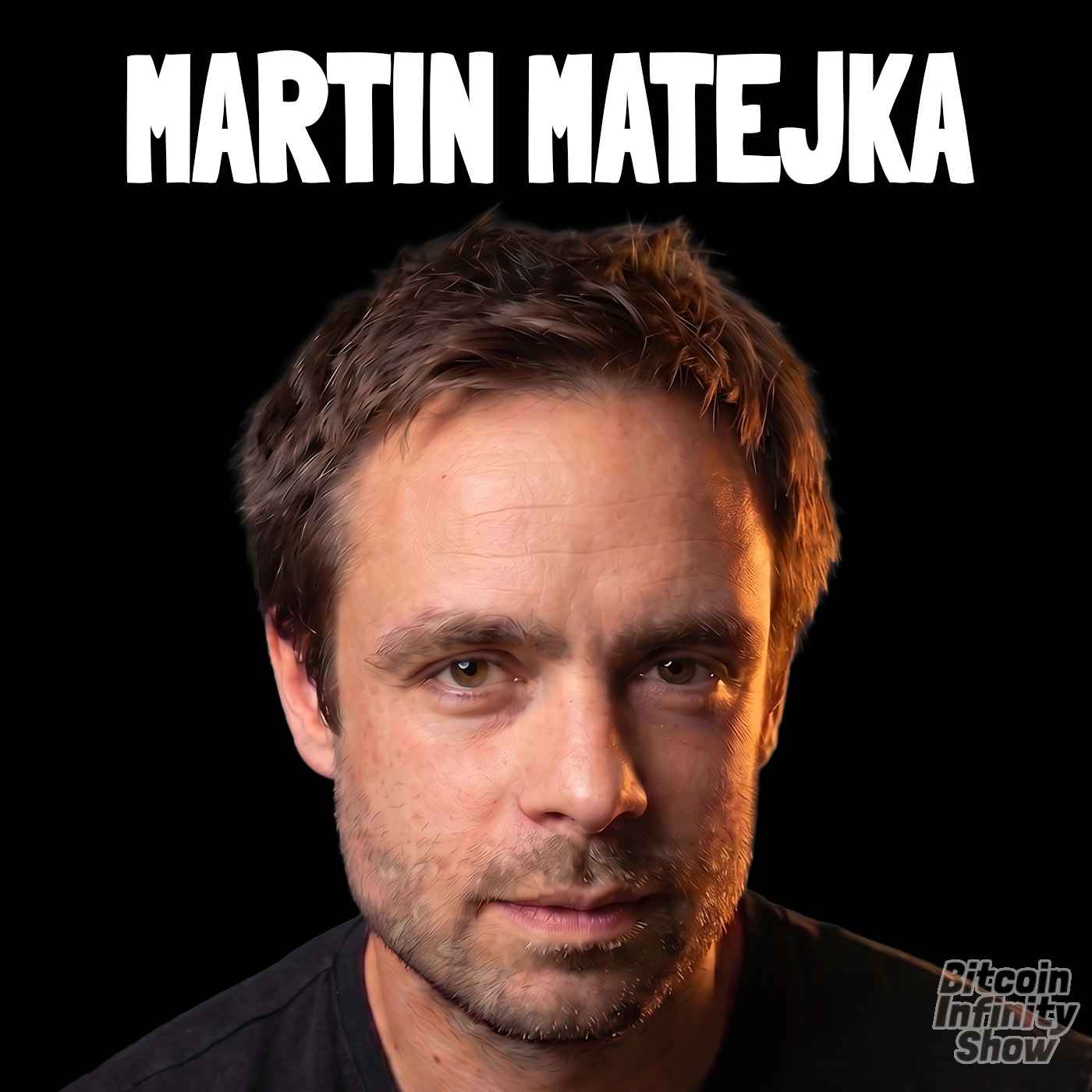
How Bitcoin Backed Lending Actually Works with Martin Matejka | Bitcoin Infinity Show #212


 Fountain

 YouTube

 Spotify

 Apple Podcasts

 RSS Feed
Martin Matejka joins the Bitcoin Infinity Show to talk about using Bitcoin as collateral for loans without handing your coins to a trust me bro platform like the ones that collapsed in the last cycle. He and Knut get into how Firefish uses Bitcoin layer one tools like multisig, timelocks, and partially signed transactions to keep counterparty risk low, why borrowing in fiat is really a bet against a failing currency, and how self-custody changes what it even means to own an asset. The conversation widens into real estate as a store of value, the illusion of ownership under central planning, and why sound money and abundant energy point toward a freer future.
Connect with Martin:
Connect with Us:
https://www.bitcoininfinityshow.com/
https://bitcoininfinitystore.com
https://twitter.com/BtcInfinityShow
https://twitter.com/knutsvanholm
https://twitter.com/lukedewolf
Thanks to our sponsors - check out their websites for info:
Firefish: https://firefish.io/ - Use Code INFINITY!
Bull Bitcoin: https://app.bullbitcoin.com/registration/infinity
BitBox: https://bitbox.swiss/infinity - Use Code INFINITY for 5% off!
Bitcoin Adviser: https://content.thebitcoinadviser.com/freedom
The Freedom Footprint Show is a Bitcoin podcast hosted by Knut Svanholm and Luke de Wolf.
In each episode, we explore everything from deep philosophy to practical tools to emit freedom dioxide to expand your freedom footprint!
0:00 Martin, welcome to the Bitcoin Infinity Show. Nice to have you here. Hi, Knud. Thanks for having me. Yes, I think most of our listeners do not know who you are. So why don't we start from the top with a TLDR on who you are and what you do? Of course, why not? I'm a Bitcoiner, ex-TrotFi guy, now building Bitcoin startup and trying to make Bitcoin a little bit more usable for some of the people So that's it in a nutshell, I guess. Yes. And what's the startup? Yeah, it's Firefish. It's platform for loans backed by Bitcoin.
0:41 So what it allows people is actually to access the value that is accumulated in their Bitcoin holdings. We created kind of marketplace around this concept so other people can fund Bitcoin backed loans. Yeah, this is an interesting topic. There are a lot of similar companies around and of varying quality, to say the least. This is something that I do not normally recommend to people. I mean, Firefish has gracefully agreed to sponsor this show, and I've decided to take on you as a partner because I liked your platform better than most other platforms. mostly because it's more secure and has a more technical solution to this thing and that it's a marketplace for these instruments.
1:31 I still advise most people to just hodl for longer than they think they should hodl before they start using their Bitcoins as a medium of exchange or as collateral. But what are your views on this? Why did you start working on this? And what were the motivations for starting Firefish? Well, I was in a position that I would use the service, but I didn't find any platform that would actually, I would feel comfortable to use. There was a time, perhaps you remember those days when the BlockFi and Celsius were still around and, you know, I was in a personal situation where I required some cash for, to pursue investment and hold some Bitcoin that time.
2:18 And I was, Hey, perhaps I should use that as collateral. And I realized that there are not good options at all available. There have been these platforms where I started to call them trust me, bro platforms where you trust some bro on the other side, you, you send them your Bitcoin and hope that it will come back one day. And for many people, unfortunately, this didn't end up well. Look, both, both block five and Celsius went belly up. And I started to think about that perhaps we as Bitcoiners, as a community, deserve more secure platforms and maybe we should even use the programmability that is embedded in Bitcoin.
3:00 Maybe we should use Bitcoin script in some way or another. So we started to think about how to minimize the counterparty risk that is embedded, how to make collateralized lending as secure as possible for the borrower. We came up with a specific protocol that is using only Bitcoin layer one. The technical capabilities that already exist are and are battle tested on Bitcoin, such as multisig, partially signed Bitcoin transactions and timelocks. And we created some kind of a contract on the Bitcoin network that facilitates the escrow, the underlying security instrument.
3:45 So this is it. Yeah, I mean, it's impossible, I guess, to mitigate all the risk when you're dealing with fiat and when you're dealing with banks, because there's always that side of the equation. And this goes for exchanges and everything else. All the bridges between Bitcoin and fiat still have to fiddle around with fiat land. And that is where all the problems exist, the way I see it. Bitcoin itself is fairly simple, but fiat requires a lot of things like KYC. And you can also claim that you didn't do what you did and you can get your money back.
4:30 And if the company goes bankrupt, there are guarantees and stuff, meaning that the taxpayer eventually pays all the costs. How did you tackle that? Like what's your approach to fiat land? Well, maybe I will start with the Bitcoin land, like how we tackle the risks related to Bitcoin, because if you want to use your Bitcoin as collateral in a simple terms, you pretty much need to say like, this is the security that is available in case I don't pay back what I owe you. You can take my Bitcoin and sell it to satisfy the loan, right? So there is some kind of right to transfer to somebody else.
5:13 And how to do this as secure as possible? And our answer is to use Bitcoin as a kind of enforcement layer. So we created kind of a simple kind of contract that pretty much says, once Bitcoin is on a particular address, it can be spent only in two ways. either back to the borrower, and that address is part of the partially sent Bitcoin transaction, so it's pretty much baked into the contract, or to the liquidation address. And your trust towards the platform is not zero, but it's limited to the extent that Oracle, that is currently Firefish, chooses one of those directions. So we, as Firefish, we cannot send Bitcoin to my personal Trezor or any preferred hardware wallet or not even to the tax office if they require us to only to do to those two predefined addresses. Back to your question about the fiat currency. Like what I would say, what is interesting to see is that you are on the good side of the equation. You are pretty much short fiat currency. Like as a borrower, you create the liability in fiat currency. You can see that as shorting fiat currency per se.
6:32 That means that you are benefiting from the fact that fiat currency is deteriorating in the value over time. You borrow $1,000, you repay $1,000 plus interest in some time. What is interesting, $1,000 now is not the same as $1,000 in the future. So being short fiat currency via loan in general, it's quite interesting financial strategy. Like there are two, like maybe I'll share a little bit about my like investment or financial thesis. One of them is long Bitcoin. That's why I hold Bitcoin because I think it's going to be one way or another like core of a better financial system.
7:17 That's one thesis I hold. another one is that fiat currencies are going to zero in definitely over over a long run so i'm doing my best to be as short as i can fiat currency and like one of the ways how you can do it is taking a loan it doesn't need to be backed by bitcoin uh alone in general yeah i mean this is how the the richest guy to come out of the weimar republic made his fortune is to you know take as much loans in the failing currency as possible to buy as many assets as possible, mostly gold in his case. But I guess this is the same tactic. To me, it sounds like if you're going to do this and if you're going to survive the short-term volatility, which may span decades, you sort of already need to be financially set for this to make sense.
8:16 Would you agree with that? Well, yes. Let's put it this way. We think actually the collateralized lending is kind of a machine gun you have in your hands. You can also hurt yourself I mean there risk of liquidation There is some element of risk that you are taking when engaging with Bitcoin back loans It can be very very useful to you and to your financial strategy. I use this strategy myself whenever I need cash for whatever can be my kids education. I tend to use Bitcoin back loan. At the same time, if you overexpose yourself to the Bitcoin back loan, you are facing risk of liquidation.
9:14 This is something that everybody should be aware of. Yeah, and I think if I remember correctly, that the smallest amount of collateral that you allow for is like double what you're, right? Yes, we decided not to fiddle with this parameter too much to make it as safe as possible for borrowers. And we originate all loans at 50% LTV. That means that to borrow like 10,000 euros or dollars, you would need twice as much value of Bitcoin at inception flow. Yeah, so let's dig a little deeper into this.
9:57 So for instance, if you take out a loan to buy another asset than Bitcoin, would that really be advisable given that Bitcoin will probably outperform all the others? Is there a point to that? Could you like collateralize your Bitcoin to buy more Bitcoin, for instance? Would that be a good idea or is that just stupidity? This is what some people do. And I'm not here to judge. I think like it needs to be everybody's own decision, like how big of allocation of the assets to Bitcoin, whether it is 100% or less or even more. Like if you use Bitcoin collateralized loan to buy some more Bitcoin, then your like allocation of your wealth can be more than 100% to Bitcoin.
10:46 So there is an element of leverage to it. If you use this strategy, you could use Bitcoin back loans for consumption, but also to pursue financial investment or scale up your business. This is what a lot of our clients do. They actually scale up their business. Yes. And do you think this is of detriment somehow to Bitcoin being used as money? Like, isn't this taking away from that market? Like Bitcoin being used as a medium of exchange over space? or is that like not important? What are your thoughts around that? Well, I realized that there are a lot of, so much different expectations from Bitcoin and a lot of people disappointed because their expectations are not met.
11:35 I'm not here to judge like what is the use case for Bitcoin that should be pursued. I'm happy that people are working on a medium exchange kind of use case like a Lightning Network is growing like month by month and all these. I'm happy for that. Like we decided to perhaps extend the store of value kind of thesis of Bitcoin or use case. And I really think accessing the value in store of value asset is just kind of a natural extension of this use case. So honestly, I don't think this should be like competing cases. I think like in the free market, we should be trying to pursue both of them, or maybe even some more.
12:19 Yeah, I agree with that. I think the value of a thing like this is different for your KYC stack than for your non-KYC stack. So I'd say if you live in a country where you know that you're going to get a big capital gains tax bill as soon as you sell your Bitcoin on your KYC stack, then maybe this is a better solution for getting some medium of exchange use out of that stack, whereas it's not as useful for your non-KYC stack, which you can just use as money anyway. Would you agree with that? Yeah, I would agree with that.
12:59 At the same time, I think the dilemma I was facing at some point in my life was, you know, there is some strategy or investment I would think to pursue. It was a business, right? And I was in a dilemma there. do I sell my Bitcoin? And, you know, that was the best asset I had on my own balance sheet. So, you know, I'm coming from the traditional finance. And it seems like clear for people in TratFi, that holding the best assets on your balance sheet is a good idea. And creating liabilities in the bad assets is also a good idea. And I was in this deal. I'm like, do I sell my Bitcoin, the most precious asset I have on my balance sheet? And I was like, no, no, I'm not gonna do that.
13:41 And how do I, you know, access the liquidity that I need for my other goals? And this is why the collateralized lending is such a powerful tool. You don't need to give up ownership of the best things you have to be able to pursue your goals. No, and if you expect your company or your investment to outperform Bitcoin, then it's a non-brainer, I guess. But I view post-hyper-Bitcoinization, where there's only Bitcoin around, it will be way harder to make a company actually profitable. I can even see a scenario where you start a company to make your stack diminish a little slower because everyone's stack will diminish over time.
14:31 Almost everyone's. Because it's a deflationary type of money, there's a limited amount of it. So eventually they will fade away. It's such a weird thing to think about. But we're living through the early stages of hyperbiconization. And these bridges between the new world and the legacy system, they sort of have to exist. Yeah, and if people want to use them, they should use the more secure ones rather than the block FIs and the Celsius of the world, let's just say that.
15:12 Of course, 100%. And I agree that these tools, like we are building tools for world as it is now. We are hoping for a better world with a much better financial system over time. And we are building for nowadays. And whatever is making Bitcoin more useful to people is actually supporting Bitcoin adoption over time. And we are building tools for Bitcoiners. We are Bitcoiners. We are pretty much building tools for community and we hope it will help to make Bitcoin more usable for some of the people, maybe not for everybody. Honestly, I don't think collateralized lending will be used by everybody, but we hope those products and tools will be kind of of high value to some of the Bitcoiners around.
16:02 Yes, I would add to that that whatever adds use value to Bitcoin as money, I don't agree that Bitcoin should do everything. It should still be money, but as long as it's a monetary use case, then I'm totally for it. So is it a good idea to collateralize Bitcoin to take out a mortgage to buy a house, for instance? What's your thoughts around that? Depends. Currently, the interest rates you could get on mortgage tend to be lower than on the Bitcoin back loans. Honestly, I think this is a transition period again.
16:44 like there is a discrepancy between the rates on Bitcoin back loans that are currently, they're finally single digit, even on a non-custodial platform as ours, on a secure platform as Firefish, but still you could get much lower rates taking out a mortgage. And the reason is that there are proper credit rails built around the real estate. They are depending on the legal system largely on the legislation, but they kind of work. We see what we do as a kind of building a credit rails around the Bitcoin We will not need to depend on the legal system nor government enforcement because we can enforce the legal contracts in between borrowers and lenders via technological means using Bitcoin blockchain and its execution environment.
17:36 So back to your question, I guess in some situations it makes sense. In some situations, it can be cheaper to take out a mortgage backed by real estate. Yeah, and the thing is, Firefish is a marketplace for these things. So interest rates go down naturally because there's a free market happening there where people try to outcompete one another for the cheapest loans. In fiat land, that isn't really true because it's all being centrally planned by central banks setting interest rates for the other banks and so on and so forth and printing money, quantitative easing and all of this.
18:22 All of these malincentives sort of play into that whole thing. So it's sort of the illusion of low interest rates and you don't see the entire costs. For instance, when I hear the word negative interest rates, it's just like, I know that there's no such thing as a negative time preference. People can have a very high time preference, but it cannot be negative. Everyone prefers money now to money later. That's always true. So, yeah, I think this is fair. Let me be a devil's advocate. bit here. I would just add that unless there are costs related to holding the money or the asset.
19:09 What we have seen recently, and I think it's kind of a case now, is that there is no explicit interest rate curve on Bitcoin, but I would assume that there would be negative interest rates. Because people prefer financial exposure to Bitcoin price, comparing to holding physical Bitcoin. Holding physical Bitcoin implies some costs to institutions and they prefer not to deal with that thing. So it seems that unless, like your argument is true, unless there are some perceived or real costs related to holding to the asset. I think this is the thesis in Seyfedin's Principles of Economics book, that negative interest rates can actually be possible given that the cost of securing the money you're holding is higher than there's a balance there somewhere. So if you want to remove that cost, you might as well lend it to others and take on some risk that way. What would be the incentive to be the lender on FireFace? Like not the borrower, but to actually provide the liquidity for others.
20:20 what's the incentive to do that the interest of course but yeah what what would be the best argument for anyone to do that to believe or not there are still some people that hold some savings or some assets in a fiat currency and for those i think the value proposition is pretty simple interest rates that are much much higher than the risk that is involved Imagine the investment that is backed by twice as much collateral as your investment. So what is nice on this, maybe I'm just diverting a little bit, but on Firefish, you really don't need to care who is opposite side of your trade.
21:03 If you are lending out money to someone, you don't really care whether it's Warren Buffett or a lady from the grocery store downstairs. You don't give a damn. I mean, the Bitcoin is the security behind and you don't really care about the credit score or who they are, if they're a billionaire or not. To invest on Firefish, it means that whoever you lend your money to, your investment is secured by Bitcoin collateral. Like they will either pay you back or their Bitcoin is used to pay you back. There are no other way. So in my eyes, there is very, very limited risk embedded into this kind of transaction.
21:46 And interest rates are still relatively high, much higher than on your bank account. All right. And one more thing I would add is that for many people on our platform, actually, this was their first encounter with Bitcoin. My parents are using Firefish to lend out their savings. They are not holding any Bitcoin. They don't have any Bitcoin address, not the Bitcoin wallet. They cannot operate Bitcoin. Still Bitcoin is somehow useful to them. They are lending money to random people across Europe and Bitcoin is making the transaction secure. So they're using Bitcoin without even touching it.
22:29 And for them and many others, this was their first encounter with Bitcoin. So would you say that it could be an onboarding tool like that, like a tool for orange peeling people who hold large fiat stacks? It is. It is like on our platform, it is onboarding tool. People realize that Bitcoin is useful to them. I'm not saying that everybody starts to wear orange T-shirt the next day, but they realize that there is something to it. Like this internet money is not only for geeks and, you know, economics freaks. It's useful as it is, and it's helping secure their transactions, to secure their life savings sometimes.
23:20 Yeah, why not? Why not just hop onto the train, right? If you can make money off of it. So, yeah, we mentioned real estate there before. I know you have some other thoughts around real estate. What do you think is going to happen? Is this part of the everything bubble? Why is real estate the way it is? What are your thoughts around the real estate market? Well, I've been thinking a lot in this regard for the last recent months and years. And I was thinking how actually real estate relates to Bitcoin and to some other store of value assets. Like real estate seems to be by far the biggest store of value asset. And what is interesting, it's not only store of value asset, there is also the utility value to it. So when you kind of dissect the value of real estate and real estate market, it seems to be partially utility driven, like the shelter value, but also to a large extent, there is some monetary component to it. Like people use it to be shielded from the monetary inflation pretty much.
24:29 And it's interesting to think about like why real estate, why not other assets and et cetera. And it seems to me, it got a lot of to do with these credit rails that are built around the real estate. It's very easy to borrow, to acquire real estate, but also to refinance, to use your real estate portfolio to excess liquidity for anything else. It's super easy, at least in the first world where the legal system works, because enforcement and like this credit plumbing is dependent on the legal system.
25:10 You might ask like, or I'll ask you like if you have three choices, like you could collateralized house, Ferrari and Goldbar. Like, or you are a bank and you should lend against these three assets. Like, which would you choose? And maybe not, but I would assume you would choose the house. Like, Ferrari can be driven away. Goldbar can be just taken to your next flight to Kuala Lumpur and sold on the, on the, on the black market or whatnot. And house will still be staying there. and itself can be enforced by the legal system.
25:52 What I'm saying is that perhaps we came to much better collateral than real estate that is not dependent on the legal system that can be transferred all around the world And that can be liquidated in a split of seconds A collateral whose value is clear at any single second in a time. There is a super liquid market for Bitcoin and you could realize the loan, I mean, the sale of collateral in a split second. I think once the credit rails around Bitcoin are more mature, this is something that we are working on at Firefish, we might see a tectonic shift in asset allocation across the world, where people realize that perhaps real estate might not be the best store of value asset.
26:44 asset, and perhaps more and more people will realize that there are better assets, more fitting the digital world we live in. And in my eyes, that's Bitcoin. So how I see the future evolving is that over time, this monetary premium on the real estate will tend to collapse and we will see a lot of capital inflow into the Bitcoin. I really think the prerequisite for that to happen, besides other things, is also functional credit market around the Bitcoin. Yeah, I mean, it's the tragedy of the commons, right?
27:24 Because there are so many tragic side effects to real estate being store of value. Like I always try to promote this. There's no, the dichotomy between store of value and medium exchange is really false. it's all medium of change. It's just that it's medium of change over time and space. So I prefer medium of change over time to store a value because that's what it actually means. You're trading with your future self. And when the money is broken, as in case with fiat, people put their money in real estate instead because of all the reasons you said. A Ferrari can be driven away, a gold bar can be stolen, but a house is what it is. And And since everyone else also expects all the house prices to go up, everyone also expects more money to be printed because that's the only way houses can go up in value.
28:19 In fact, it's the only thing anything can go up in value because if you denominate in Bitcoin instead, which is fixed, you can see that all prices are dropping forever, including for real estate. But the sad side effect is that, for instance, quite close to where I live, there's a quite luxurious area, which is a ghost town, because all of the houses there are bought for the store of value or medium exchange over time purpose only. Sure, some of them are holiday homes, but people aren't even there for their holidays. They're just empty, and they're too valuable to rent out to people, I think, because it's just a ghost town. And this is what happens. The billionaires buy up all the beachfront property and still you have a housing crisis in the country because it gets funneled into the hands of the already rich and they buy up all the houses and poorer people have no place to live. It's very expensive to be poor in fiat land.
29:21 So Bitcoin solves both those problems, I think, because if you have an asset which is more secure than real estate to put your use as a store of value, then all of a sudden it makes no sense to own more than one or maybe two houses. Maybe you own one and maybe you own three houses because you want some jurisdiction or arbitrage or something. But more than that makes no sense whatsoever because you can just put it into Bitcoin and it's going to pay you off more. If you zoom out, you can see that all prices of all houses, all real estate prices are dropping if you're using the right denominator. If you're denominating Bitcoin, they are dropping over time.
30:03 So I think that it's just a matter of time before this tectonic shift that you talk about plays out, because it has to and it will solve. This is one of the famous Bitcoin fixes this cases, right? Because Bitcoin actually does fix this in a very direct way. To a big extent, I would say that in my eyes, it got all the properties to fix this monetary value that is embedded in real estate. I think over time, real estate should really converge to its usability properties that it would be priced based on cash flow.
30:43 And it will be much more normal to rent a house and not to own it because you just use it as another tool that you are using. It provides you shelters, you pay for shelter. If there is no expectation that the price would go up in time and it's kind of shielding you from inflation, then you are indifferent whether you own or rent a property. People prefer to own it because it's shielding you from the monetary inflation. At the same time, you are pretty much leveraged because you take mortgage and this is how you kind of manage yourself. This is what people do, people are not stupid. What I wanted to say as well is that it's not going to solve all the problems of the inflated housing prices, because to a large extent, it's driven by the central planning as well. You are living in Europe, I guess, same as me, and we have a huge problem with the central planning. It's an illusion. Owning real estate is pretty much an illusion, like that you own it you're pretty much uh it's it's just like it's it's uh it's some data in a government database like you will realize that you would realize what i'm talking about if you try to build a house on a random plot of land you own somewhere like uh it's not permitted by the government and you cannot do anything with that land until they love you so is this owning something I mean, like they allow you to have some rights towards the real estate, but in reality, it's government's real estate that you can use for some time if they allow you.
32:26 Yeah, and especially if you're paying property tax, then it's just the mafia owns the building. Like it's that simple. And this is so interesting because like, yeah, there's a difference between ownership and possession. And ownership is supposed to be your legal relationship with a thing. Possession is actually being in possession of that thing. So the Ferrari, for instance, the thief would possess the Ferrari, but you would still own it. But you can't do much about that if you don't have the rest of society to try to catch the thief and give you the Ferrari back. So Bitcoin, on the other hand, are they even ownable?
33:08 The information about the asset is the asset. So you can act as if you own it because you think that the likelihood that someone else has access to the same private keys as you do is very low. And also the probability that the system will change in the future to where the 21 million cap will ever change. That is also super low. So you believe these things and you take them for granted. And that allows you to act as if you owned it, which is actually way more powerful than literal ownership. Because literal ownership doesn't even exist in Fiatland. It's always permissioned. You're always only semi-owning stuff with a permit from the government saying that, okay, you can live in this house.
33:56 So Bitcoin is really empowering people in that sense. It's giving the power back to people and making ownership possible again. Mopa, making ownership possible again. That's a nice hat. Those are very interesting ideas, Snoot. Have you ever thought about it that way? Like a question that if you actually can own Bitcoin or not? Have you thought about it on that level? I never thought, but I'm pretty sure I will after this episode. Those are interesting ideas. I never thought in this direction. Yeah, there's another thing. People say that Bitcoin is backed by energy, but I think that framing is completely wrong too, because behind the energy.
34:43 is a person running a node. So a person voluntarily buying hardware and choosing what software to run on that hardware. So it's actually backed by human beings. The energy is just a proof of work to prove to that human being that this system actually works and no one can cheat it. So it's part of what makes you believe in the system, but the believer is one level deeper than the energy involved. Do you have any thoughts around that or thoughts around energy in general? Well, there are like a lot of kind of metaphors people use about Bitcoin. Some of them make more sense than others. Like, I like to see Bitcoin as a piece of technology that, you know, serves some cases and helps people in this and that. It got some specific properties. Like using these metaphors about stored energy or something, it's just too esoteric for me work in this level of abstraction, let's put it this way. Yeah, all the metaphors are flawed. There is no correct metaphor. We still we use them to make sense of things but it also leads to a lot of confusion sometimes i mean the the yeah the term wallet yeah i i agree like bullet is like metaphor as well like you are storing a secret i don't know if that is uh a wallet but like secret storage would be maybe
36:17 more appropriate word uh for that also like i think there is a lot of misconception in uh in general in economics. People misuse inflation. People think that the CPI, like changing the price index and the inflation are the same terms. And they're obviously not. I think there are a lot of misconceptions coming from flawed economics education that people face. absolutely the CPI basket is sort of it's the pay no attention to the men behind the curtain thing look at what the right hand is doing while the left hand is printing money it's not highlighting the underlying problem because housing gets more expensive fine art gets more expensive that's where the money ends up so the stock market keeps growing, all the stocks keep going up in price.
37:18 Even during COVID, for instance, the stock market boomed, which makes absolutely no sense if you have some knowledge about economics. Yeah, 100%. And well, there is still like one piece of economics I tend to preach people about because I stopped preaching about Bitcoin or, you know, stuff. But inflation in my eyes, it's such a misuse term that I still kind of trying to explain people that the problem is much higher than they think. That like neutral monetary system, you would see the prices go down due to technological progress of pretty much everything over time.
38:02 This is the normal situation, not the zero CPI kind of change over time. So the problem of central banking and money printing, so to say, is much higher than people think. It's not only this CPI number they see in the newspaper, but also all the technological progress that is stolen from them by government and central banks. This is something I tend to explain to normies. Maybe I would have one question to you. Like I'm kind of struggling to explain Bitcoin. why it is important without explaining what's the problem. Like there is underlying monetary problem we are facing as a society that we still kind of didn't get rid of the central planning in the monetary area. How would you explain why Bitcoin is important to every Joe in a bar without mentioning there is some problem? Because when you are talking about problems, it brings a lot lot of negativity to the table. And I'm struggling how to bypass this negativity and just to bring positive solution or not even solution like positive aspect to it. Yeah, that's a good question.
39:17 And it's a hard problem. I don't think you can understand Bitcoin without understanding the problem. Because it's sort of like explaining medicine to someone who has never realized that they had a disease or maybe that's a bad metaphor but you sort of need to understand that prices ought to be going down and not up and most people are like that really requires a rewiring of the brain for most people because most people the insight is horrible to people because that means that the entire system that we're living in is a lie, and that all the politicians and all the bankers have been lying to them all along, which is a very harsh truth for people and a hard pill to swallow.
40:07 If you think deeper about it, it says a lot about democracy. It says that democracy doesn't work since we end up in this situation, even though it's supposed to be the will of the people and stuff, but still complete assholes end up on top and they steal from everyone all the time it's a very hard pill to swallow but i think you have to start there and my favorite way of initiating that conversation is saying okay so two questions the first question is if people practice doing things do they usually get worse or better at the thing they're practicing doing and the answer is obvious You get better if you practice.
40:48 So the second question is, so why aren't all prices going down forever? Because those should be connected. If we get better at doing things, the cost of everything should go down. And it's like, if they get that, that's a very good gateway drug. Because maybe you can get their brains going. And you don't have to frame it as a negative thing. You can just say, so just ask those two questions. The other one I love is... Those are good questions. The other question I love, but this is more in normal land, that question might be too deep for certain people. You can start by asking, why are people in the public sector paying taxes? What's the point?
41:30 If they're paid by taxes, why are they paying taxes? And the only reason they are is because they want the facade of them being as productive as the private sector, which they're clearly not. Their cost. Sure, they might provide value and stuff, but not as much value as they could have provided had they been in the private sector. So that another one of those really simple questions that I love asking people Just sneak it in there somehow Got you Why do you think are not all the public expenses in the normal land funded by the monetary inflation outright?
42:12 Why does this puppetry of tax system and all the bureaucrats and everything that is clearly not effective exist at all? And if you are printing money, why don't you just print money to fund public expense and not play with taxes and all these unnecessary things? Why do things that modern societies, now that we call democratic societies, Western societies, evolved in this way? Yeah, I think how history played out plays a huge role in that. So we have to know the history of taxation and the history of banking and the history of central banking.
42:56 So the history of fractional reserve banking is when banking was born, there's a guy in the village who happens to have access to some kind of vault or he promises to keep people's assets safe from thieves. And he charges a bit of a fee for doing this. Sometimes the fee is baked in in that he can use the assets to lend out to other people, so you can actually make money putting your stuff in the vault. But the point I'm trying to get to here is that whenever this primal banker figures out that he can give out more receipts for stuff in the vault than there is actually stuff in the vault, that's where fiat money starts.
43:38 So the banker realizes that he can get very rich by giving out more receipts than he actually has stuff in the vault. And people start trading these receipts. That's the first monetary bill, how that is introduced. It's way more convenient because you don't have to trade the actual gold, which is heavy and hard to divide into smaller pieces. You can just trade the pieces of paper. and the banker can just print pieces of paper until everyone calls his bluff at the same time where a bank run ensues. And this happened a whole bunch of times historically and it's actually the reason the central bank was born.
44:19 The central bank was born to bail out the poor banker who finally got to experience the find out part of the fuckaroundery by being chased down with pitchforks and torches by angry customers, which is the way things should be. Like banks who deal in fiduciary media or fractional reserve, they should be like kicked out of society and thrown in jail and stuff. That's the proper way to handle that. But instead, they form a cartel and they invent the central bank to bail out the bankers whenever they're in trouble. And all the central bank does is amplify the problem because it's very hard to do a bank run on a central bank.
45:01 So I think the evolution of the central bank is different to the evolution of politics. It's not like directly connected. And it's not the exact same people that benefit from taxes that benefit from central banking existing. But of course, there are political ties. The central bank wants to be free to do whatever it wants. So it can print money to bribe politicians to make rules that are better for them. The smaller banks can do the same thing. If they can make money from interest from money that doesn't exist, if they can do fractional reserve banking, they can bribe politicians to make decisions for them that are good for them and not for their customers. So it's a vicious cycle. And I don't think that they claim that we need both money printing and paying taxes. It's more a product of how history played out than a planned thing. It just happened to happen that way.
45:57 But the problem gets worse. The bankers get more powerful and the politicians get more powerful because of both these things. And right now we're in a world where there are four countries that don't have a national debt. Because in order to keep up with the pace of the other countries, all the countries need to take out loans themselves. And your taxes goes to paying interest to those evil bankers. Like it's just vile through and through. So that's why you need a higher and higher tax burden, even though you're printing more and more money. So it's just funneling wealth from the people to those who already have the power. And quantitative easing, for instance, is when the US government goes to the Fed and says, Harrison, government bonds, we want these in exchange for newly printed dollars.
46:47 So the Fed prints new dollars in exchange for government bonds. But what is a government bond? It's a promise from the government to extort even more money from the population in the future. So it's a promise from the government to be even more as holy to your children than they were to you. And what you get in exchange is money that works even less well. so it's all a vicious evil cycle and it's impossible to stop because it's always exponential the new interest that isn't in circulation you need an interest on that interest so it compounds, right?
47:31 so all fiat currencies are hyperinflating they're just doing it at different paces but it's inevitable they all die and they all have to die hyperinflating so that's why they reset monetary systems every once in a while like the euro for instance when the pesos and the whatnots of the world of Europe were going to shit they had to like invent a new thing and then they claim that that is much more legit than the old ones and it just simply isn't the only thing that is legit in the monetary world is bitcoin because it's the only one that has a capped supply so end of rant Yeah, we have Bitcoin. I think like you mentioned that things are getting worse over time. And I would maybe provide a slightly different view on that. From my personal experience, I see that the things are getting better over time to some extent. Believe or not, I was born in a communist country back in the 80s. And things had clearly changed for better. At that time, pretty much all aspects of the society in where I lived had been centrally planned, like from the central banking down to any possible aspect of human life, like distribution of the groceries. It was handled by government.
48:59 And we as a society got rid of that clearly, for a better. There are still some realms of central planning that are kind of intact. And I just wondering why exactly like monetary like area why central bank Why like we kind of rely on the central planning in such an important part of you know functional society as this amazing invention we did as mankind that is money. It allows us to, you know, exchange value and you know, create very complex systems and very complex production systems to organize as a society for very complex projects. And we still are okay for central planners to do the job for us.
49:53 Like why do you think this is the area that stayed in government control for such a long time? time. It doesn't seem to change in the very next, very near future. But on the positive note, I would mention that now I think we have a tool we can base a much better financial system on. In my eyes, it's Bitcoin. Honestly, I don't know if hyper-Bitcoinization ever happens, if it is happening tomorrow or never. I don't want to speculate on that. I don't know how we will use the Bitcoin exactly, if it is going to be more sort of a value or like medium exchange or how exactly, or maybe it's going to be just the collateral we use, but we will have this healthy base for the modern finance. This is what I know for sure.
50:41 Back to my question, why do you think that the central banks are still kind of on? They operate as they operate and we got rid of the central planning in most of the areas over the last, let's say 200 years yeah first to address the everything isn't getting worse part because uh i don't i'm not saying that everything is getting worse everything is getting better the cost of production and the cost of transportation of every single good and service in the world is lower than than it has ever been it's just that we don't see that because we live in fiat land so it's not accurately reflected but some people see it and the closer you are to the monetary spigot the more you see it. And of course, if you lived under communism, or if your parents lived under communism, of course, it's better now than it used to be back then, because that was totalitarian. That is where we're headed if we go down the wrong path here. I think the reason the central banks are still so dominant in every single country is because people aren't aware of any alternative to it. And this is partially by design, because there was an economist called John Maynard Keynes that governments absolutely loved, because he said that government spending is what makes for a good economy. So he promoted government spending, and of course, governments love that. So of course, in government-funded universities, that guy is predominant in the curricula. That's what people are being taught.
52:16 And he was simply wrong. But there's like no alternative. All the dissenting voices, like the Misesians of the world, get suppressed by this ginormous machine that is the state and the banks, the banking cartel. Because they have all the power and they're not going to give it up easily. They're going to give some power back to the people where they deem it necessary. but in the long run, it leads to more and more control. And the only way out of it is Bitcoin, the way I see it. Up until 2009, there simply wasn't an alternative to it. Knut, may I have one more question? What do you think are other areas besides the monetary kind of realm where the government is still keeping control and it's kind of a trouble?
53:10 it's making our lives worse comparing to more kind of free market. Like, what are the particular areas you see as examples of that? Like we identified central banking and a possible solution, Bitcoin. What are the other possible areas that Bitcoin don't solve? Maybe. And what would be the solution in your eyes? Well, I believe that government is a net bad for society always. So I think that, sure, completely, a world without government would be a world without aggression. And that's what I want to aim for. So in the libertarian worldview, it's sort of like you want to minimize the number of aggressive interactions between people. So you want people to do things with consent and never with coercion. And it's kind of utopian because inevitably someone will take other people's stuff. And this is what government is. I think it goes through, it infects all areas of life. Anything government touches is made worse because the government touched it. The biggest problem, as I see, is not even freedom of speech or censorship or surveillance or stuff like that. It's simply resource misallocation. For instance, all the green policies that are so popular in Europe, 99% of that is just a giant misallocation of resources
54:41 and it's cosmetics. It doesn't make a dent in changing any actual numbers of CO2 levels or anything like that. The earth doesn't care how much lipstick our politicians puts on a political decision. It's just creating these ginormous semi-free markets for allocating resources that wouldn't have been allocated the way they are right now had we had a functioning free market. For instance, all the wind farms out in the North Sea and stuff, I think it's all a giant waste of money. And, you know, shutting down fully functional nuclear power plants and trying to replace them with solar and pushing people to drive electric cars and stuff.
55:28 All of this is just a giant misallocation of resources. And the main purpose is getting votes from retards. And I don't believe it at all. And of course, the even more destructive thing is war. War is the worst thing that government does. And any funding towards war is making things worse and not better, in my opinion. So if you see these things as criminal gangs, it becomes much clearer. So Ukraine versus Russia, for instance, you have the smaller gang, criminal gang Zelensky, fighting the much bigger criminal gang, criminal gang Putin.
56:08 But the biggest criminal gang on earth, which is criminal gang NATO, doesn't like that. So they send a lot of resources to criminal gang Zelensky so that he can go and kidnap 18-year-olds and send them to the slaughterhouse that is the war. And all of this to decide who gets to put a flag on a piece of land somewhere And it just vile through and through And the reason that it exists is because we have taxes and inflation And the only way to achieve true world peace is to opt out of that and stop funding these assholes from funding wars and funding aggression.
56:53 So I think Bitcoin is our best shot at actually regaining some sovereignty and stop sponsoring pedophiles and murderers. Got you. And I'm glad you mentioned energy because this is kind of the area I really care about. Yeah, you're the energy guy, right? Yeah, that's pretty much where I spent all my career before Bitcoin. And ultimately, I decided to leave corporate world forever and focus on Bitcoin. But before that, I was really deep in energy and energy commodities and trading. And actually, I was seeing from the pretty much front seat how the central planning in energy ended up destroying Europe in my eyes.
57:45 I really think that a lot of economy and human action and production is just downstream from energy. And creating abundance in energy is actually creating abundance in society, like free and prosperous people. And at least in Europe, but I think in most of the world, we decided to go pretty much opposite direction. to pursue ideology instead of focus on producing energy. So it was sad to see, really, that since early 2000s, I think, we pretty much started to walk down this road of central planning and pursuing energy policies that have been purely ideological with the consequences we are seeing now.
58:37 We are seeing strong decline, I think, in availability of energy to anybody, like of our capacity to produce whatever is making our lives better for the false promise of saving the planet. And I'm sorry for my rant, but I mean, like this is something I really care about still, energy and related topics. And for me, this is another area where we see that the central planning is evil and doesn't work and it's actually making everybody's life much worse. Absolutely. Absolutely. I mean, I come from the substrain of this business too.
59:23 I used to work for a shipping company that shipped technicians and repairmen to wind farms in the North Sea and the Baltic Sea. So I saw it firsthand. And I saw when they were building these things, if there were two competing companies, so one company could own the farm and another company could own the contract for the farm, And sometimes there was one guy on one ship and his bag of tools was on the other ship because that's how it had to be contract-wise. So they wasted tons and tons of diesel to just get the guy and the stuff out to the wind turbine, which is to me so ridiculous.
1:00:06 And the funny thing is that it's so reminiscent of how the old East Bloc and how the Soviet Union worked. They also did a lot of collective centrally planned bullshit cosmetic things like this for the greater good of the collective. And it's the exact same thing. It's a milder form of communism, I guess, but it's still the same phenomenon. Resources being destroyed because you put a central planner in place and you don't let things play out naturally. And I'm here to fight against it because I see through the bullshit. joining you. I mean, yeah, it's so visible in the field of energy. But, you know, as you mentioned, like, in the former communist countries, we took this to extreme. But at the same time, like pretty much all the Western civilization is going slower, but same direction as well, direction of more central planning and less freedom. And it's very sad to see.
1:01:10 I think we, on the contrary, we have some interesting tools and technologies that are coming over that might help us to be freer from the government. Yeah, we have to break free. That's the only way. Defunding them is the only thing that works, unfortunately. You can't just vote harder and hope that that will work because that's not the power dynamics at play here. Anyway, if people want to find out more about Firefish, firefish.io, right? It's the site. It's the website, firefish.io, or you can check our Twitter or X account firefish underscore IO.
1:01:58 Yeah, and where can people find out more about you? And is there anywhere else on the internet that you want to direct our listeners to? Well, I'm not active so much on my socials, so I would strongly recommend to follow Firefish.io with much more content than I produce personally. All right, so go check that out. And I do believe I have a discount code of some kind. So try code infinity wherever you go on the internet. It will probably work. Is there anything else you want to talk about before we close this out?
1:02:43 Is there anything we've skipped over here or missed? Well, we pretty much touched the areas that I deeply care about. Bitcoin energy central planning yeah there will be some more but let's keep it for another interview or if you will invite me in the future maybe you can place the link with your code to the show notes this is also where like your listeners can find a find a convenient way how to reach us absolutely and thank you very much for the conversation and looking forward to more interesting conversations in the future.
1:03:24 And thank you for the good questions and letting me rant too on my own pod. I like that. Thanks for having me. Bye. This has been the Bitcoin Infinity Show. Brush your teeth. Till next time. Bye. Thank you.