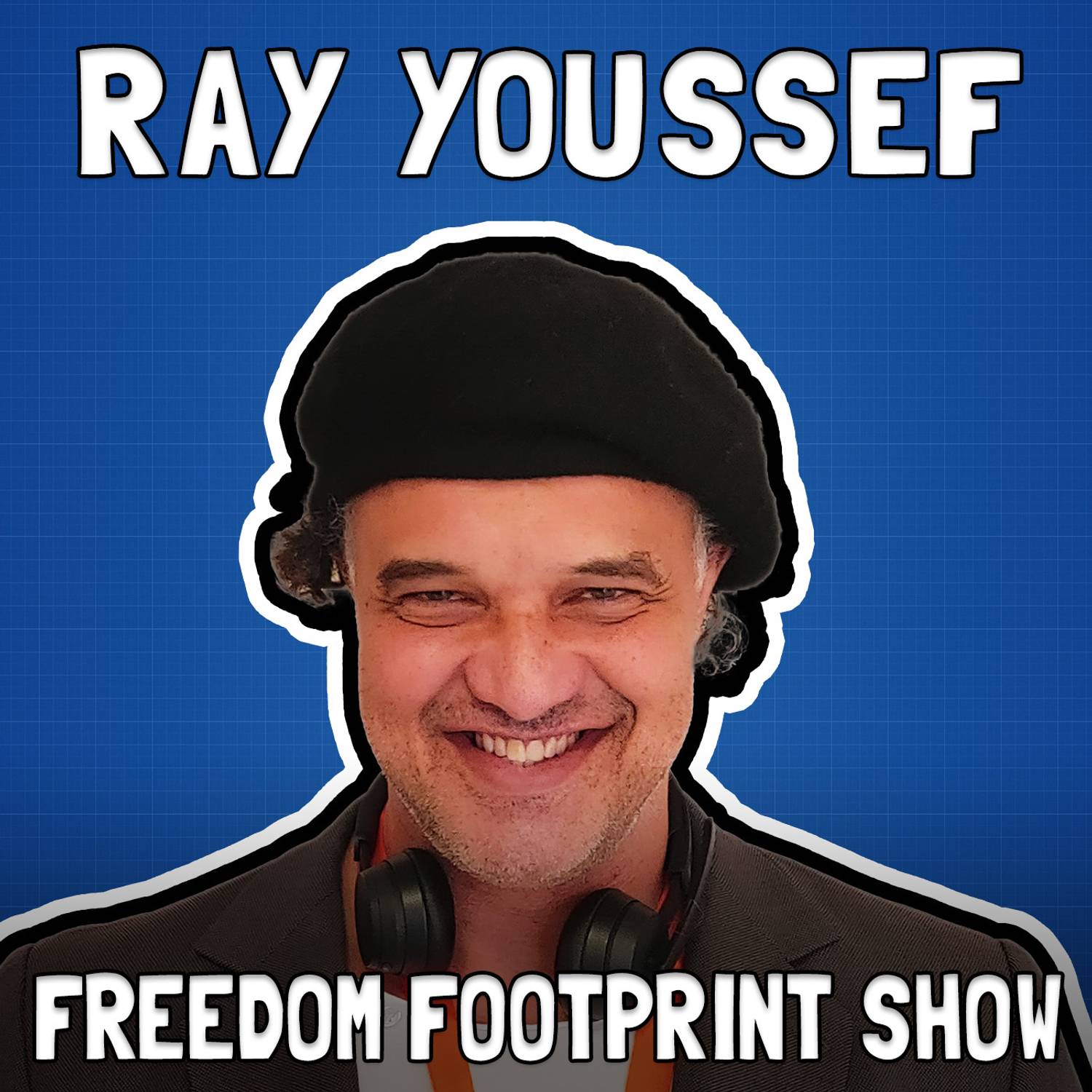
Fighting Financial Apartheid with Ray Youssef - FFS #64


 Fountain

 YouTube

 Spotify

 Apple Podcasts

 RSS Feed
Join us on the Freedom Footprint Show as we explore the revolutionary potential of Bitcoin in the Global South with Ray Youssef. From his unique perspective as a first-generation immigrant and serial entrepreneur, Ray provides an in-depth analysis of Bitcoin's role in overcoming financial apartheid and empowering communities. This episode is a deep dive into the intricacies of Bitcoin's impact on global finance, highlighting the innovative strategies that can be employed to harness its full potential.
Key Points Discussed:
🔹 Ray Youssef's entrepreneurial spirit and Bitcoin discovery
🔹 Bitcoin as a solution to financial challenges in the Global South
🔹 The development and significance of CivKit in global marketplaces
🔹 Strategies for global financial inclusion and empowerment
What You Will Discover:
🔹 Personal anecdotes and experiences shaping Youssef's Bitcoin advocacy
🔹 Technical insights into peer-to-peer marketplaces and decentralized systems
🔹 Future prospects of Bitcoin in reshaping global financial dynamics
Connect with Ray:
https://twitter.com/raycivkit
https://civkit.github.io/
Connect with Us:
https://www.freedomfootprintshow.com/
https://twitter.com/FootprintShow
https://twitter.com/knutsvanholm
https://twitter.com/BtcPseudoFinn
Thanks to our sponsors - check out there websites for info:
AmberApp: https://amber.app/
Wasabi Wallet: https://wasabiwallet.io/
Orange Pill App: https://www.theorangepillapp.com/
The Bitcoin Way: https://www.thebitcoinway.com/contact
Geyser: https://geyser.fund/
Support the Show:
If you value what we do here at the Freedom Footprint Show, consider sending us some value back. You can send us a boost or stream us some sats on Fountain. Check out https://www.fountain.fm/
You can support us directly with Bitcoin on Geyser Fund: https://geyser.fund/project/freedom/
Your engagement helps us keep bringing you the content that empowers and educates on bitcoin and freedom. Let's head towards the orange glowing light together!
Chapters:
00:00 Introducing Ray Youssef
03:45 The Global South
12:14 How Bitcoin Helps the Global South
18:33 Phone-Based Payments
20:17 CivKit
28:11 Bitcoin Adoption
30:23 Financial Apartheid
37:35 Building Marketplaces with CivKit
45:24 More on CivKit and its Goals
50:52 Hawala and CivKit
54:50 CivKit and the Future
58:04 Making the World a Better Place
The Freedom Footprint Show is a Bitcoin podcast hosted by Knut Svanholm and Luke de Wolf.
In each episode, we explore everything from deep philosophy to practical tools to emit freedom dioxide to expand your freedom footprint.
Join us as we head toward the orange glowing light together!
The Freedom Footprint Show is a Bitcoin podcast hosted by Knut Svanholm and Luke de Wolf.
In each episode, we explore everything from deep philosophy to practical tools to emit freedom dioxide to expand your freedom footprint!
00:00 - Introducing Ray Youssef
03:45 - The Global South
12:14 - How Bitcoin Helps the Global South
18:33 - Phone-Based Payments
20:17 - CivKit
28:11 - Bitcoin Adoption
30:23 - Financial Apartheid
37:35 - Building Marketplaces with CivKit
45:24 - More on CivKit and its Goals
50:52 - Hawala and CivKit
54:50 - CivKit and the Future
58:04 - Making the World a Better Place
0:00 Ray, welcome to the Freedom Footprint Show. Thank you so much, brother. I appreciate it. You got that one off? Yeah. Seriously. We have the great American Egyptian Commando, in the house, something like that. So Ray, would you give our listeners the TLDR on, on, uh, on who you are and, uh, why you're in this room? ? My name is Ray Yusef. Uh, I'm a serial entrepreneur. I'm also. I'm a first generation immigrant to America from Egypt. I came over when I was two years old, not alone, naturally. My father went first and my mother brought me and my sister over and my parents were pursuing the American dream and they were doing so.
0:43 It was, there was no opportunity back home where they were, which is sad and kind of insane considering how rich of a country Egypt is. But looking back on my life and coming to know the world as I have. There's a lot of countries like that, Nigeria, you know, all the entire global South, basically. These countries are loaded with natural resources, brilliant young people, and there's no opportunity there. So we came to the West. We had a hard life. I grew up in Hell's Kitchen in New York in the eighties and nineties, working at my parents newsstand, which was quite the education on how to do business on the street, yet it served me well. Then I became an entrepreneur. It just means no one would hire me.
1:23 So I taught myself how to code, started building websites and, uh, ironically enough for over 20 years, um, all my startups were peer to peer. All of them were peer to peer, peer to peer, music, peer to peer, ringtones, peer to peer, file sharing, peer to peer, everything, just trying to cut out the middleman, right? And, and every single, um. Startup that I had, the problem was always billing, right? And then I discovered peer to peer electronic cash. And I'm like, Hey, wait a minute now, this might solve my problem. That's why I'm here because I've spent the past eight years building a peer to peer marketplace. Yeah. Used it on top of Bitcoin.
2:05 And I got about 13 million users in Africa and the global South. Some really big wins in that last project in that, um, besides being a bootstrap company, that's always nice. I never took VC money, say no to the man, no judgements. Um, with number one, we got the first Bitcoins into Africa, which is extremely difficult because it's hard to get money out of Africa, so how are the Africans going to pay for the Bitcoin from the Americans, Europeans, and Chinese? So we had to figure out a hack there, and I'll happily tell you how that hack happened. But the best thing, for me, was that, uh, watching how the Africans use Bitcoin taught me about what Bitcoin was truly good for.
2:47 Because they're the ones that showed me, hey, this is not just a store of value or a speculative asset class. It's not about the price, it's about the purpose. And their purpose was to solve their biggest problem, which is that they can't move their money around. Their money is trapped, you know, if you want to send money from... Nigeria to Cameroon, you're better off getting on a bus with a suitcase full of cash. Because the inter swift pan African banking system is even worse than the western banking system. Right? And there's all kinds of issues there, but the Africans basically showed me what Bitcoin was truly good for. It's about the purpose, and that is as a medium of exchange, rather than the price. So, thank you to them, and because I listen to them, that's why I'm here.
3:30 People respect me, not because I'm the smartest guy in the room, but... Because I had the sense to humble myself, go to the global south, talk to the actual customer, and listen to them, and here I am. So, so where do you, what trends do you see in the world right now? Where is the global south going, and where, maybe more importantly, where is the western civilization going? Like, if you can even call it that at this point. Yeah. Yeah, well, I kind of saw the writing on the wall about 15 years ago when I started waking up, you know, and, uh, the more I woke up, the more rabbit holes I fell down. I just became disgusted. I looked around me and I'm here in New York City in the middle of this kind of Western civilization where all the money is, the UN is right across the street, and the State Department was right across the street, and the big J.
4:20 P. Morgan was right across the street, and I'm in the center of it all. And I remember sitting there, um, I was actually homeless at the time because I went down this rabbit hole, all I did was devour books and I'm sitting there across the street from the Council of Foreign Relations. This is the place where all the world wars were started, I'm sitting there, some Domino's pizza from the garbage, the raw dough, and I'm looking at this place, and I'm like, am I ever going to make a change in this world, like, I'm a, but by then I was a crazed conspiracy loon just by myself, and homeless as well, and I just remember looking at that building and wondering, how are we going to stop this?
5:04 So, at that point, you know, I was totally disgusted and I was looking for a way to make a difference and magically I discovered Bitcoin and it reawoke the fighter in me because I saw a path to victory at that point, because I understand that this battle for humanity, and that's exactly what it is, is fought in four different dimensions, right? Pillars of power, you could also call them. The first and most important is the spiritual. That's our base. Looking around me in America, it was gone, man. The enemy, the goal of every enemy general is to demoralize your opponent. Well, America was demoralized. It's a corpse. I looked at it like, damn, we're not going to win that one. Not here. The Global South is a different story. They still have that spiritual.
5:48 And the second, uh, dimension is, uh, military, physical combat, not going to win there. These devils have the biggest navies in the world, no fucking chance, right? And the third is the information war. And back then it was totally locked down. Social media was around, but right now we're starting to see social media really pick up giving people a voice and they're starting to change the narrative. However, looking at that and thinking adversarially, as I always do. The tactics of the dark side, um, is simple. They know the sons and daughters of Adam, that's those humans, are very forgetful creatures. So all they have to do is keep lying, lying, lying, wait till we forget, wait till we get tired, wait till we get more desperate, and then rinse and repeat.
6:31 So we can't win there either, at least not on that front without backup. So the first dimension, or the fourth dimension really, and the most important pillar of power is the financial. At first, use that to buy media control, program our minds, and gain control of our armies. Then, move the chess pieces around and have more power after every round, right? We're in round three right now. So we have to focus on that financial pillar. We have to take on that first. And the only way to do that, is by solving the biggest problem in the world, which is the money problem. It's not that there's not enough money to go around, because money is just work, and there's 3 billion unemployed young people in the world that really want to work.
7:14 All we have to do is give this world this new global financial architecture that it needs, so people can trade with each other. That is truly the, the mission of Bitcoin, right? It's not just to have a wallet. It's so that we can trade. Satoshi Nakamoto knew that, you know, the first version of Bitcoin Core had all these marketplace functions. I happen to be the only guy that built a marketplace organically in Bitcoin. So, hey, we're going to make it unstoppable, permissionless, and decentralized. And the global South will be the ones to lead it. All we need to do is deliver this path to them, and we're going to see rapid change. Rapid change, as in, within five years, you could start seeing breakaway civilizations.
7:56 All throughout the global South. You know, it sounds crazy. Wow. Is Wakanda really possible? Well, yeah, it really is. I mean, Zimbabwe was on, on the course to be the next like Wakanda. And then what happened? One trillion dollar notes. Yes. Yeah. Mugabe is evil. And it just doesn't stop. And they went the way of Venezuela. And it just happens every single time you have a civilization that is ready to break away. They get smashed. It doesn't matter if they're black or if they're white, like the Yugoslavians. like a superpower in Europe. They had their own space program and then, then balkanized.
8:36 Broken up into pieces. This dark entity out there doesn't care if you're black, white, brown, yellow, it's going to come after you. If you're getting too rich, taking care of your people too well, you're going to get the boot now. And that's the constant trend. Once the Global South has leaders that are not afraid, then things will change. Now the reason these leaders in the Global South are afraid to stand up to this entity It's simple, they might be nice guys, they might want to help their people, and I believe most of them do, but their bank accounts are in London, Paris, and New York, so they step out of line, that's it, that's why the global south needs, it stands the most to benefit.
9:20 from solving this problem, the money problem, and once we solve it for them, they will pick the entire world up together, even the West, as it's spiraling down now into destruction, and it absolutely is. In fact, I think the whole West has been a corpse, or at least America. For the past 20 years, really since, since they got JFK, honestly, and the Catholic Church, you know, it all happened around the same time. They destroyed the moral fiber of the country and it's just been chopping it down ever since. But as the Global South rises, and it is, it will pick up the entirety of the world. That's what I believe. I do believe I answered your question. Yeah. Yeah. So what's, what's the money situation in Egypt?
10:02 Like it's Egypt. This is just to lead up to the joke. It's Egypt, the pyramid scheme, like it's just a scam at this point, you know, the whole thing is, it's not even, it's not even, it doesn't even qualify as a scheme. It's just a scam. Like all the economies of the global South are basically a huge scam set up by these, you know, central bankers. That incentivizes corruption was, you know, people always ask me, you know, Egypt is an African country, or at least it used to be culturally. And then once Gamaldo Nasser died, they took Egypt away from Africa and put it with the Middle East. And that was a mistake. Unfortunately, the Egyptians ended up being second or third rate Arabs instead of first rate Africans.
10:45 This was all by design. So, um Yeah, the financial system in Egypt is just like the rest of the global south. It is basically a vassal state and all the, you know, if you go to the minister of economics in any global south nation, their number one concern is, do we have enough? And I believe my video is out. Until next time, bye. Bye. Bye. Bye. Bye.
11:27 Bye. Bye. Your whole country is 20 percent poorer. And that's what's happened. They have that power. They can do the same thing to gold or silver, and they have them. This is the problem. They control price discovery. So if any one of these guys in the global south steps out of line, they're going to get the call and the call is going to be like, Hey, you're doing something we don't like, don't you know? We can make you a whole lot poorer overnight, and you better step in line. That's it, they don't need guns, they don't need the marines to land, they control price discovery. It's a little mad wizard on this dashboard of evil and he's got the little levers. Let me punish him and say, oh, this guy is sucking up real nice, let me give him a little bit more.
12:11 And this is what we're up against. So, so, so how does that quote unquote war play out? How, how does Bitcoin take over Africa and South America? It's like people like Bukele will, will they show up, uh, in Africa as well? Or like, uh, or is this a roots, roots movement, grassroots movement? Yeah, there's not going to be a Bukele in Africa because the pressures are very different. Remember, Bukele is already using the US dollar, so they can't get him with the whole inflationary currency wars attack right there. He was also very, um, I don't like to use the word egotistical because I'm a fan of Bukele, but He had a, he had an objective and it was very, you know, he just pursued it.
12:54 But the Africans are going to be far more practical, right? They want things. They're going to make them money, help them save money, let them use their money. It's very, very practical over there. And they have to, they are towing a very fine line. Because remember, African leaders that step out of line end up dead. People always ask, hey, Africa's poor because it's corrupt. Isn't that it? They're all corrupt. Well, yeah, most, almost all these leaders are quote unquote corrupted because they see what happens to the non corrupt leaders. They get killed. Thomas Sankara, Burkina Faso, killed by the Americans. Um, Patrice Lumumba, killed by the French and the Belgian. You know, they sent back, they boiled his body in sulfuric acid, sent back his...
13:37 Molar, 61 years later to his family. And this is why you never hear about it. You know, we're hearing about what's happening in the Middle East right now. And it's, it's, it's terror beyond terror. But this has been happening behind the scenes throughout the entire global South for the past hundred years. And no one hears about this. So naturally the leaders over there are scared. They don't want to do anything. So, how can Bitcoin help? That's the question, right? So, it's more like, how can the global South take over Bitcoin, rather than how Bitcoin can take the global South. You have to see it in that way, and then it works, right? Because when you go there, if you go there if you like, you try to push them on Bitcoin, hey, there's this great libertarian technology, where you can store your own keys, and they'll stare at your face and look you in the eyes and be like white boy problems just like, all right, but if you go to them and you're like, you know, they smell scam, right?
14:31 Because if you go to Africa, so many people have been scammed by all this crypto stuff. And it was before crypto, they were scammed by the MLM stuff. And then the MLM guys got into crypto as a senior superior form of money transmission. But that's the key. It's the transmission that they have a problem with. If you tell them, Hey, hold on a second. You don't have to invest in this and you don't have to care about the technology either. You know, we're not going to get into ones and zeros and start writing code right now. This is a very simple way for you to do things you couldn't do before. And if you so choose, start your own money services business on this platform. It's a platform. And make money move and make profit. And you start giving them examples, right? Like, hey, I tell, this is a great example I use all the time.
15:13 I have a friend in Berlin. She's got, you know, a sister in Kenya. She sends money over with Western Union. Sister has to go pick it up in cash, go away online. You know, she pays a huge fee, you know, but forget the fee for a moment. So I asked her, okay, um, does your sister have an M Pesa account? That's like the top mobile wallet. In Kenya. Yeah. She's like, yeah. Give me her number. So I go on to the peer to peer marketplace that I was running and I search in Kenya. Is anyone here that wants to buy Bitcoin, pay with mobile money M Pesa I find a guy, several, but this guy, had the best price, he's willing to pay 4 over market because Bitcoin is more scarce in Kenya.
15:56 I started to trade with him. He says, give me the number. So I give him, uh, my friend's sister's M Pesa number. The Bitcoin is in escrow, so he sends it first. And then my friend gets a text from her sister, and she's like, hey, my sister's asking where this money came from. She got a hundred and four euros worth of Kenyan shillings. This guy's willing to pay 4 percent over market price. So I sent a hundred euros to Kenya. At a 4 bonus and her sister got it instantly and she could spend that on M Pesa So my, my friend looked at me and like, can you do that again?
16:37 I'm like, yeah, I can do it anytime. This guy's always buying. She's like, can I, can I. Can I do it myself? I'm like, yeah. And I just showed her how to do it. Next thing you know, she's doing remittances. She's acting as a little Western Union for all of her Kenyan schoolteacher friends. And she's making a huge profit. She's making 4 percent of the Bitcoin. She's charging them, I think, anywhere from 5 percent to 9%. So she's making like a 10 percent profit. Her friends are getting the deal at half the price and her friends and family can spend it immediately. It's a huge win for everybody. And you can do that to get money into the global South, which is called remittance. And you can use that to get money out of the Global South to merchants in the Global South or whoever can make payments or buy stuff on eBay or whatever that's called payments.
17:21 It just allows the money to flow around. And if you're smart and you have a community, you can start a business with it, whether it's a Western Union or a PayPal. Or whatever it might be. And that's what people on the platform I built did. Now this works so well in the global South. There's a lot of smart young people that have these huge problems and are very ambitious and hungry. So I kind of created, um, this marketplace of arbitrage traders, peer to peer arbitrage traders. And it's a humongous business. People have no idea how big it is. And it's only going to grow. The problem is, you know, there's Bitcoin that acts as the clearing layer for this, the wallet, but you still need the order book, you know, like the listing of all the offers, like, Hey, I got a 100 Amazon gift card here.
18:06 Give me 70 bucks for Bitcoin for it, right? Or, Hey, I want to make a, uh. Uh, There is all these things you can do. And uh, I lost my train of thought, what was I talking about? Uh, yeah. That's all that happens, which we have some guys at UNTAR doing. The M Pesa is a funny story in itself, right? I read somewhere there was like 70 percent of the Kenyan economy at some point. Oh, it's more. It really took over. It's more now. Yeah, it's crazy.
18:48 How would you describe that? It's like prepaid SIM cards? It's like PayPal on a mobile wallet, basically. That's what it is. The top telco there is called Safaricom and they just started, you know, letting people be able to send money with an SMS. Yeah. And that's how it started. It wasn't even SMS to use, um, USSD, which is like interactive SMS. So before the most of them, Pace is not even on smartphones. People are sending out those little great mentions on the Nokia. That's how they're using it. And when you think about it, it makes logical sense because the same way you'd send a text message, you should be able to send value. Yeah. Right? And most of M Pesa is still on SMS and USSD and it works.
19:31 Yeah, and if that could happen to, to a shitcoin like M Pesa, I mean, imagine, like, the Bitcoin adoption could actually be quicker. Absolutely, absolutely. And you have companies like Manchin Kuro. Building on USSD, trying to make all that happen. So we have the bits and pieces out and we have lightning over there and we've got, you know, mentioned Kuro over here and we got, you know, peer to peer marketplaces like that one I built over there. And we've got decentralized market protocols over here, but someone has to bring all that together. Someone that the people trust was in the global South. They want to know who's running this thing. There has to be a person behind it. You know, it's just the way it is.
20:12 Someone has to bring that all together and make it into a cocktail that everyone can drink. That's hard. And that's one of the reasons that I started CivKit because, you know, peer to peer marketplaces like the one I built. They work. They work great. We got the 13 million users completely bootstrapped. Awesome achievement, but it was quite stoppable. Right? Because I had a huge dispute with my co founder, you know, all this drama happened, lawsuit, this, that. And, um, more importantly, U. S. regulations, it was an American company. There's no way a U. S. company can serve the global South. Because the U. S. compliance and regulations are not just dumb, but they're inherently racist.
20:54 They exclude everyone. Right, that's what they're designed to do. So I was trying to bridge these two worlds, you know. And I could, I, we were trying, we spent a fortune on compliance, but it's impossible. It was the system is designed on the other side, not to serve those people and actually to punish those people. It truly is. And I tell you, it was someone who for eight years broke his back, giving, I mean, at one point, we had a company of 450 people and there were 88 compliance people. One fifth of the company was compliant. It's more than any bank anywhere, and it still wasn't enough. And the horror stories that I can tell you, and this is very close to my heart, but imagine you're some, some dude in Africa, you're working hard, you built this whole business, you know, you're, and all your money's here in this wallet, and then you get this email, oh, your account has been frozen.
21:47 Your funds are suspended. Reason? We can't give you a reason. Sorry. it's against the law And I'm like, what did I do? This guy just stole my money. No, it's because we got a severe alert from Chainalysis. Three years ago, this African got 22 dollars from someone in Iran. Take his all lock up all his money right now. And then what the, this is reality, man. This is what happens on a scale. I'm not going to run a business like that. It is, it did help people and continues to help people, but I have to run a humane business, you know? And that's not humane, because it's not set up to be humane, it's set up.
22:29 For evil, it's set up for evil from the start and that's, that's the situation right there. So what we need to do is we need a permissionless, unstoppable, free market built on Bitcoin. That's what makes it permissionless and unstoppable, right? That can serve, you know, the entire world via OTC, peer to peer. Anyone should be able to sell anything to anyone. That's what we need and that's what I'm building. I know a company, the concept of a company on a Bitcoin standard is nothing but a telegram group, really, like you don't need any of the other stuff. It's just people.
23:09 Yeah. So it's nothing about a telegram group. Um, the problem, you know, you can run it that way and that's great, but you know. The problem is Uncle Sam. Uncle Sam's arm is long, you know, and they're going to be looking, how can we put these boys here over in jail over here? So it's all he's looking to do, man. So you have to build a system that is completely decentralized, where you don't hold customer funds, where you don't make money off the protocols. If you make money off the protocol, Uncle Sam Oh hey boy over here Going a little too fast. That's what's going on. So you have to be thinking defensively and adversarially because you have an adversary chasing you who's highly aggressive, highly aggressive.
23:53 So that's why uh, CivKit is a protocol, there's no corporate, there's no foundation, it's just a, you know, github and you know. Discord, Telegram group, and that's it. And if someone wants to build a marketplace on there, I want to make it as easy as possible for anyone to start their own marketplace. As easy as setting up a WordPress blog is, you should be able to set up a marketplace. That's what I want, because I want thousands of marketplaces all over the world. So, we're all competing with each other, competing with me, sharing liquidity, so we're all helping each other make money, and we're just getting that free trade going, because free trade makes wealth, it makes money for people. That's why business is so good, because it unlocks the power of humanity, in that we can put our hands to work over here doing this, and it might be worth a hell of a lot more to someone over that ocean over there.
24:44 And I might go over there, sell to him and the man with it, we haven't, he has got something I want. And that's it. Money allows human cooperation to scale over time and space, which is tremendously powerful because you unlock that magic key of this, I don't know what to call it, you know, human exponential value generation. Like somehow God designed that in us. That's what we have that's so special about us. Our output can be so tremendous. We can be so generative. You see it in our creativity, right? And no other facet of creation has this. And that's what the dark side is afraid of. Oh, these humans get together and they can trade freely. Oh man, they're going to break away like crazy.
25:24 You're going to have cities like Dubai busting out all over the global South. It's going to happen and it can happen fast. And that's what scares them. Because look, if you're thinking adversarially in Bitcoin, You got to get down to earth. You know, I'm a maxi. I love Bitcoin, but hey, all these people online, they're like, Bitcoin is God. Bitcoin can never be defeated. And that's just like, man, bro, all those Americans doing it too, man. We take everything into a cult, bro. And like, you hold on, chill out, bro. This is a battle here, man. They've had 14 years. To think about how to counter us, and they know they don't have to defeat Bitcoin or make it completely go away. They can just make it irrelevant. So how do you make Bitcoin irrelevant?
26:05 What if all the Bitcoin, or the vast majority of the free floating Bitcoin was not freely floating anymore, it was in these bank vaults, protected by layers of AML and KYC, and now in the UK by Jan 6, you're going to have to get taxed, a quiz to be able to buy Bitcoin, right? And if you fail it... Three times you're perm-banned You can only put 10 of your assets in. There's a, you know, it's all of these barriers are going to be coming in and that happens when Bitcoin is just an asset class sitting in vaults and it's irrelevant and they want and they know that. So now we know they know that. What are we going to do? Okay, we have some big news. We have a new lead sponsor, AmberApp.
26:48 They're the number one exchange in the Southern Hemisphere. They're rated for the best customer service around and their global launch is coming. But the reason we're partnering with AmberApp is because of the people. If you haven't listened to our episode with Izzy, CEO of AmberApp, you really should go check it out. You'll see why it made perfect sense to partner with Izzy and AmberApp. That's it. All I'll say for now, you really have to check it out for yourself. They have loads of great features coming that we're excited to share with you when the time comes, but for now, just check out the episode, check out their website, Ampr. app. You can see for yourself, why we're thrilled to bring Ampr. app on as our lead sponsor and partner.
27:29 So go check it out. Next up WasabiWallet. The privacy by default, open source, non custodial Bitcoin wallet with CoinJoin built in. It's the easy to use, comprehensive, affordable way to make your coins private. And the best part is, they've been making huge improvements to the app. They're really focusing on the user experience, adding advanced features for power users, they just keep getting better. You send your coins to your Wasabi wallet, and they get combined with loads of other coins using the Wabi Sabi protocol, so they're private on the other end. Your tracks are covered so you can work on expanding your Freedom Footprint without worrying about your privacy. So, check out wasabiwallet. io and download Wasabi today.
28:11 So, um, I got some numbers from, from Sweden where I'm from, about how many people like might, may or may not hold Bitcoin, uh, uh, not counting voting accidents, but from one of the. Exchanges there, they've had 300, 000 customers over the years, and there's another big exchange. So, of course, there's some overlap, but if you add another 100, 000 and maybe another 100, 000, they got it from an international exchange or because they sold something. Let's say five, and it's a country with a population of 10 million. So say like 5 percent of the population is Uh, holds Bitcoin, which means 5 percent of the population is able to pay other people in Bitcoin, but 100 percent of the population is already, um, they already have the capability to accept Bitcoin.
29:06 I mean, everyone does. Accepting Bitcoin is easy. It's like, well, you, you can't acquire them if you don't have them in the first place, but you can always sell something for it. So the way I see it is that this economy is already bootstrapped. It's already there. Uh, the, it's just that we need. More and more people to figure out that the old system is bullshit, so they can start accepting Bitcoin for their goods and services, and then this happens naturally. What are your thoughts on that? yeah. So the first business I started in Bitcoin wasn't actually my old marketplace. It was before that. I made a POS for retail merchants to accept Bitcoin. This is back in like 2014. And it didn't work for a year.
29:46 I went around begging the hot dog dealers and bar tenders and restaurants to accept Bitcoin. And some did, my good buddies did, but no one came in to pay with it because no one had any Bitcoin. So they forgot how to use it. Like this is bullshit. So there are some core problems to fix there. I know we're all dreaming of the day that we can buy a latte with Bitcoin and we think that, Oh, we've made it. We created a circular economy. Uh, and I've come to see that that will indeed happen one day, but not if you try to pursue it on that level, it's not going to work. We have to go where the traction is. And that means we have to go to where the problems are, just like any good entrepreneur. And I don't see bakeries, you know, saying, Hey man, everyone's trying to come here and pay with Bitcoin, bro.
30:27 We've got to accept some Bitcoin. That's not a problem. They have, which is no demand. So we have to go where the demand is, where the problems are, and that's the global south. That's where it's like Egypt, Nigeria, etc. People there can't, you know, send money out of the country because of the capital controls, right? Huge problem is there. Massive problem. They can't even send money to the country next door, you know, because of how broken the system is over there and more capital controls. And that's why When you, when you start to appreciate how deep the problem is over there, you know, it's mind blowing. I even gave it a name. I call it financial apartheid because that's really what it is. It's like, you want to talk about racial apartheid? Yeah, okay, I can't go use that bathroom over there.
31:08 Okay, that's, you know, whatever, but... If I, if my money is trapped in where I was born and I can't even send it to the country next door, I can't access liquidity opportunities outside of the country, I can't even buy stuff outside of the country, if my friends and family outside of the country in California would want to send me money, I lose 50 percent each time. Like, what's going on? The government isn't even getting the volume share of that. It's Western Union. So, the entire area is just being screwed over. That is a real problem. That's what keeps you poor. You know, I'm happy to use my own bathroom. As long as I have money, I'll build a great bathroom. But if you're kept poor, like, that is the worst form of apartheid. Financial apartheid is the most devastating.
31:50 The problems that the global south has with money are so extreme. It's hard for us to appreciate. We have to solve that problem. Like, who cares where you're buying latte? I mean, buy the latte from you? Well, that's fine. I'll order the best coffee made from raccoon poo from, you know, Peru or wherever, and I'll get it here, and I'll set up a whole, like, you know, that's the real problem here. So, let's focus on that. Let's focus on building a system of transfer. Where we can move money into the country, move money out of the country, move money pan African, pan Latin America, pan Southeast Asian with no problems. We do that and we're going to see an explosion of wealth. Think of it like this. How rich would America be if I couldn't send money from New York to New Jersey?
32:35 If I had to go through... Huge conversions, capital controls, all this red tape. Would America be the most richest country in the world? No, it'd be a third world country. And that's the situation in Africa. There's 50 countries, 54 countries. It's impossible to even send money from one country to the country next door, even with mobile money. With mobile money, M PACE is in actually 10 different African countries. I cannot send money. From an M Paisa account in Ghana to an M Paisa account in Kenya. Financial apartheid is real, man. Bitcoin has to focus on solving that. And that's hard. That's extremely hard to build a marketplace.
33:17 Extremely hard. The hardest challenge in the marketplace is the fraud. You're dealing with people online you've never met before. The Bitcoin is there. You can ensure that, you know, that's there, which is trustless. But what about the fiat side of the transaction? How do you know the gift card is good? How do you know this guy is actually in charge of that bank account or PayPal account? How do you know this guy won't charge back the debit card, right? That's the hard part. And I spent eight years of my life, you know, building a system. That was quite reasonably the most secure the world has ever seen. Less than 1 percent of our transactions had a dispute and almost all of them were just with the highly risky methods like gift cards, right?
34:00 So Bitcoin needs to focus on the biggest problem and that's OTC, over the counter money transfer, peer to peer, that if we get all of these arbitrage traders doing that, all the people going to these marketplace apps built on this marketplace to do what they need to do. Man, you're going to see tremendous volume moving across Bitcoin. And eventually those people are going to be like, some of those people getting those services won't even know Bitcoin exists. A good financial services vendor will abstract away that whole process for granny, you know, but eventually, you know, if Bitcoin is power on all of these rails, man, it's going to start to trickle down. It's not just the people that are handling it on the business side, but other people are going to want to come in and understand how this thing works.
34:45 And that's how you get a technology and it might be invisible at first, and then it will become more visible as a store of value, as an asset, and maybe even an ethos, but coming up to the people of Global South, being hallelujah, welcome to the gospel of Bitcoin, that, that strategy doesn't work, and it doesn't work with the retail merchants either because you're not solving a problem that they have, but the peer to peer angle does work, which makes people rich. Every week I get pictures. Hey, he's my new Lexus. He's my new house. I built my business on your platform. Oh man, I love Bitcoin. So the monetary apartheid that you're talking about, like there's been a bunch of uprisings in the old French colonies of West Africa, like Niger and Senegal and stuff.
35:32 Like, are those countries in a different situation than the other African countries? Do you see Bitcoin adoption happening there first because they're more aware of the problem because of that French Frank bullshit? Well, yeah, they're in the same financial situation as those other countries, you know, the difference there is, uh, their leadership, you know, they actually had a situation where their leaders, you know, said, you know what, enough is enough. They broke out, they've managed to survive them until now, and they managed to get intelligence from another superpower, Russia and China in this case, and they're continuing to stay alive. But financially speaking, you know, they're still in the same situation as all these other countries in that.
36:17 They're all sitting there and waiting and being like, Hey bro, when is this new global financial architecture you guys been talking about been ready? Huh? And they're looking at us and we're in crypto and being like, there's a bunch of scammers and dudes in wizard's hats and apparently these guys like meat, a lot. And they're like, nah man, this is not what we're waiting for, like, show us that this thing works for us. Show us that we can use this. To build corridors, just like the BRICS nations are building corridors, right? And that's what we have to do. We have to build a new global financial architecture that all these folks are waiting for. Now, great, you can self custody your Bitcoin just like you would with a Bitcoin. Great, that's nice.
36:57 But all they want to do is trade. Trade is the main thing. That's what Bitcoin is really about. It's about making the money flow around. Satoshi Nakamoto knew that. That's why... The first version of Bitcoin Core, the very first version, had 11 opcodes in there for marketplace functions, inventory, escrow. They were removed later because they were cluttering things up and Satoshi left, but of course, it's all about the marketplace. And money is worthless without trade. Exactly, that's what it's for. It's all about the trade, man. That's all it's about to exchange human value across time and space. So we need that marketplace. We have to build that marketplace. Now, a marketplace is cool, but when you really get deep into marketplaces, and I can say I have some authority there, you start to see that, uh, and the core services that are required to build a marketplace.
37:52 are actually 99 of governance governance And that's that's why we call it civilization kit instead of market kit, because when, okay, you got your marketplace, which is just like an order book, like Craigslist, a payment with the condition, like all our debit cards have the escrow off hold, you know, and a wallet, right. And taking the, we already have the wallet part, you know, non custodial lightning wallets. That's great. The order book we're building on Nostr and the escrow we're building on Bitcoin, uh, uh, discrete law contracts and Bitcoin script, right? So we're building all this. That's nice. We're going to have that. And that's what every other marketplace system has.
38:33 That's not enough, man. That's just like the basic basics of the basics. There's three other ancillary services that you need. In order to make it work, let's combine our water bottles for an epic presentation. All right, look at it. So here, three water bottles represent these three ancillary services, right? So the first thing you need is a reputation, right? And reputation for a lot of reasons. So people can know who to trust when they're doing a trade, like how much volume has this guy done with how many people, how important were they, you know, and also just to Keep the order book clean from spammers and basics like that, right?
39:14 Need some form a reputation. Now, of course, the OPSEC people will be like, It should be anonymous. Your pub key should be the only identity you need. And of course, yes, it can be purely anonymous if you so choose. But guess what? In a peer to peer trade, sometimes you want to know who you're dealing with. If I'm going to let you, if I ask you to use your Swedish bank account to make a payment for me for Swedish cookies and whatnot, I hear they're really good, you don't want to know. Oh, who is this guy? Me. And who am I actually sending the money to? Is it really a Swedish cookie company? Or is it, you know, some dude selling weed, right? You want to ID me in case your bank gets back to you, right? You want to protect yourself.
39:55 And that's fine. You should be able to do that. So you need some form of decentralized identity that is purely optional, because once you have that and reputation, you open up, you open up a huge avenue, which is give people in the global South their own credit score. So you're going to send out credit and lending services as well. So it's essential to keep the marketplace clean in order to keep the market, the trading safe and to extend out a credit score for people. So the reputation is needed and to do it right, we're using something called Web of Stakes. We'll actually be able to calculate a web of trust score for everyone without revealing their graph. Very mucho importante, right? This is actually pretty heavy stuff. So it's needed. So all your OPSEC people.
40:36 Zip it. So the second thing you need is, uh, you need a stable unit of accounts, right? Because, you know, Bitcoin is great, uh, but during a trade, people prefer something stable. So they don't have to count, you know, the price of Bitcoin goes down 20 percent during a trade. I get 20 percent length, so when I... Bargain for I'm screwed. Don't want that. So there should be some kind of stable e cash. That is essentially the minting part, right? Which only civilizations do, nation states do, right? They mint their own money, right? So you need something of that. Of course, the e cash is backed up by actual Bitcoin. So I love Tether. Tether is awesome. It's a huge use case.
41:17 Uh, but you know, Uncle Sam doesn't like Tether. So we have to think defensively. Right, so we need something, a stable unit account that is backed up by Bitcoin. And RGB, which the Tether guys are working on, seems to be very fruitful, uh, technology. So that'll also be within CIF Kit, right? Mutual importante. So, so far we have the reputation and identity, right? This is something, ID cards usually come from governments, right? Passports, etc. We have the minting. Right? Another huge government, civilization grade service. And the last one, number three, is also the hardest one, my good man. It's real hard, actually. And that is, uh, I'm gonna drink some of this Kool Aid right now. Uh, Decentralized Courts.
42:03 I am. Decentralized Courts. We need a way, in cases of financial disputes, and there always is, there will be recourse. So I built these, um, you know, a system of financial arbitrators, but it was centralized. It was people working for Ray. That's why if someone loses their 50 gift card dispute, they'll come on Twitter and they'll say, Ray, you scammed me. You're in cahoots with the scammers, Ray. I'm like, no, bro, I'm not. But I can understand why they might think that way, because it's not a decentralized court system. What we need to have is a listing of all of these truth oracles, which is essentially what one of these judges would be, right, they're a truth oracle.
42:46 And the system should randomly choose one that is best suited for you to, that has experience, that has a reputation, that, you know, to be able to handle your kind of trade, that speaks your language and the counterparty's language. And they'll get a fee. And there should be an appeals process as well. And that's one of the reasons why you also need the reputation score for the judges as well. So all these systems kind of work together, but without this, without the decentralized court system, you'll never get true scale. It is critically important. Even if less than 1 percent of trades end up in dispute, that 1%, you know, the whole thing throttled. Did you hear about a company called Disp?
43:28 Dispute. io. Yes. Yes. I have, you know, Dispute. io. A very Rothbardian way of, like, thinking about. Yeah. Yeah. He has a certain approach to doing it. I need to dig in deeper. I think he's here actually. Is he? Okay. I'm not sure. I'm supposed to have a call with him. But look, there's a company called Klarna. A Swedish company. Yeah. Yeah. They do disputes for e commerce. Now we're talking about just starting an entire new dispute cottage industry just for these peer to peer trades. And the world will need it. And the more peer to peer grows, and it will, the bigger that industry is going to get. So if you guys want to start a bunch of disputes moderation business out of Sweden, you absolutely can.
44:09 You know, there'll be so much room for that. And that's what you get. You're getting now a truly decentralized civilization because you've got. This, you know, baked in reputation, credit score, ID, you've got, you know, stable e cash backed up by the realest, most honest money in the world. And you have a global decentralized court system for decentralized justice. Like, who cares about DAOs? What you need are decentralized autonomous courts. You know, that's what we really need, right? For justice. And if you have all these things combined, you can actually build a marketplace on them on that, that will scale, that will scale to a billion or more people, and it'll actually give you everything you need to have your own government.
44:54 Like, it really is. 99 percent of governance is about money. Like, who cares about the voting? Who cares about the protests or the deeds or whatever? All that stuff is just... Was it Rothschild quotes, like, uh, give me the control of the... The country's monetarism and I care will not care about its laws any longer. And so exactly, he wanted to control precisely of the volume of money in circulation. And these things allow you to, they don't let anyone control the volume. The volume just grows organically, right? So it's all about this. This is basically the kernel of civilization in code. Like these are the elements I just outlined for you. This is it. I've thought about this for years and this is what's needed to make everything else on top of this, like whether you want to build a money market system on top of it or a dex or whatever.
45:41 These are just silly things to help, you know, open up more products, more opportunities for people. This is the foundation. Wonderful. And okay. So, so maybe a concrete question on this with the, with the SIV kit. And, uh, I understand first of all, why that you're, whenever you mentioned that this, the, uh, the peer to peer marketplace, that there was all the, the drama and all that, um, don't need, don't need to go into that here. But, but the question is, since that's no longer something that you're. Working on or with, or whatnot? What's, what I, what is the Civ kit? Uh, uh, first of all, a little bit, TLDR, just in terms of, to, we, we've been talking about it, but just to introduce it, but, but then where do you see that going forward?
46:32 Yeah, so Civ Kit is just a protocol, just like Bitcoin, right? It's not a business. There's no foundation. There's no. The protocol doesn't have any way to earn money, right, and it's open source for life, right, and it's built, CivKit is built on Bitcoin, clearly, it's built on Nostr, and it's built on Tor, and there'll be other technologies coming there, but those three are the only truly decentralized technologies. Private, uh, technologies that we have right now, and that's, they're going to be the entire CivKit stack. So it'd be things like that, right? So CivKit is just a protocol. If you want to start your own marketplace, you want to start Knut Marketplace or Swede Marketplace, right?
47:16 Like whatever you want to call it, you can, I will set it up such that, you know, we'll have like a big, a civkit. org is like wordpress. org, and then there'll be, let's say civkit. com or whatever you call it. Where, where you'll be able to, you know, go on, type in, I want to start Swede Marketplace. Okay, great. You know, send some sats and we'll set up your CivKit node for you on DigitalOcean. You pay DigitalOcean, you know, with that money, right? And that's it. You set it up. You put in the variables. I want my escrow fee to be this. I want, you know, these payment methods supported, these currencies supported, et cetera. I want to sell these kinds of products and boom, you've got your marketplace and we're going to, we're going to give away the front end code as a progressive web app where it'll just be a Nostr relay browser, right?
48:04 Where people can go on there real easy, search the marketplaces. Every single tweet marketplace will be there. Feds Marketplace, Egyptian Marketplace, Limey Marketplace, all these marketplaces in the world will be there and you can browse each one of them or you can do a search and browse the entire global order book and everything will be there. People will be of course, the killer app is OTC. Because that's the biggest pain point, right? That's where it's hard to find any kind of services like that. But people, if they so choose, they can sell shoes or diapers or whatever they want in there, and no one can stop them, right? But the primary use case will be OTC, and if you start Sweden Marketplace, you will earn money. Off every single trade that people are doing in your marketplace, you will earn money as sats.
48:47 So you are incentivized to run a CivKit node. And that's how it will work. So how is the project funded? Like how does CivKit make money? It doesn't. It doesn't. And that's by design. Yeah, I'm funding it myself. Me and my, you know, Nick Gregory, we're all funding it ourselves. Um, and that's, it's, uh, it's not a way for me to make money. It's a way for everyone to make a lot of money that cannot be stopped. And if I'm smart and a good business entrepreneur, I'm going to build successful applications on top of it. And I am, I absolutely will. And I will make money off of those and I can't be stopped. And we're all going to share liquidity with everyone. Noones. com, which is another great peer to peer startup.
49:29 It'll be, uh, you know, HODL, HODL, BISC, uh, Bitfinex has their own peer to peer. I would like to talk to all of them and say, Hey, mirror your liquidity on Sivkit, man. I'll start up a note for you. Mirror your liquidity on there. You'll make more money because there'll be people coming in from all over that will trade with these vendors on your platform. And you will start earning some off some of them because you don't custody any of their funds. And it's anonymous. Well, you have no compliance overhead, bro. We just brought you all this new business, right? And we're all sharing the liquidity. And we don't have any of this compliance or custody overhead. Who's gonna hate me, man? NCOB technology, you could call it that.
50:10 No compliance overhead, bro. That's right. Man, yeah, look, I mean, I, I do believe, you know, innovation friendly regulation definitely has a place, you know, I'm, I'm, I was like the first guy to go to the Nigerian government, like, hey, what's up, welcome from high, we're high, we're Bitcoin people, let's work together. And they looked, they looked at me and they were like, so happy, they're like, you're the first people that ever came to us. So look, I'm confident that we can, uh, work with governments and we can come out with maybe something simple, like a peer to peer license.
50:52 If you were like a Hawala license, basically it's Hawala, you guys heard of Hawala? Imagine we have like... And can you explain the concept? Yeah, Hawala is just Arabic for money transfer. It's a system that started a thousand years ago, and these Muslim traders got around and said, Hey man, this Roman Empire, they don't like third party payments, right? They don't like, banks don't like it now either, where someone is helping you transact with, across time or space because you're not there. They say, Hey man, we need this third party payments if we're going to run these multinational trading caravans, you know, and they're like, alright, let's do it. And they create a system of peer to peer. Where, you know, they didn't have a blockchain back then, but they had their holy book, the Koran, which was like the first immutable ledger, unchanged, so they trusted each other to settle between each other.
51:36 And these Hawala agents would, like, for example, if I wanted to send money to my pops in Egypt, but I don't have an Egyptian bank account. Hawala Akbar. That's it. No. Allahu Akbar. Yes. Oh, hold up. No, it's a different route, Abigail. My Abigail's not good, but nice try. So if I need to go, if I need some money to Egypt, I would, you know, go to this guy on the corner. He might've been running a hot dog stand. I'm like, yeah, he's got his little Washington Express sign. I'm like, hey, what's Washington Express? He's like, oh. My uncle Ahmed in Cairo, you know, and Bangladesh, my cousin, you know, uh, Ishmael or whatever, you know, they can move money around there.
52:16 I'm like, Oh, so I give you a hundred bucks here. You can send them my pops in cars. Like, yeah, sure. But my cousin over there will do it. I'm like, okay, that's how you do it. That's Hawala. That's it. That guy and his cousin over in Cairo and Bangladesh or wherever. They have a trust relationship now with Bitcoin. It's like a wallet 2. 0 was with these peer to peer marketplaces They can introduce people to all of these cousins Around the world that you trust or brothers or magical money friends or let you borrow like your princess Yeah, but you borrow your bank account cash or whatever payment method and the money is secure But they'll go first. We'll give them one effort was to see the crypto is there right the Bitcoin is there So that's what a wall is The show is also sponsored by Orange Pill App, the Bitcoin only social network where you can stack friends who stack sats.
53:01 You can connect with your favorite Bitcoiners on the app, make local connections, and even connect with Bitcoiners around the world. You can see what's going on in your area and organize and attend local events. I've been to multiple events organized on Orange Pill App and they brought Bitcoiners together from all over. And now, with group chat, it's easier than ever to stay in touch with all your Bitcoin friends. The best part is you know it's high signal. There's no spam on OrangePillApp because everyone pays to be there. So download OrangePillApp on Apple or Android and start building your local network of Bitcoiners. Next up, The Bitcoin Way. Their mission is to onboard, educate, and remove barriers to taking self custody of your bitcoin. They cover everything from cold wallets to nodes, no KYC bitcoin purchases, inheritance planning, payments, and more.
53:48 Whether you're new to bitcoin or you're an experienced bitcoiner looking to expand your freedom footprint, Or you know someone who this sounds perfect for? The Bitcoin Way has something for you. They have a skilled team, well versed in the Bitcoin space, and their goal is to make all the complexities of Bitcoin as straightforward as possible for everyone. And the best part is you can get started with a free 30 minute call with their team. Go to thebitcoinway. com slash contact for more info. Our newest sponsor is Geyser. They are the portal to the creator economy on Bitcoin. On Geyser, creators can monetize their work through their communities in a social and engaging way. And supporters can send sats to their favorite projects.
54:29 Geyser has also recently integrated with Zapps and Podcasting 2. 0. So every Zapp sent to a Geyser address shows up on the Geyser page. We have a Geyser fund ourselves. It's the best way to support our show directly with Bitcoin. So whether you're a creator or a supporter, check out geyser at geyser. fund today. I lost my train of thought. what was the question before that? Well, the connection to CivKit and how this system is going to not only grow with the technology, but what do you see this actually doing in the next few years? Because you wouldn't have come up with it, I think, if you didn't see this actually becoming adopted, right?
55:12 Yeah, so I was... Running peer to peer marketplace myself every week, I get a couple of emails. Hey, you guys offer white labels. We want to have our own peer to peer marketplace. Finally, CZ came to me. He's like, yo, man, let's do a deal. And we did a deal. We use one of our products, but really they were just there to copy our whole marketplace. And he did, which was fine. Business is business. But instead of CZ stealing my idea, why doesn't everyone steal my idea? How about that? And I helped them. It's still my idea. It's not really my idea. Local bitcoins did it first. I stole it from them. So let's open up the floodgates, man. Let's let everyone have their own peer to peer model.
55:52 Even like little communities, if a whole nation state wants to get on, it should be able to work. You want to get on the bitcoin standard for real and not just the wallet, the whole shebang? Get on CivKit. It's a civilization toolkit for like a reason. That name is not a mistake. Because what we're living in right now is not civilization. It is literally just a little... System of pressure chambers that are gauged and controlled with a certain gradient by some evil wizard with a switchboard dashboard of evil. And we're just tired of it, man. We're just tired of being poor. We're tired of living. You know, we're not like, there's a type one civilization, type two, type three. We're not, we're nowhere even near type one.
56:32 We're like a type 0. 00 1, as it gets better, we should be far, far ahead. We should have had flying cars by the fifties, man, let's be honest, and I'm sick and tired of living in the ghetto, you know, like we can do a hell of a lot better. And that's all CivKit is. People have been asking me for this. I see a tremendous need for this. My head is not up in the clouds. It's on my feet or on the ground. You know, I've been in the global South. I see what people are doing. I see the problems that they have. So hey, I didn't see anyone else delivering this to them. You know, it's like most CEOs are too afraid to talk to their customers. They're almost having apathy or they're scared. I love these people and they love me.
57:13 So I'm going to give them exactly what they need. And that's what CivKit is. Fantastic. Building type 2 civilizations from scratch. Like, exactly. Fantastic. Yeah. Let's get a type 1 first. Type 1. I always mix those up. We should be like, we're not even at type 0, man. Come on. But even a type 2 civilization starts on earth and stops with somewhere around Uranus. It's all about humans. That's what I'm trying to say. It really is. And, um, and I don't want to go too deep down the rabbit hole here, but, you know, I'm only concerned about this world. I don't care about the moon or Mars or Saturn or Uranus or whatever.
57:56 Forget them. Even Mars is outside of the hash horizon, so we couldn't sync the Bitcoin blockchain on Mars. That's a whole different discussion. I'm concerned with right here on Earth. Get that right. And that's it. That's all any human should be concerned about. Do not be losing your head in the stars or any of this. Let's get it right over here. Trust me. That's going to be hard enough, man. We're fighting for the whole universe here, guys. We're in the final round here. And by final round, I mean, we're living through a very special time right now, right? We're essentially in the, what you're going to do about it phase was the face of evil. It's just like the mass has just dropped. And you're like, Hey, what are you going to do about it? They're challenging our humanity right now.
58:38 What are you going to do about it? We can do whatever we want. What are you going to do? Because they want to create a matrix of control where escape is not just impossible, but unthinkable because they've got it on the money side. They have the full information side of control. Yeah. Taken to the maximum. Exactly. They're not going to get it. Constant boot to the face. That's, that's, that's the alternative. Yeah. So we either win or we die because I don't want to live in a world like that. I don't want to raise children in a world like that. So the urgency is on. We don't have more than six and a half years. They're talking about 2030 real hard. And you guys have seen for the past three years, since 2020, there's been four different psyops.
59:21 Global in scope 4. The rate is increasing, like, up to 2030 it's going to become, hey, every three months there's going to be a new SIAB, and every month, every week, they are not stopping, and they have had 2, 000 years to plan all this. And it becomes a virtue signaling mechanism to follow the new rules that they impose on people. They have programmed, uh, compliance into the minds of almost everyone. That's why it's a zombie apocalypse. That's what it is. Like these people are like, Oh, a new thing. It's sad to see, you know, but honestly, we don't need 95 percent of the population to be with us to win this thing. Even just a dedicated and determined 3 percent of the population can win this thing.
1:00:06 No, absolutely. Yeah. No, that's the power of the human spirit. It's not about the numbers. It's about the will. You're not willing. To do what the other guy is NOT to win. Doesn't matter if he's bigger, faster, stronger, has more money, whatever. Trust me. If you're in a fight, if you've been in enough fights, you realize that. And we're in a fight now, believe me. So you, you said, uh, with all this in mind, that you've got your feet firmly on the ground. Is there a head in the clouds to this where you have some optimism? Oh, absolutely. Look, I know what the prophecies are. I used to be an atheist, but then I began to see that the people that actually run the world I do believe in this crazy comic book nonsense, and I began looking for spiritual depth.
1:00:50 Look, we're going to win, the good guys are going to win, we're absolutely going to win. There's a lot of confidence from knowing you're going to win. It's a little scary right now, because we're all looking for that path, right? Like, how are we going to get to the win? These guys control all these nuclear weapons, all these big boats, and arrows of fire, and warplanes, and oh my god. There is a path, you know, and the path is through the money. We have to take the pillar of power that these guys took first, focus everything on that, focus all of our energy on the global South because they're ready to move and man, the opportunities will present itself. It's like driving from New York to Los Angeles, right?
1:01:31 You can't see the 3000 miles ahead of you. You're only seeing 10 meters ahead of you with those headlights. But that's enough with the faith that you're going to get there to actually get there. So we just have to keep going. It's all about the struggle. This world is a test. If it wasn't hard, it wouldn't be fun, and it wouldn't be worthy of heaven. So enjoy the test and aim for heaven number seven, seventh heaven, that's the spot. That's my home. That's this. I think that's a great spot to wrap this up on. I'd say, uh, as we say here, as we were talking about with Izzy, like all you need to do is focus on the orange glowing light. And you are certainly a ray of orange glowing light, Ray, so thank you very much for doing this.
1:02:16 Thank you, brother. Let's go back to the conference and have some lunch. Yes, sir. Thanks a lot. This has been the Freedom Footprint Show. Soft ending. Yes, sir. Cheers. Thanks a lot. Yep. Appreciate it.